By James Amoh Jnr.
Accra, Sept. 10, GNA – Equality Now, a Civil Society Organisation, has warned that the persistent delays in passing Ghana’s Property Rights of Spouses Bill and the Interstate Succession Bill are undermining women’s dignity, security, and equality despite constitutional guarantees and recent progress in gender legislation.
Ms. Esther Waweru, Senior Legal Advisor at Equality Now, speaking at the opening of a two-day civil society workshop in Accra, said the continued inaction left discriminatory provisions in place and perpetuated injustices against women and children, especially in cases of death or divorce.
“More than three decades after Article 22 of Ghana’s 1992 Constitution mandated Parliament to enact spousal property rights legislation, this obligation remains unfulfilled,” she said.
She stated that, “Similarly, weaknesses in the current succession laws continue to disadvantage widows and children, particularly within customary and religious contexts.”
The workshop, running from September 10 to 11, 2025, is being convened by the Initiative for Gender Equality and Development in Africa (IGED-Africa) in collaboration with the Solidarity of African Women’s Rights (SOAWR) Coalition and hosted by Equality Now, Kenya.
It brings together civil society organizations, women’s rights groups, lawyers, and policymakers to examine Ghana’s family law reform agenda and develop strategies for stronger advocacy.
Ms. Waweru said while Ghana had made progress with the passage of the Affirmative Action (Gender Equity) Act, 2024 (Act 1121), implementation must not stall, and Parliament must urgently act on outstanding family law reforms.

She noted that the provisions of the Affirmative Action Act must move beyond paper into meaningful implementation, addressing Parliament’s long delay in passing key family law bills despite constitutional guarantees, reconciling tensions between statutory, customary, and religious laws, and strengthening civil society advocacy to sustain progress in the face of political and cultural resistance.
“Without comprehensive reforms, many women are left vulnerable, excluded from property ownership, or forced into cycles of poverty and marginalization. Family law reform is foundational to achieving gender equality,” she emphasized.
The Affirmative Action Act, passed last year, mandates at least 30 percent representation of women in governance and decision-making structures.
Advocates, however, cautioned that its success will depend on rigorous enforcement and political will.
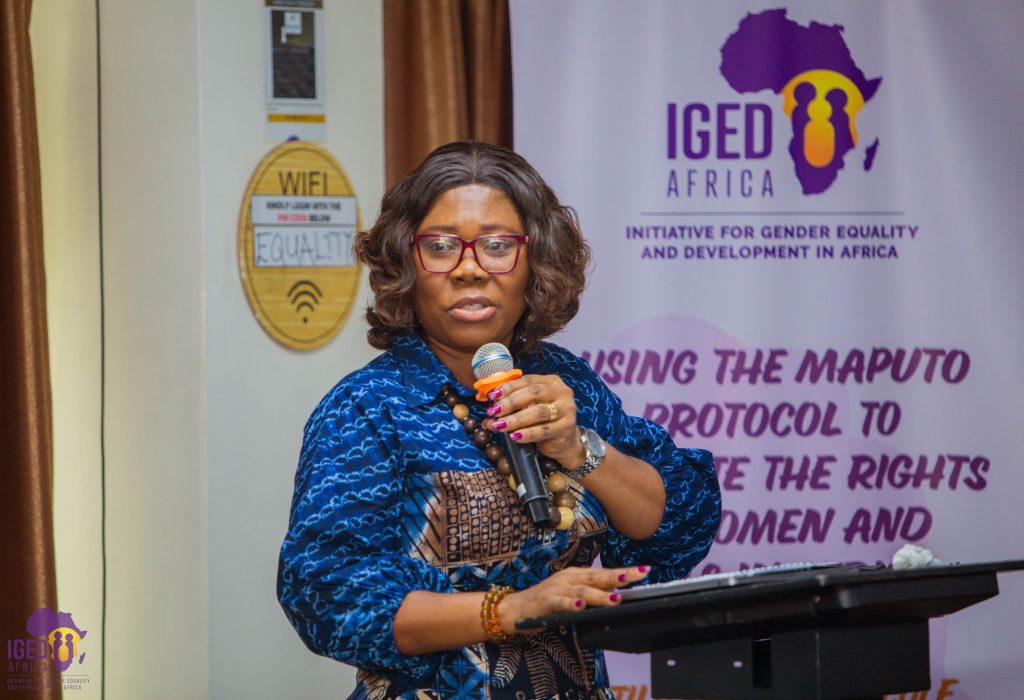
Ms. Waweru said the stakes were high for women and girls in Ghana: “When women are guaranteed equality within the family, they are better positioned to contribute politically, socially, and economically. The delays in reforming property and succession laws are not just legal oversights, they are violations of women’s rights.”
Ms. Sylvia Horname Noagbesen, Executive Director of IGED-Africa, underscored the importance of collaboration among civil society groups and explained that IGED-Africa’s work grew out of longstanding challenges around women’s property rights, land rights, and inheritance laws.
She stressed that coalitions such as SOAWR and the African Family Law Network were critical in sustaining advocacy and aligning national reforms with continental frameworks like the Maputo Protocol.
“Family law is not just about legal technicalities; it affects every one of us. The more we work to address these issues, the better the lives of our families and society as a whole,” she said.
The workshop will draw lessons from other African countries and seek to build stronger solidarity among Ghanaian CSOs. Organizers hope the discussions will generate concrete advocacy strategies and pressure Parliament to act on long-pending bills.
GNA
Edited by Christian Akorlie