By Frank Kwame Abbor
Ho, June 19, GNA – Mr James Gunu, Volta Regional Minister, has outlined significant achievements in education, healthcare, water supply, infrastructure and economic development, reaffirming government’s commitment to accelerating development across the Volta Region.
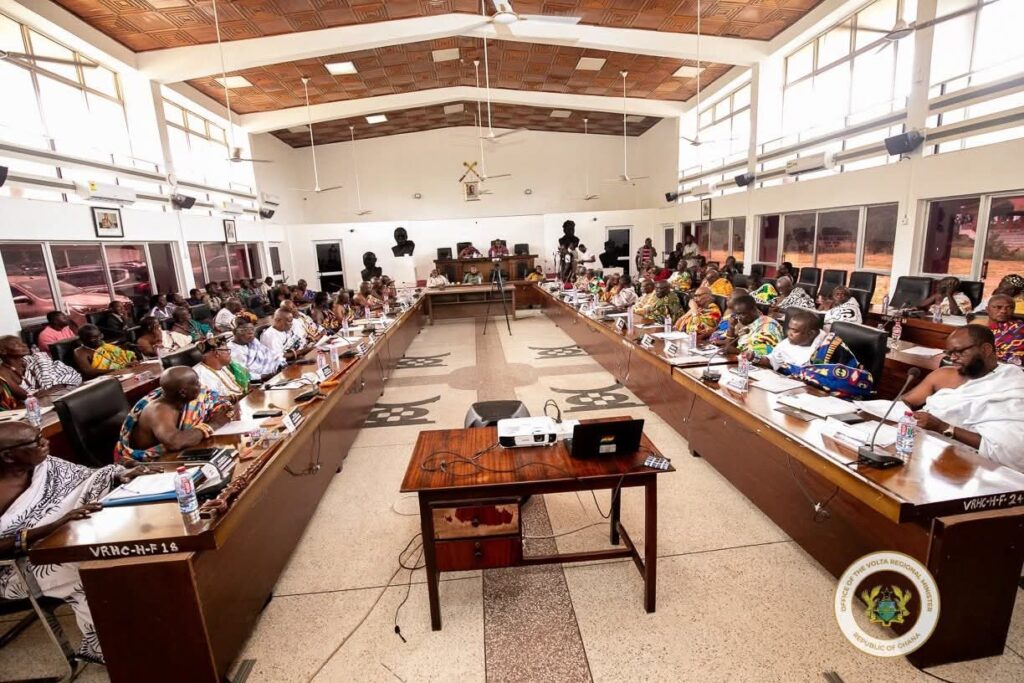
Addressing members of the Volta Regional House of Chiefs in Ho on June 19, 2026, the Minister said the government had embarked on numerous projects aimed at improving the socio-economic wellbeing of residents and bridging development gaps across the region.
Mr Gunu said education remained a key priority, with several infrastructure projects currently underway in senior high schools through support from the Ghana Education Trust Fund (GETFund).
He disclosed that 24 dining halls, 40 dormitory blocks, 15 six-unit classroom blocks, 12 nine-unit classroom blocks, 13 eighteen-unit classroom blocks, 12 administration blocks, four science laboratories, four libraries, 34 toilet facilities, 59 staff bungalows, eight headmasters’ bungalows and 68 sick bays were under construction across the region.
He noted that the projects were expected to improve teaching and learning conditions and create a more conducive environment for students and staff in beneficiary schools.
On healthcare, Mr Gunu said all district assemblies in the region had been directed to construct at least two Community-based Health Planning and Services (CHPS) compounds annually to address infrastructure deficits.
He explained that while the region required about 460 CHPS compounds, only 207 currently existed, leaving a gap of 253 facilities.
The Minister said government was also constructing healthcare centres across the region as part of the implementation of the Free Primary Healthcare initiative introduced by President John Dramani Mahama.
He said all 18 districts were expected to benefit from the intervention.
Touching on water supply challenges, Mr Gunu said government was drilling mechanised boreholes for communities and institutions while pursuing major water expansion projects.
He revealed that Ho and its environs currently required about 33,000 cubic metres of water daily but received only about 11,000 cubic metres.
He said work was progressing on the Kpeve Water Supply Expansion Project and the Adidome–Akatsi–Aflao water transmission project, which is expected to deliver about 35,000 cubic metres of water daily to communities along the corridor upon completion.
The Minister also announced that every district in the region would benefit from a 24-hour economy market project.
According to him, the facilities would include shops, pharmacies, parking spaces, kindergartens and other supporting infrastructure designed to promote economic activity around the clock.
Mr Gunu disclosed that progress was also being made towards the proposed Keta Port project. He said environmental approval had been secured and that the Ghana Ports and Harbours Authority had received expressions of interest from 42 potential investors, from which four would be shortlisted before a final investor is selected.
He said government was additionally pursuing discussions with neighbouring countries to position the port as a regional trade hub and was exploring the possibility of establishing a railway connection between the port and Burkina Faso to facilitate cargo movement.
On agriculture and employment, Mr Gunu said government had distributed about 180,000 day-old chicks across the region under a poultry development initiative, with each district receiving 10,000 birds in the first phase.
He added that more than 1,200 beneficiaries had been enrolled onto the National Apprenticeship Programme, while about 500 young entrepreneurs had received seed capital through the National Entrepreneurship and Innovation Programme (NEIP).
The Minister further highlighted ongoing coastal protection interventions, including the West Africa Coastal Areas Programme (WACA) and the Blekusu Phase Two Sea Defence Project, which he said was about 35 per cent complete.
Mr Gunu also stressed government’s commitment to tourism development, citing efforts to improve access roads to the Wli Waterfalls and other tourist destinations to boost visitor numbers and stimulate local economic growth.
Addressing road safety concerns, he expressed worry over the increasing number of fatalities on the Eastern Corridor Road and pledged continued collaboration with relevant agencies to improve road safety and emergency response services.
He also announced plans to strengthen facilities at the Peki Government Hospital, including support for the establishment of an Accident and Emergency and Trauma Centre.
Mr Gunu appealed to traditional authorities to continue partnering government in advancing development across the region and encouraged chiefs to offer constructive advice where necessary to ensure sustainable progress.
He expressed optimism that ongoing interventions and flagship programmes would accelerate socio-economic transformation in the Volta Region and improve the quality of life of residents.
Members of the Volta Regional House of Chiefs commended the government for the development initiatives underway across the region and urged authorities to sustain the momentum to ensure that every community benefits from ongoing interventions.
They reaffirmed their commitment to supporting government efforts and pledged continued collaboration to promote the socio-economic development of the Volta Region.
GNA
Edited by Maxwell Awumah /Kenneth Odeng Adade