By Daniel Adu Darko
Accra, March 6, GNA — The Petroleum Hub Development Corporation (PHDC) has held a strategic engagement with leading Ghana’s Civil Society Organisations (CSOs) in the energy sector to deepen stakeholder understanding and support for the proposed Petroleum Hub project.
The meeting held n Accra, brought together representatives from more than 25 CSOs which engaged extensively with PHDC management led by Dr Toni Aubynn, the Chief Executive Officer.
The engagement sought to enhance appreciation of the Petroleum Hub project’s strategic importance in strengthening Ghana’s energy security, generating sustainable employment and advancing the country’s industrialisation agenda.
It also provided a platform for PHDC and the CSOs to initiate a structured, long-term partnership, ensuring continuous dialogue and constructive collaboration towards the successful implementation of the project.
Dr Aubynn, speaking to the media, said that the scale and significance of the Petroleum Hub project required broad stakeholder involvement and collaboration.
He noted that the Corporation had already engaged traditional authorities, youth groups, local communities and Parliament, stressing that dialogue with civil society was equally critical.
“We cannot undertake a project like this alone. It must be inclusive,” he said.
Dr Aubynn explained that the engagement was intended to brief CSOs on the progress of the project, clarify outstanding issues and provide an opportunity for the organisations to offer ideas and raise questions.
“We want to establish a bond with them because they are neutral stakeholders whose perspectives can help strengthen the project,” he added.
He said many of the issues raised by the CSOs were supportive of the project, although concerns were expressed about land acquisition and compensation for affected landowners.
Dr Aubynn explained that compensation was a legal requirement under Ghana’s land acquisition laws and would be addressed by the government.
He said various compensation models could be explored, including equity participation by landowners or partial upfront payments with the remaining balance paid as the project progressed.
“The issue of compensation is legal and we are obliged by law to address it,” he said.
Dr Aubynn also noted that questions were raised about how the project would benefit future generations.
He said the Petroleum Hub would stimulate development in the project enclave through improved infrastructure such as schools, healthcare facilities and roads.
He added that employment opportunities generated by the project would help improve the livelihoods of families in the area.
Beyond petroleum-related activities, Dr Aubynn said ancillary businesses, including coconut processing and other agribusiness ventures, could emerge to support broader economic development.
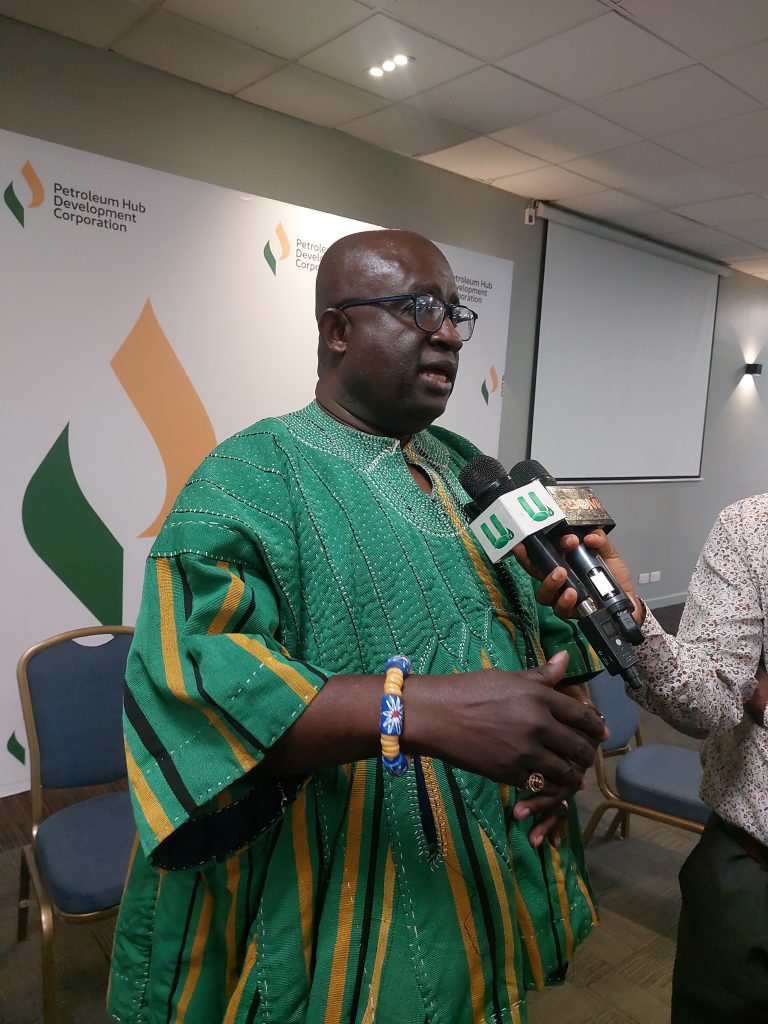
He indicated that the Corporation’s immediate focus was securing land for the project, noting that once this hurdle was cleared, investor participation would accelerate.
Dr Aubynn said the government had reduced the land mass requirement for the project from 20,000 acres to 13,000 acres, describing the decision as a significant milestone.
He attributed the development to directives from President John Mahama, adding that the Minister of Energy and Green Transition, Mr John Jinapor, and the Minister for Lands and Natural Resources, Mr Emmanuel Armah Kofi Buah, were supporting efforts to expedite the land acquisition process.
The reduction in land size, he said, required a recomputation of compensation figures, which are currently estimated at about GH¢900 million, equivalent to approximately 100 million dollars.
Dr Aubynn expressed optimism that the land acquisition process would be substantially resolved by June this year, enabling preparatory work on the project to begin before the end of 2026.
He said Petroleum Hub was a long-term development expected to span about 10 years.
“Our biggest challenge is land acquisition, but once we cross that hurdle, we can begin to attract the investors who are already showing interest,” he said.
Dr Aubynn commended the traditional leadership in the Jomoro area for their cooperation, particularly the paramount chief, whom he described as progressive and supportive of the project.
He said the resettlement process would affect fewer than 1,000 people and that most residents had expressed willingness to relocate provided their compensation and livelihoods were adequately addressed.
Dr Benjamin Nsiah, Executive Director of the Centre for Environmental Management, who participated in the engagement, stressed that land acquisition remained the most critical requirement for the project.
“Without land, you cannot start investment,” he said, adding that the government must prioritise funding to compensate landowners and secure the required land.
Dr Nsiah said civil society would continue to engage government, particularly the Ministry of Finance and the Ministry of Energy and Green Transition, to ensure adequate resources were allocated for the project.
He suggested that at least GH¢600 million should be provided in future budgets to facilitate land acquisition and kick-start investor engagement.
Dr Nsiah also recommended that the Petroleum Hub presented a Legislative Instrument to Parliament to establish additional funding sources, including licensing regimes and service fees, to ensure sustainable financing for the project.
He urged PHDC to adopt a clear short-term strategy focused on resolving the land acquisition challenge within the year, noting that securing the land would create the conditions necessary to attract investment.
The proposed Petroleum Hub project, to be located in the Western Region, is expected to become a major petroleum and petrochemical industrial enclave to boost Ghana’s energy capacity and drive economic growth.
GNA
Edited by Samuel Osei-Frempong