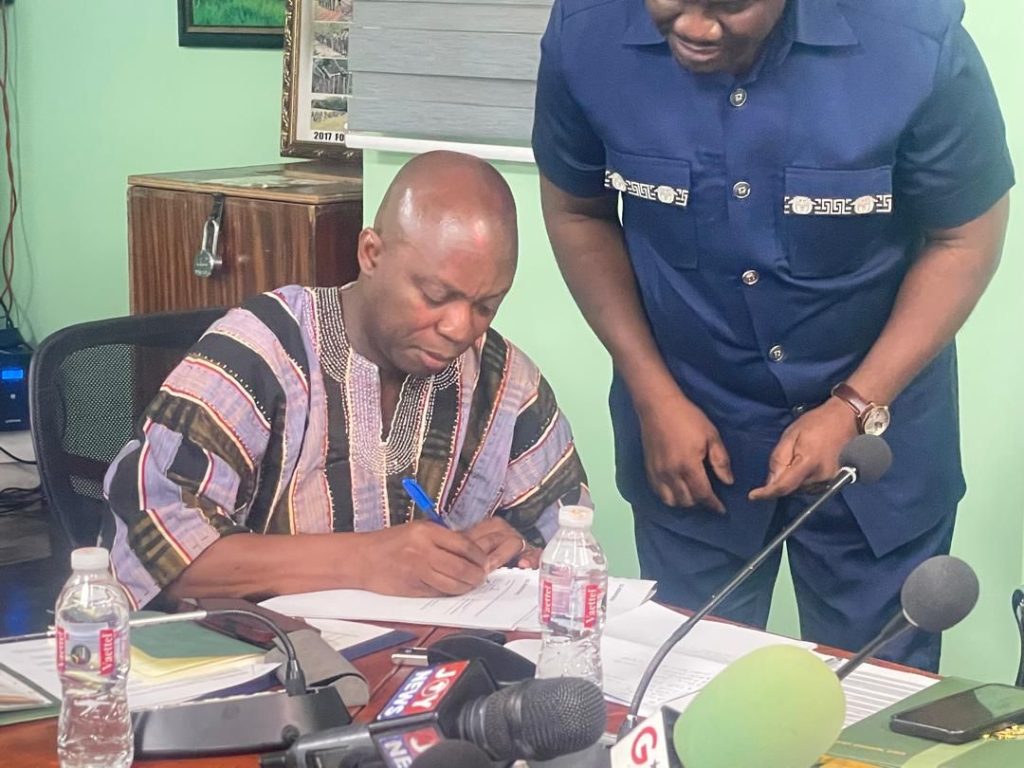
Accra, March 26, GNA – The Forestry Commission and Terraformation, a global leader in native and biodiverse forest restoration, have signed an agreement to restore up to 6,000 hectares of mangroves in the Volta Region.
The initiative, under the Keta Lagoon Blue Carbon Project, will plant 12 million native mangrove trees to protect species, strengthen coastal resilience, create jobs, improve livelihoods, and safeguard ecosystems.
Dr Hugh C.A. Brown, Chief Executive Officer of the Forestry Commission, signed on behalf of his organisation, while Mr. Jad Daley, President of Terraformation, signed for his firm, which will focus on restoration efforts within the Ramsar‑designated Keta Lagoon complex.
Terraformation will collaborate with Regenerative Development of Anlo Wetlands, Agrointroductions Ghana, local communities, the University of Ghana, the Ministry of Environment, Science and Technology, and the Ministry of Lands and Natural Resources.
“Ghana is demonstrating how climate action can go hand in hand with economic growth, restoring ecosystems while creating jobs and strengthening communities,” Mr Daley said.
Dr Brown said Ghana remained committed to partnerships addressing ecological and socio‑economic needs.
“Ghana pursues collaborations that contribute not only to ecological restoration in our country but do so in tandem with the economic and social needs of our people,” he stated.
Dr Joseph Appiah‑Gyapong, Director of the Climate Change Unit at the Forestry Commission, told the Ghana News Agency that the project underscored the importance of restoration and conservation in addressing climate change and protecting biodiversity.
He explained that mangrove restoration created favourable conditions for marine life, including endangered species such as sea turtles.
“When ecosystems are restored and conserved, they naturally support biodiversity. Marine turtles, for instance, depend on healthy coastal environments for reproduction,” he said.
Dr Appiah‑Gyapong noted that mangroves played a significant role in carbon sequestration and stressed the need for sustainable management approaches to reduce overharvesting. “These initiatives help shift pressure away from mangroves and encourage communities to protect rather than exploit them,” he added.
Mr. Raphael Ahiakpe, Country Director for Regenerative Development of Anlo Wetlands, described the initiative as both an economic and environmental intervention.
“What we are doing is not just an economic activity; it is also a restorative effort that helps combat coastal erosion and its devastating effects,” he said.
Mr. Ahiakpe said the project was timely, noting that many coastal communities were grappling with poverty, unemployment and the overexploitation of natural resources.
“This project will help reduce harmful environmental practices and contribute to national and global climate change mitigation efforts,” he said.
The Keta Lagoon Blue Carbon Project is expected to remove an estimated 2.3 million tonnes of carbon dioxide equivalent over a 40‑year period.
GNA
Edited by Kenneth Sackey