By Edward Dankwah, GNA
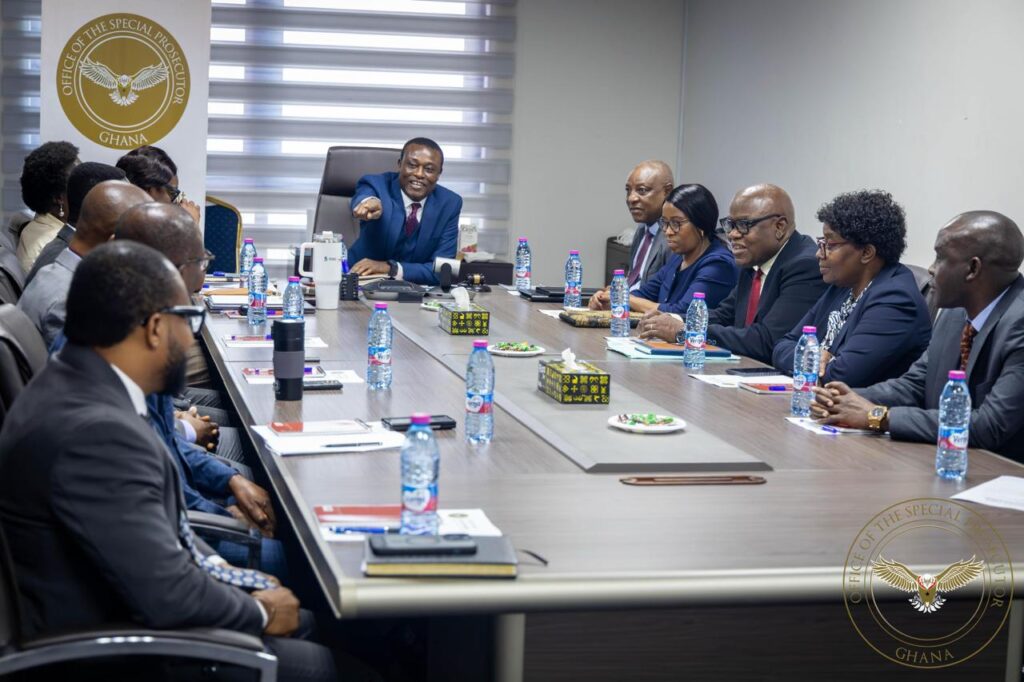
Accra, June 12, GNA – A delegation from Zambia’s Anti-Corruption Commission (ACC) has concluded a three-day study visit to Ghana’s Office of the Special Prosecutor (OSP), aimed at deepening institutional cooperation and sharing best practices in the fight against corruption.
The visit enabled officials from both agencies to engage in extensive discussions on investigative techniques, asset recovery, digital forensics, prosecution strategies and public engagement initiatives designed to strengthen accountability and transparency.
A statement issued in Accra said the exchanges also focused on the institutional framework supporting Ghana’s anti-corruption architecture and the practical challenges associated with enforcing accountability in politically sensitive cases.
The delegation was received by Mr Kissi Agyebeng, the Special Prosecutor, Ms Cynthia Lamptey, Deputy Special Prosecutor, Directors of the Office and other senior officials.
Mr Agyebeng outlined the circumstances that led to the establishment of the OSP, highlighting its statutory independence and mandate to investigate and prosecute major corruption cases involving politically exposed persons and private sector entities.
He noted that since its inception, the Office had encountered challenges including institutional resistance, resource constraints and efforts to undermine its prosecutorial authority.
Despite these obstacles, he said, the OSP had emerged as a key institution within Ghana’s anti-corruption and governance framework.
Directors and senior officials of the OSP subsequently delivered presentations on their respective areas of responsibility, including prosecutions, investigations, asset recovery and management, strategy, research and communications, digital forensics and human resource management.
The discussions also examined the OSP’s Youth Against Corruption initiative and the use of digital platforms and data-driven approaches to promote public engagement and corruption prevention.
Members of the Zambian delegation observed that both agencies were established on comparable legal foundations, with safeguards for leadership tenure, powers of arrest and asset recovery, and mandates for public education and stakeholder engagement.
However, they noted significant differences in prosecutorial arrangements. Unlike the OSP, the ACC does not possess independent prosecutorial authority and must refer major cases to the Director of Public Prosecutions, an independent constitutional office separate from the Attorney General, whose mandate is limited to civil matters.
The ACC nonetheless maintains a team of seconded prosecutors authorised to handle less complex cases internally.
The delegation also showcased several Zambian initiatives aimed at promoting integrity and accountability.
Among them are undergraduate and master’s degree programmes in anti-corruption and integrity studies at the Kwame Nkrumah University of Zambia, established to develop a new generation of professionals equipped to address governance and corruption challenges.
Another flagship initiative is the Character is Destiny programme, a values-based educational framework integrated into Zambia’s national school curriculum.
The programme seeks to foster ethical leadership, civic responsibility and integrity among young people, positioning character development as a central pillar of the country’s long-term anti-corruption strategy.
Following the presentations, the delegation toured the OSP’s facilities to gain first-hand insight into its operational environment and institutional infrastructure.
A key highlight of the tour was the ongoing construction of an ISO-certified forensic laboratory and specialised interview and interrogation rooms.
The project, funded by the European Union and implemented by GIZ, is expected to enhance the OSP’s forensic and investigative capabilities and strengthen its capacity to handle complex corruption and financial crime cases in line with international standards.
The Zambian delegation was led by Justice Evans Hamaundu, Board Chairman of the ACC, and included Board Members Engwase B. Mwale and Jack Kalala, Director-General Daphne Pauline Soko Chabu, Director of Investigations Gibson Chizanda and Acting Head of Corporate Communications Chilufya Chisanga.
The visit underscored the growing collaboration between African anti-corruption institutions and their shared commitment to strengthening governance, accountability and the rule of law across the continent.
GNA
Edited by Benjamin Mensah