By Anthony Adongo Apubeo, GNA
Pelungu-Ziemboug (U/E), June 8, GNA – World Vision Ghana, a Christian humanitarian organisation, has planted 100 tree seedlings at the Ziemboug Community, a suburb of Pelungu in the Nabdam District, as part of activities to commemorate this year’s Tree for Life Day and to promote environmental sustainability.
The exercise was undertaken through World Vision Ghana’s Farmer Managed Natural Regeneration (FMNR) Heritage Project, which is being funded by the European Union under the Sustainable Forest and Cocoa Programme through the European Forest Institute.
Through the intervention, World Vision Ghana is working to restore 1,500 hectares of degraded land and empower more than 10,000 people, particularly women, youth, and marginalised groups, to champion environmental restoration and climate adaptation.
The tree-planting exercise brought together officials from the Nabdam District Assembly, the Forestry Services Division, the Ghana Education Service (GES), traditional authorities, community members, teachers, and pupils.
Mr Rexford Bugre, the Northern Regional Operations Manager of World Vision Ghana, in a speech read on his behalf by Mr Joseph Edwin Yelkabong, Bawku Cluster Area Programme Manager of World Vision Ghana, said the initiative was a practical demonstration of the organisation’s commitment to environmental sustainability and climate resilience.
He explained that the trees would provide shade for pupils and community members, improve air quality, reduce soil erosion, beautify the school environment and community, and contribute to the restoration of the local ecosystem.
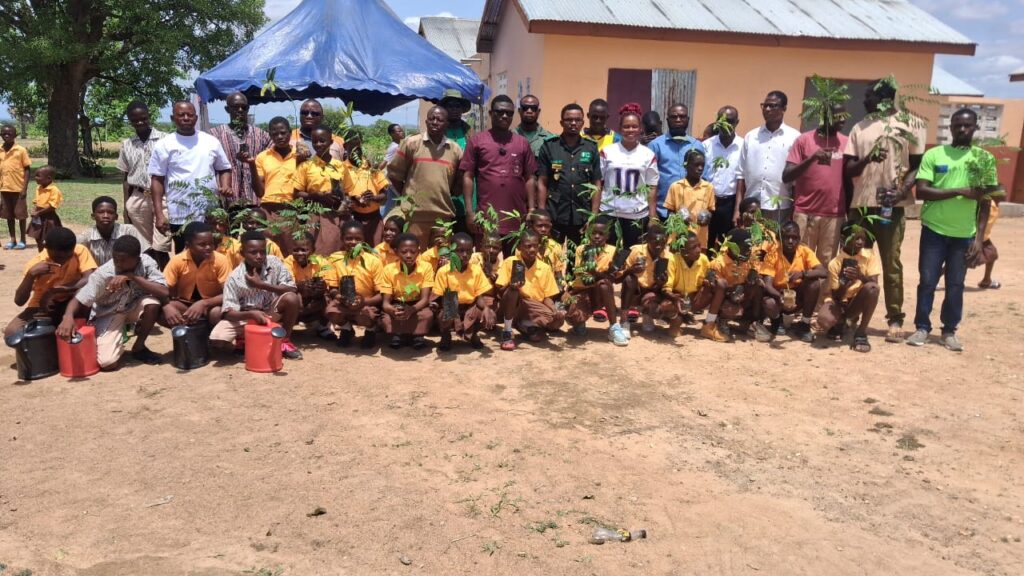
Mr Bugre noted that the exercise formed part of efforts to restore degraded landscapes, conserve biodiversity, and improve livelihoods through community-led environmental restoration approaches.
“This initiative aligns strongly with the United Nations Sustainable Development Goals (SDGs), particularly Goal 13, which calls for urgent action to combat climate change and its impacts; Goal 15, which promotes the protection, restoration, and sustainable use of terrestrial ecosystems; and Goal 11, which seeks to make communities safer, more resilient, and environmentally sustainable.
“Through our collective efforts, we are also contributing to Goal 6, which emphasises access to clean water and sanitation, as healthy forests and vegetation play a critical role in protecting water resources and maintaining ecological balance,” he said.
He assured stakeholders that World Vision Ghana’s commitment would not end with the planting of the seedlings, adding that arrangements had been made with school authorities and community leaders to ensure regular watering, monitoring, and protection of the trees.
Mr Jonas Bugre, FMNR Heritage Project Manager at World Vision Ghana, urged community members and pupils to focus on nurturing the trees to maturity rather than merely planting them.
“We are not just coming to plant the trees and go, but we are coming to grow the trees,” he said, stressing the need for continuous monitoring and care of the seedlings.
Mr Francis Tobig, Nabdam District Chief Executive, said the District Assembly had committed to supporting tree-planting and tree-nurturing efforts across the district, adding that plans were underway to distribute seedlings to schools, health facilities, and communities, while agriculture and forestry officials would monitor tree survival rates on a quarterly basis.
The DCE also disclosed plans to institute an award scheme to recognise communities and institutions that successfully nurtured and protected planted trees.
Reverend Father Luke Atanga, NGO Desk Officer at the Nabdam District Directorate of the GES, commended World Vision Ghana and its partners for the initiative and expressed the directorate’s support for implementing environmental restoration programmes in schools.
He encouraged teachers and pupils to become champions of environmental conservation and take responsibility for protecting the planted trees for future generations.
Mr Michael Manor, Nabdam Forest Range Manager of the Forestry Commission, called for the scaling up of FMNR approaches to restore degraded lands and forest reserves, adding that the concept was more cost-effective and had a higher survival rate than conventional tree planting.
FMNR is an easy and low-cost land and forest restoration technique used to increase the number of trees in fields without necessarily planting new ones. It involves protecting and managing existing trees and shrubs through pruning to enable them to regenerate naturally.
The Tree for Life Day celebration was observed under the theme, “Forests and Economics.”
GNA
Edited by Caesar Abagali/Linda Asante Agyei
June 08, 2026
Reporter: Anthony Adongo Apubeo
Email: [email protected]