By Francis Ntow, GNA
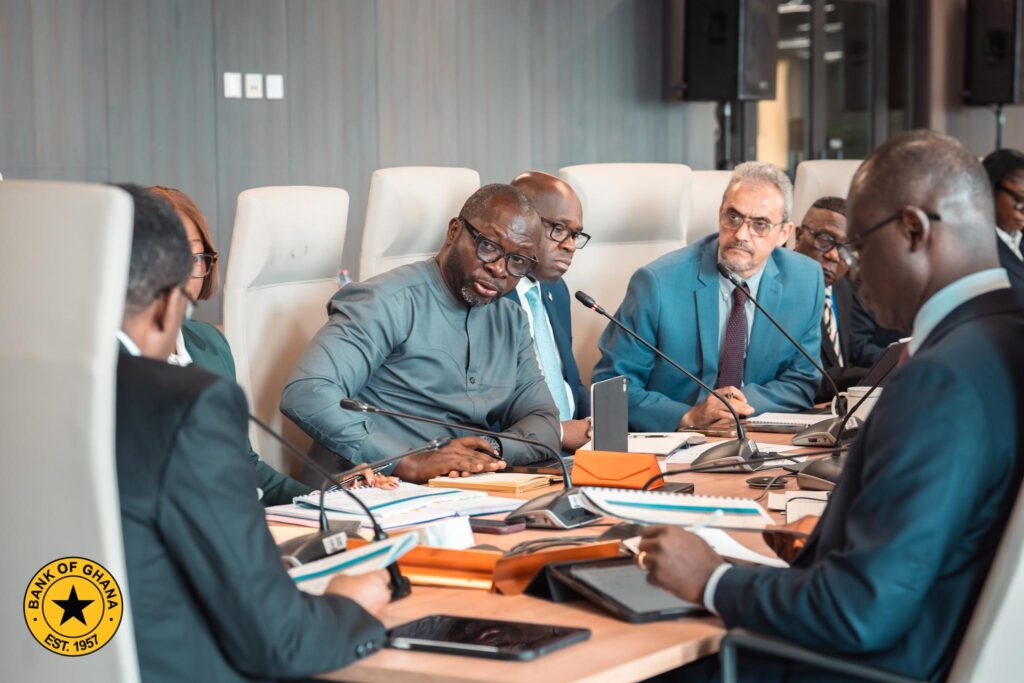
Accra, June 16, GNA – Dr Johnson Pandit Asiama, Governor of the Bank of Ghana (BoG), Tuesday urged commercial banks to increase support for Ghanaian entrepreneurs and export-oriented businesses to help transform the country’s recent economic stability into broad-based prosperity.
He said achieving that goal would require banks to develop innovative financial products that respond to the evolving needs of households and businesses, while positioning themselves as strategic partners in economic development rather than merely providers of credit.
Dr Asiama made the call at the opening of an engagement with banking sector executives in Accra.
He noted that the banking sector continued to show strong recovery, with total assets expanding by 26.6 per cent to GHS493.9 billion in April 2026.
The sector also recorded improvements in capital adequacy, with the industry’s capital adequacy ratio rising to 22.3 per cent from 17.5 per cent a year earlier, while the non-performing loan (NPL) ratio declined from 23.6 per cent to 18.0 per cent.
The Governor urged banks to leverage gains from macroeconomic stability, declining interest rates and advances in financial technology to deepen their contribution to productive economic activity.
He stressed that the long-term sustainability of the financial system depended on the strength of the real sector.
“The challenge before us is not just to preserve stability but to transform stability into prosperity for our people,” he said.
“Let us, therefore, leverage the stability and work together to channel capital into productive sectors, empower entrepreneurs, support exports, deepen regional integration and strengthen public confidence in our financial system.”
Dr Asiama encouraged banks to complement their lending activities with business advisory services, market-access support and export clinics as part of their corporate social responsibility initiatives.
“These are essential for generating sustainable credit demand, quality assets, employment and economic prosperity,” he said.
He reaffirmed the Bank of Ghana’s commitment to working with banks and other stakeholders to strengthen channels that convert remittance inflows into productive investments.
Dr Asiama said that would include the development of innovative investment-linked remittance products capable of mobilising capital for business expansion, infrastructure development and long-term capital formation.
Despite the sector’s progress, he cautioned against complacency and urged banks to strengthen credit underwriting standards, improve loan recovery processes and fully comply with regulatory requirements aimed at reducing non-performing loans to prudential targets.
He also called on banks to actively support Ghana’s ongoing third-round mutual evaluation by the Financial Action Task Force (FATF), noting that the outcome would have significant implications for correspondent banking relationships, investor confidence and the country’s international financial standing.
On the broader economy, Dr Asiama said the Composite Index of Economic Activity expanded by 12.6 per cent in March 2026, compared with 2.3 per cent during the same period in 2025.
He said the growth was driven by robust expansion in private-sector credit, industrial activity, consumption and trade.
The Governor noted that inflation increased slightly to 3.7 per cent in May 2026 from 3.2 per cent in March, marking the first consecutive rise since December 2024.
However, he noted that core inflation, which excluded food and energy prices, continued to decline, indicating subdued underlying inflationary pressures.
He explained that the Monetary Policy Committee’s decision to maintain the policy rate at 14 per cent reflected the central bank’s commitment to preserving macroeconomic stability while supporting the ongoing economic recovery.
Dr Asiama said Ghana’s fiscal position remained strong, with prudent expenditure management resulting in a fiscal surplus equivalent to 0.1 per cent of Gross Domestic Product (GDP) in the first quarter of 2026, exceeding programme targets.
He added that the external sector had also strengthened, with the current account surplus reaching US$3.1 billion during the period, supported by strong export earnings from gold and cocoa, as well as stable remittance inflows.
Gross international reserves increased to US$14.4 billion, providing 5.7 months of import cover and enhancing the country’s resilience against external shocks.
GNA
Edited by Agnes Boye-Doe
Reporter: Francis Ntow
[email protected]