By Prince Acquah, GNA
Cape Coast, May 30, GNA – Professor Joseph Benjamin Archibald Afful, a Professor of Applied English Linguistics, has called for major reforms in academic writing programmes in Ghanaian universities to equip students and researchers with the appropriate skill set to improve quality of academic works and enhance global visibility and acceptability.
He observed that foundational academic writing programmes in many universities heavily focused on corrections, creating a deficit in discipline-specific context for students.
Citing some of his major works over the last 27 years, Prof Afful underscored major student challenges including synthesising, referencing, and language use as well as linguistic challenges faced by researchers publishing in international journals.
In that regard, he argued that: “There must be a curricular shift away from remediation toward discipline-specific orientation, combined with technology-based and critical-based pedagogy to address modern academic needs.”
Prof Afful, a Professor with the Department of English under the College of Humanities and Legal Studies at the University of Cape Coast (UCC) was delivering his inaugural lecture on the topic: “A tale of two cities: The case of an applied English Linguist.”
Reflecting on his 30-year academic journey, the lecture focused on ‘two cities’ – English for Academic and Publishing Purposes (EAPP) and Socio-onomastics, the study of names and how they relate to society – with the aim of making them ‘first class cities.’
“Implementing specialised English for publishing purposes and graduate writing courses is essential to boost the global visibility and research output of Ghanaian universities,” he stressed.
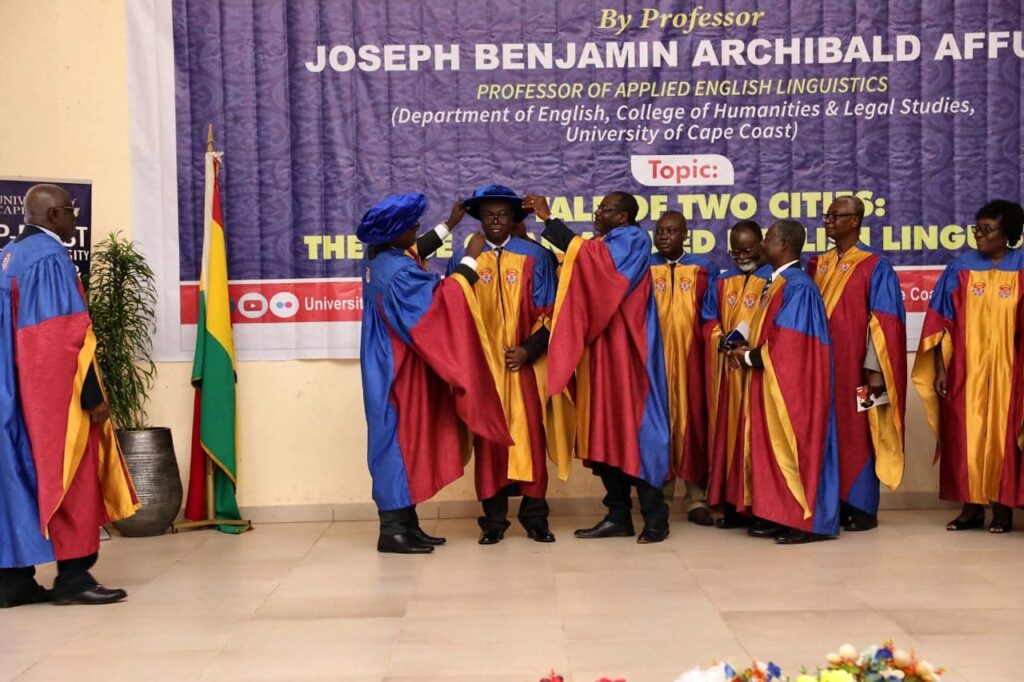
The English Linguist entreated all public universities in Ghana to introduce academic writing courses for postgraduate students to strengthen academic literacy and research communication.
In the case of UCC, he noted with concern that the academic writing course for graduate students had not been reviewed since its introduction in 2017.
Prof Afful recommended that tertiary institutions institutionalised specialised retraining programmes for ‘English for Academic Purposes’ instructors and postgraduate thesis supervisors.
Additionally, universities must also provide internal funding and specialised training for junior faculty and doctoral students in international publishing literacy, citation practices, and genre conventions.
The university don also proposed workshops to help doctoral students understand rhetorical and linguistic features such as meta-discourse, hedging, and evaluative language to prepare them for international publishing.
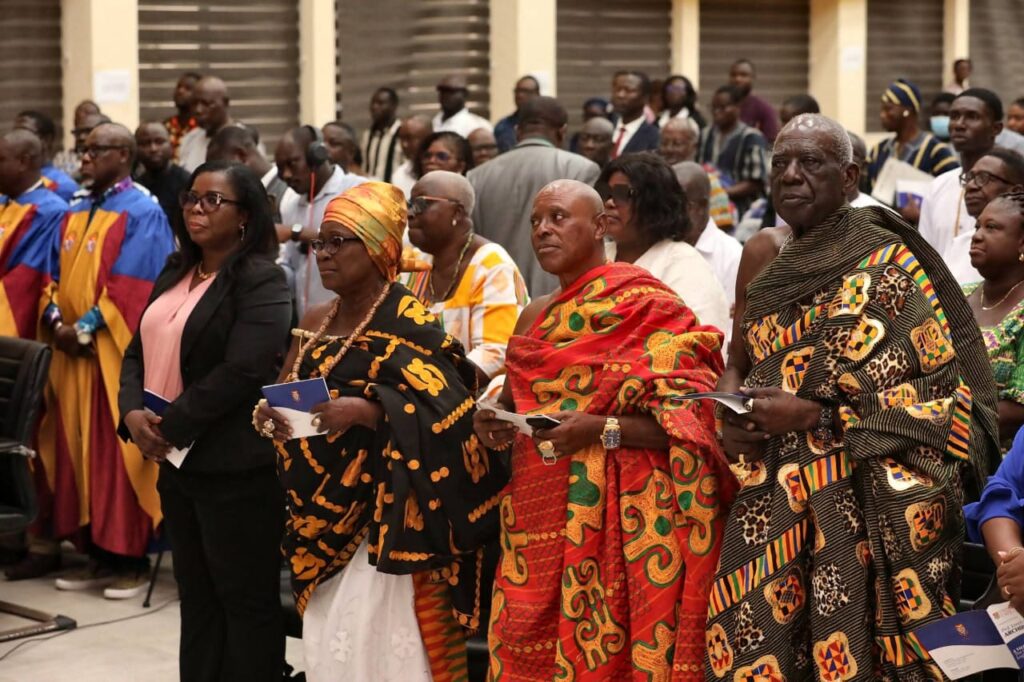
On socio-onomastics, Prof Afful highlighted years of research into address forms among students, lecturers, couples, churches, and social groups, explaining how such practices reflected authority, solidarity, resistance, love, and identity in Ghanaian society.
He explained that naming and address practices in Ghana reflected social identities, power relations, and cultural values across communities and institutions.
Thus, he cautioned that: “misunderstanding context-specific address practices can lead to social friction or ineffective cross-cultural communication.”
He therefore called on government agencies, civil society organisations, and corporate institutions to promote indigenous Ghanaian naming and address practices to preserve cultural identity and local languages.
Specifically, urged the Ministries responsible for Tourism, Culture, Local Government, and Rural Development to establish guidelines for naming public spaces and institutions while preserving national heritage.
GNA
Edited by Alice Tettey/Kenneth Odeng Adade
Reporter: Prince Acquah
[email protected]