By Laudia Anyorkor Nunoo
Tema, May 01, GNA — As the 2026 Basic Education Certificate Examination (BECE) approaches, a growing number of pupils are being pushed to sit the exams ahead of schedule, raising concerns about child welfare, systemic manipulation, and the integrity of Ghana’s basic education system.
For 13-year-old Ama Poku (not her real name), the pressure to write the BECE early began as a suggestion from a private tutor but has since evolved into a demanding routine of school and intensive extra classes, leaving little room for rest or normal childhood experiences.
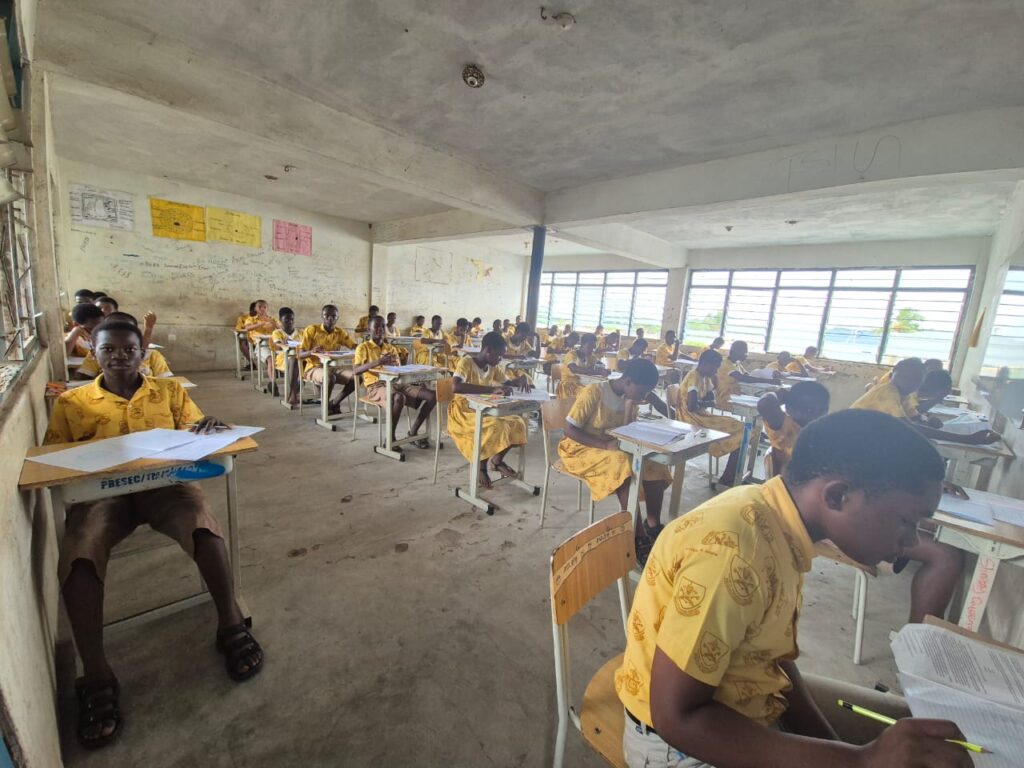
Her situation reflects a broader and increasingly common practice in which pupils in Form One and Form Two are registered to sit the BECE—often outside their schools—even though the examination is designed for candidates in Form Three.
From exception to trend
What was once limited to a few exceptional cases has now evolved into a competitive practice, driven largely by parental pressure and perceptions of academic superiority.
Early candidates are often labelled “brilliant,” reinforcing a cycle in which more parents push their children to follow the same path, regardless of readiness.
However, education stakeholders argue that early participation is not necessarily a measure of intelligence but rather a deviation from the structured progression of learning.
Excellence or acceleration at a cost?
Cases such as that of Master Melvin Mawuli Papanii Agboada, a 14-year-old University of Ghana student who wrote the BECE in Form Two, continue to fuel the perception that early progression signals brilliance.
While his academic success is widely admired, it has also sparked debate about whether such acceleration should become the norm or remain limited to truly exceptional cases.
His mother, Miss Gertrude Akweley Addy, a science teacher, supports accelerated learning for gifted children.
“If the child has the ability, they should be encouraged and supported,” she said, dismissing concerns that such advancement undermines childhood development.
Hidden drivers: money and manipulation
Beyond academic ambition, financial incentives are quietly shaping the trend. Some parents admit that skipping Form Three reduces education costs, allowing them to redirect funds toward senior high school.
More troubling, however, are allegations of systemic manipulation.
Investigations indicate that some pupils are registered through public schools they do not attend, with cumulative assessment records—which account for about 30 per cent of BECE results—sometimes reportedly fabricated to support such candidates.
Stakeholders warn that this practice distorts academic evaluation and exposes pupils to unethical behaviour at an early stage.
Private schools bear the cost
Mr Kwesi Ntow-Boateng, an educationist with over 40 years of experience, described the trend as disruptive, particularly for private schools.

“What used to be minimal has now become a competitive practice,” he said.
He explained that when pupils leave in Form Two to write the BECE elsewhere, schools lose projected revenue, affecting their ability to sustain operations.
“It creates a financial shock; how do you pay teachers when students leave before completing the cycle?” he asked.
He added that schools also lose recognition for pupils they have trained, as certificates are issued under different institutions.
Strain on the system
The implications extend beyond individual schools.
Education planners rely on predictable student progression, but early candidates introduce unaccounted numbers into the system, complicating planning for senior high school placements, infrastructure, and resource allocation.
“There is a school population census, yet you still have additional candidates entering the system unexpectedly,” Mr Ntow-Boateng noted.
Child readiness in question
Educationists caution that early examination does not always align with pupils’ emotional and academic readiness.
Those who skip Form Three may miss critical elements of the curriculum, leading to knowledge gaps and difficulties coping at the senior high school level.
There are also concerns that normalising shortcuts could shape attitudes toward learning and integrity in the long term.
Call for urgent regulation
Stakeholders are calling for stricter oversight and clearer national guidelines to regulate BECE registration and curb abuse of the system.
They emphasise the need to balance academic advancement with the well-being of pupils while protecting the credibility of the examination process.
As Ghana prepares for the 2026 BECE, the growing trend of early participation raises a critical question: whether the pursuit of accelerated success is undermining the very foundation of the education system.
GNA
Edited Audrey Dekalu
Reporter: Laudia Anyorkor Nunoo