By Eunice Hilda A. Mensah
Accra, April 13, GNA – Stakeholders in Ghana’s Technical and Vocational Education and Training (TVET) sector have called for increased investment, stronger policy implementation, and enhanced industry collaboration to drive economic transformation.
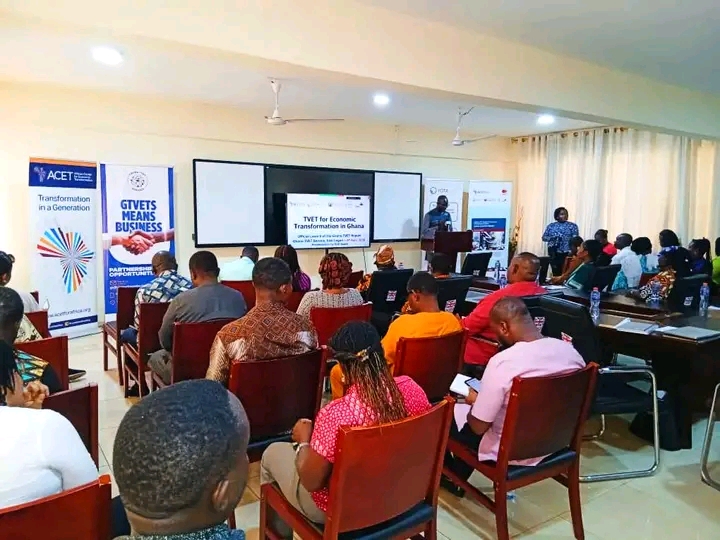
The call was made at the launch of the Ghana TVET Report in Accra on the theme, “Building TVET Systems for Economic Transformation in Ghana,” which brought together policy leaders, development partners, and industry players.
Presenting the key findings and policy recommendations, Mr Kofi Asare, the Executive Director of Africa Education Watch, emphasised the need for sustainable funding sources and urged government to increase public investment in TVET to at least five per cent of the national education budget.
He also recommended strengthening the implementation of the TVET policy with a focus on Fourth Industrial Revolution (4IR) and green skills, as well as establishing Public-Private Partnership (PPP) frameworks to deepen private sector participation.
Mr Asare called to scale up Competency-Based Training (CBT) and Recognition of Prior Learning (RPL) across both informal and formal TVET providers, while mainstreaming digitalisation and infrastructure development in TVET programming.
He highlighted the importance of promoting gender equity and inclusion through incentives, safe learning environments and mentorship programmes and urged a review of TVET policies to explicitly address gender equality in access and outcomes.
He advocated research into innovative solutions to strengthen TVET delivery systems, harmonisation of formal and informal TVET sectors for standardised certification and the establishment of operational frameworks to improve collaboration between regulatory institutions.
Mr Asare also stressed the need for pre-service and in-service training for TVET instructors, particularly in green and 4IR-related skills.
The report identified policy gaps, noting that implementation did not always reflect policy alignment, leading to a disconnect that affected outcomes within the sector.
Dr Eric Kofi Adzroe, Director-General of the Ghana TVET Service, expressed appreciation for the renewed attention being given to TVET, noting that the sector had long been neglected.
He underscored the importance of widely disseminating the report and called on industry to play a leading role in skills development through apprenticeship and workplace learning.
Dr Adzroe revealed that efforts were underway to map industries across regions to TVET institutions to better match skills training with labour market demands and address skills shortages.
Research such as the Ghana TVET Report, he said would help support and sustain the sector and urged both national and international partners to invest in TVET training programmes.
Madam Mavis Owusu-Gyamfi, President of the African Center for Economic Transformation (ACET), said the report formed part of a broader regional initiative aimed at strengthening TVET systems for economic transformation across Africa.
She explained that the initiative, led by ACET in partnership with Africa Education Watch, Toyota and supported by the Mastercard Foundation, covered six countries: Côte d’Ivoire, Ethiopia, Niger, Rwanda, Uganda, and Ghana.
Madam Owusu-Gyamfi said the study across participating countries sought to address a critical question of how TVET systems could be strengthened to better respond to the needs of evolving economies.
The launch reaffirmed the need for coordinated efforts among government, industry, and development partners to reposition TVET as a key driver of Ghana’s economic transformation.
GNA
Edited by Linda Asante Agyei