By D.I. Laary, GNA
Accra, April 10, GNA – The Council for Scientific and Industrial Research–Institute for Scientific and Technological Information (CSIR-INSTI) on Thursday unveiled an Artificial Intelligence-powered malaria diagnostic application alongside a suite of technologies aimed at improving healthcare and agriculture.
The innovations were showcased at the Institute’s 2026 Open Day, held under the theme: “Transforming Innovation Through AI, Precision Technologies, and Open Scientific Knowledge.”
The event brought together policymakers, scientists, students, and the public to examine tools designed to address practical challenges, including faster disease diagnosis, improved soil analysis, and access to agricultural data.
Dr Paul A. Danquah, Director of CSIR-INSTI, said the malaria application was developed to support frontline health workers and expand access to timely diagnosis.
“Without early detection, malaria can be fatal. This tool brings diagnostic capacity closer to communities,” he said.
Among other exhibits were mobile applications for detecting crop diseases in maize and tomato. The tools enable farmers to capture images of infected leaves and receive instant analysis powered by artificial intelligence.
A real-time soil testing device, currently undergoing trials, can assess multiple soil parameters on-site, reducing reliance on laboratory testing and enabling quicker decision-making by farmers.
The Institute also presented the Ghana Agric Data Hub, a digital platform integrating weather data, cropping calendars and agricultural datasets to guide planting, pest control and harvesting decisions.
In addition, the Farm Academy e-learning platform offers training modules and video tutorials to promote the adoption of research-driven farming practices.
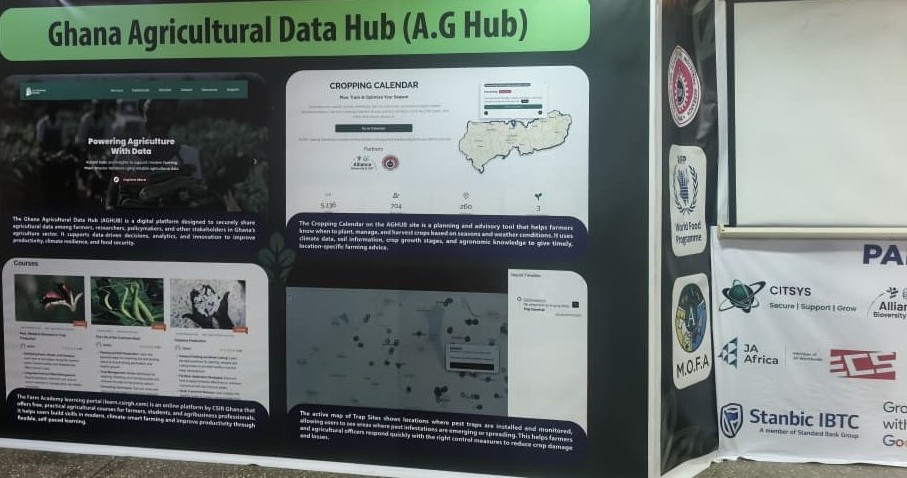
CSIR-INSTI highlighted its Digital Agricultural Innovation Hub, which hosts over 400 hundreds of technologies, as well as the KwaFu Marketplace, an e-commerce platform connecting actors across agricultural value chains.
Other tools included an Extension Portal that facilitates communication between extension officers and farmers using multimedia formats, and an Early Warning System providing real-time alerts on pests and diseases.
Despite the breakthroughs, Dr Danquah said funding shortages and ageing infrastructure remained major obstacles to scaling the institute’s work.
He noted that while CSIRINSTI has produced 150 publications and 24 technologies in recent years, many of the tools cannot reach farmers or clinics without sustained investment in equipment and facilities.
Prof. Paul Bosu, Director-General of CSIR, described the event as a platform to elevate research impact and technological development.
He described the day as “AI technology day,” adding: “This open day will zipline the Institute into higher levels of research, technology generation, and project influence.”
He noted that the Council was strengthening partnerships, including a recent memorandum of understanding with AI Africa to build staff capacity in artificial intelligence across disciplines.
He noted that CSIR was operationalising an endowment fund and urged staff to support the innovation.
In his remarks, Council Chairman Mark Anthony Taylor said aligning research outputs with national priorities such as industrialisation and digitalisation was essential to maximising impact.
“Our focus is on strengthening research and ensuring CSIR contributes significantly to socio-economic development,” he said.
The technologies demonstrated at the event are expected to improve agricultural productivity, enhance resilience to climate variability, and expand access to healthcare services.
Participants said the innovations underscored the role of science in addressing everyday challenges and improving livelihoods, stressing that the technologies were not just about science, but about saving lives, feeding families, and giving communities hope.
Others noted that the precision innovative tools reflected Ghana’s efforts to apply science and technology to everyday challenges, from faster malaria diagnosis to more resilient food production.
The Open Day highlighted both progress and constraints within Ghana’s innovation ecosystem, as CSIR-INSTI seeks to deepen the application of artificial intelligence in key sectors.
GNA
Edited by Linda Asante Agyei