By Edward Dankwa, GNA
Accra, Oct. 15, GNA – The National Disaster Management Organisation (NADMO) has planted 750 trees and donated 100 waste bins to selected institutions, as part of activities to mark the 2026 International Day for Disaster Risk Reduction (IDDRR).
The exercise involved the distribution of both fruit-bearing and non-fruit-bearing tree seedlings, including avocado, mango, orange and coconut, to provide shade, food and other environmental benefits.
The activities began with a commemorative tree planting at the NADMO premises and continued at Flagstaff House Basic School, Labone Senior High School, Accra High School, the Ghana Prisons Service’ Bolster Home at Roman Ridge, and Accra Girls Senior High School.
It received sponsorship and support from Go Energy, the Adventist Development and Relief Agency (ADRA), the Forestry Commission, Parks and Gardens, and the Mastercard Foundation.
Go Energy supported the initiative with a cheque, while ADRA provided tree seedlings and the 100 waste bins.
Madam Charlotte Norman, Director of Climate Change Adaptation and Disaster Risk Reduction at NADMO, said the initiative was aimed at supporting environmental sustainability, reducing carbon emissions and contributing to efforts to address climate change.
She said NADMO had extended the exercise to about nine districts, while the headquarters engaged several schools and institutions.
The Director said the donation of 100 waste bins was also intended to address improper waste disposal, which contributed to flooding in many parts of the country.
“People often say they have nowhere to dispose of their rubbish, and when they see clouds gathering, they rush to throw it into gutters,” she said.
Madam Norman called on organisations to support waste management by donating bins to institutions, markets, lorry parks and hospitals, stating that collective efforts would help improve sanitation and reduce disaster risks.
She added that building resilience required sustained efforts to minimise the impact of disasters on communities.
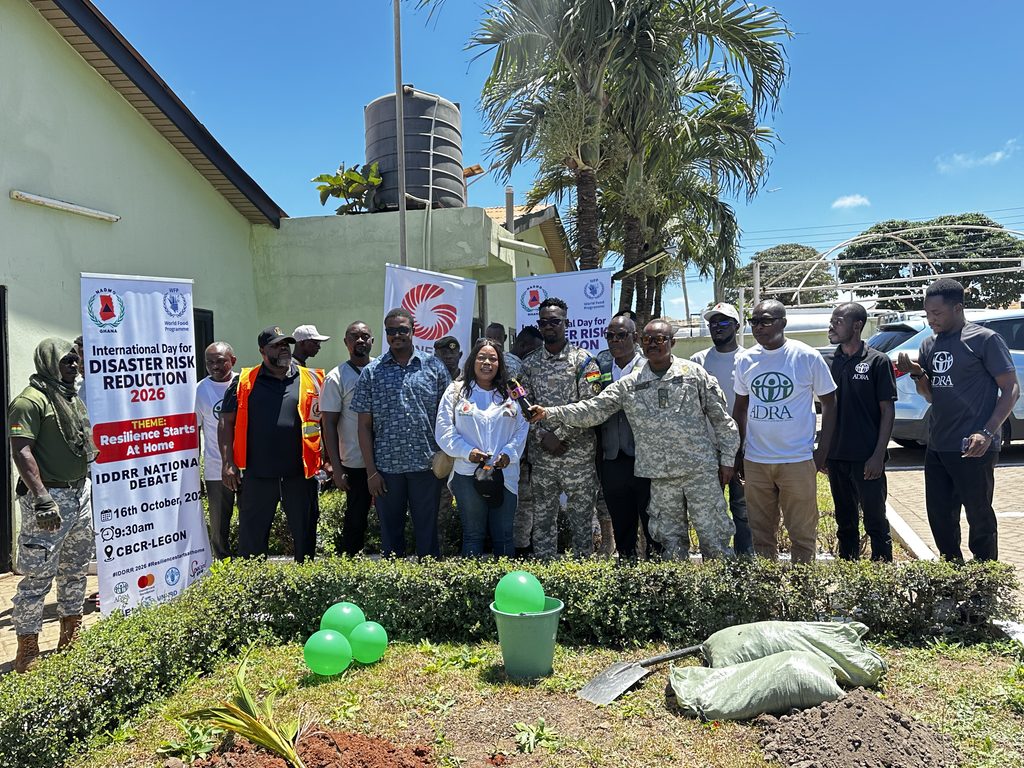
Alhaji Ahmed-Rufai Aggudey, the Deputy Director-General, Technical at NADMO, urged Ghanaians to cultivate the habit of planting trees in their homes, schools and communities to restore the country’s green environment and build resilience against climate change.
He said tree planting was essential to addressing environmental challenges, including rising temperatures, flooding and soil erosion, which continued to threaten lives and property.
Alhaji Aggudey said schools formed an integral part of the home because students were members of families and communities, making them important partners in promoting environmental protection.
He explained that although newly planted trees might not provide immediate shade, their long-term benefits would be significant, urging students to nurture the trees and serve as environmental ambassadors.
“Climate change has contributed to environmental challenges, including intense heat, flooding and damage to buildings during rainfall, so there’s the need for collective efforts to restore vegetation,” he added.
Alhaji Aggudey observed that Ghana’s once-green environment had been significantly depleted over the years, resulting in rising temperatures, with people experiencing extreme heat even after walking short distances.
Although tree planting alone might not completely prevent the effects of climate change, he said it could help reduce their impact and improve environmental conditions.
He urged individuals to plant trees wherever possible, adding that the initiative should inspire the next generation to protect the environment and preserve the natural heritage for posterity.
Alhaji Aggudey said the trees being planted symbolised a commitment to rebuilding the green environment and creating a healthier and more beautiful society for future generations.
GNA
Edited by Christabel Addo