By Ernest Nutsugah
Accra, Aug. 15, GNA – Mr Ace Anan Ankomah, a legal practitioner, has challenged social clubs in the country to move beyond friendship and fellowship and position themselves as engines of national development.
He said clubs and associations needed to mobilise resources, expertise and networks to create lasting social impact, stressing that nation-building could not be left to government alone.
Mr Ankomah was speaking at the 25th Anniversary Lecture of The Union Social Club in Accra on Friday, on the theme: “Brotherhood and Nationhood.”
The lecture brought together professionals from academia, business, politics, the media and civil society to share ideas on the role and future of social organisations.
Mr Ankomah, a member of the Club, said volunteer associations, alumni bodies and professional societies had a responsibility to build stronger communities, promote public service and nurture ethical leaders.
“If governments build the machinery of the state, social clubs build the character of the citizens who operate that machinery,” he added.
Mr Ankomah noted that nations were ultimately built by citizens who trusted one another, organised voluntarily, served their communities and developed leaders.
“The true measure of a social club is not the elegance or prestige of its members, but its lasting impact on the lives of the people and the future of the nation,” he said.
Mr Ankomah, a former lecturer at the Ghana School of Law, emphasised the importance of trust, mutual respect and shared responsibility in enabling social groups to achieve their common objectives.
“A nation’s greatest wealth is not measured by its gold or Gross Domestic Product (GDP); it is also measured by the trust its people place in one another,” he stated.
He called for a shift from casual social gatherings towards initiatives that promoted positive causes in education, health and other sectors, with measurable outcomes.
Mr Ankomah also encouraged the Club’s leadership and members to remain united, provide mentorship and nurture the next generation of leaders.
“The strongest social clubs do not merely bring together people who are similar. They bring together people who are different but committed to a common purpose,” he said.
“We must learn to build a community before we build a nation. Don’t just recruit the next generation; prepare the next generation.”
Mr Alexander Afenyo-Markin, Minority Leader and Member of Parliament for Effutu, highlighted the positive impact of social networks on his life and career, urging members of the Club to continue contributing meaningfully to society and holding political leaders accountable.
“Let your voices be heard. Criticise us because we need to make Ghana a better place. There is no other place than our country, so let’s continue to be of service and use this Club as a vehicle to transform our nation,” he said.
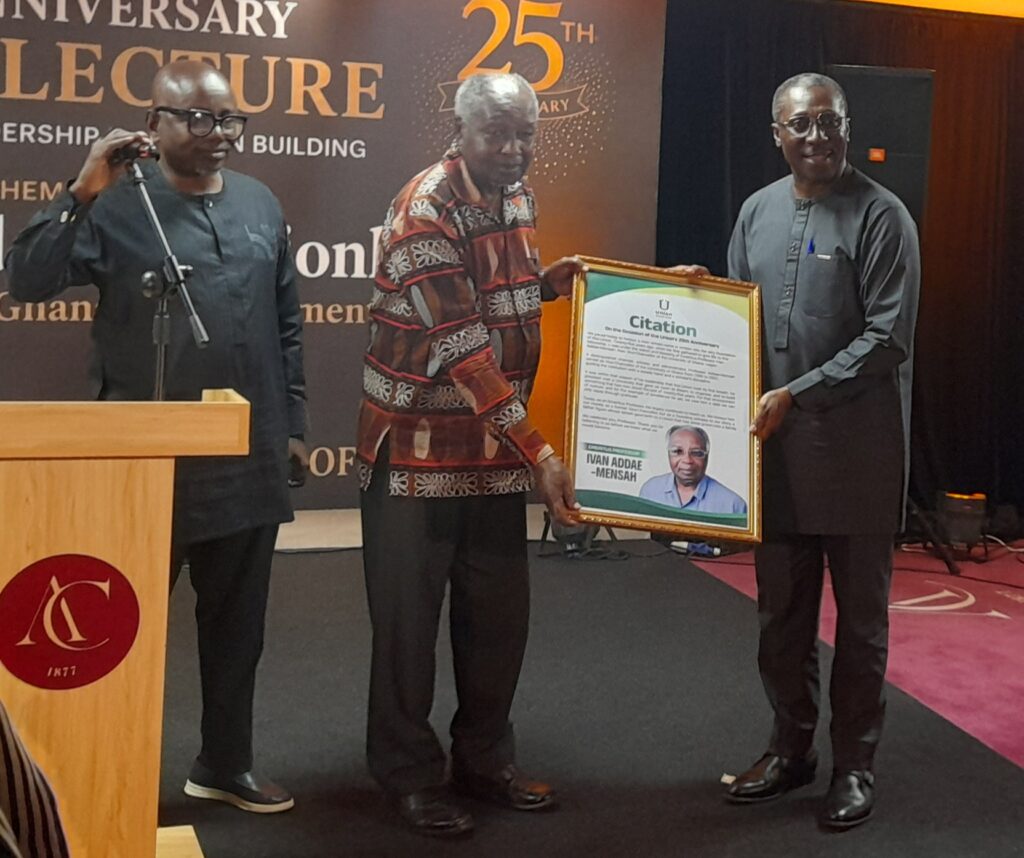
Emeritus Professor Ivan Addae-Mensah, a former Vice-Chancellor of the University of Ghana, spoke about the benefits of belonging to social clubs and encouraged The Union to remain focused on its mission.
He was honoured with a citation for his contribution to the development of the Club.
Dr Isaac Adupong, President of The Union Social Club, acknowledged the contributions of members and successive executives over the years, highlighting the progress made since its establishment.
He said the Club would continue to adapt to changing times while remaining committed to its founding ideals.
“An anniversary causes us to look back, but we have the opportunity to also look forward and see what can be different and better,” he said.
“Our founders gave us this Union; our responsibility is to ensure that the next generation makes the Union stronger and gives it greater value.”
The anniversary lecture formed part of activities marking The Club’s quarter-century of friendship and fellowship, with members reflecting on how social organisations could translate such bonds into broader social and national impact.
GNA
Edited by Agnes Boye-Doe
email: [email protected]