By Maxwell Awumah, GNA
Ho, June 18, GNA-The Seventh Vice-Chancellor’s Distinguished Lecture Series (CVDLS) has been held at the George Afeti Auditorium of the Ho Technical University (HTU), on the theme: “Business Practice Education and Research in the Era of AI: Implications for Technical Universities in Ghana.”
The lecture series was instituted to provide and guide career-focused vocational and technical higher education, enhance impactful research and propagate applicable knowledge that resonates with the needs of industry and society.
Delivering Guest Lecture, Professor Dr Ron S. J. Tuninga, Rector, Wittenborg University of Applied Sciences, Netherlands said Artificial Intelligence (AI) presents opportunities and challenges and it behooves on Technical Universities (TU) to transform these tools to improve the competitiveness of Ghana and Africa in the global context and focus on both regional and global needs of education and research.
He entreated technical universities (TU) to be co-creators of innovation, develop ecosystems in research work and on new models of industrialisation to impact students’ learning skills and societal development.
Prof Tuninga urged the technical university to thrive on multi-disciplinary educational models, develop core skills in industry, business and society with the enhancement of students’ life-long learning skills to enhance employment opportunities and innovate to satisfy humanity.
“Lifelong learning strategic implications for TU in Ghana must include modular and flexible learning, reskilling and upscaling, industry-responsive education and ultimate learning skills.
Human capacities in the AI era should entail leadership communication, critical thinking, greater creativity, ethical reasoning, ethnical literacy, flexibility and agility as well as life-long learning,” he emphasised.
He noted these are essential learning outcomes for TUs which could focus on entrepreneurship and multidisciplinary learning while moving away from siloed education and combining business, ethnical studies, science and social sciences in education.
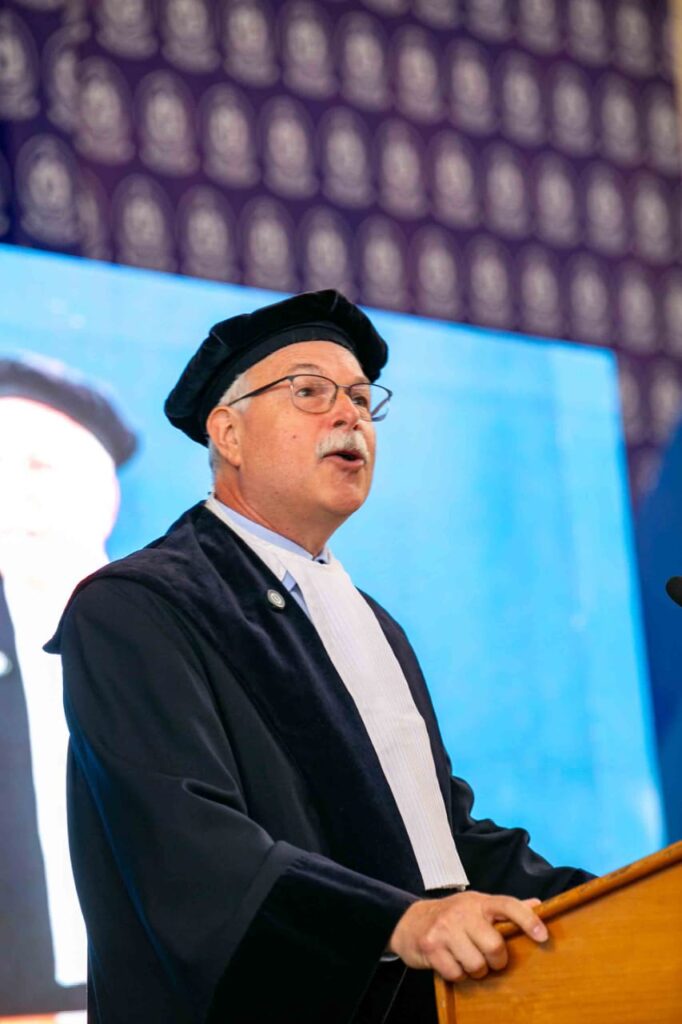
Prof Tuninga, who has over 70 publications to his credit, tasked TU managements “to lead with clarity in the midst of complexity, act with responsibility in the midst of uncertainty and to build institutions that are as adaptable as they are purpose-driven.”
He emphasized integrating AI into technical and business education curriculum, data analytics, machine learning, ethics, critical thinking, problem-solving and creativity gravitating from rote to judgmental learning and mastering on content, competences, pedagogy and delivery.
Prof Tuninga said opportunities available for Ghana and African businesses and companies in the deployment of AI would be high productivity, reduced operational costs, data-driven decision-making, new entrepreneurial ecosystems and innovation in underserved sectors.
He identified the challenges of introduction of AI in business as skills shortages, weak digital infrastructure, technical dependency, limited AI research ecosystems, data governance concerns, under representation, need for local datasets, indigenous AI applications and context-sensitive innovations.
The global business cum management icon announced the “first African Round Table on Business Practice Education and Research scheduled for 2027.”
Together, he said with industry players, public sector, policymakers and researchers across West Africa, this platform intends to formulate answers to opportunities and challenges of the future.

Prof Ben Q. Honyenuga, Vice-Chancellor of the HTU, said the lecture series command stimulating intellectual discourse, provide new insights, challenge existing paradigms and inspire action-oriented research that aligns with HTU’s strategic mandate.
He said evolving technology of AI provides opportunity for expanded productivity in both academia and business environments, insisting on the need to harness and continually engage with these technologies to enhance performance to impact research and society.
“Indeed, understanding the workings of AI in education and business is a subject of necessity, and if we want to remain relevant and make an impact on the global stage,” he said, indicating that the HTU is ready to join the global discourse of AI in business and academic engagements in Ghana and beyond.
Prof Honyenuga disclosed the University is exploring avenues to integrate these emerging technologies into its curricula, to enhance capacity, improve teaching and learning and foster stronger collaborations with industry, and international partners.
GNA
Edited by Benjamin Mensah
Reporter: Maxwell Awumah
Reporter’s email: [email protected]