By Prince Acquah, GNA
Biriwa (C/R), June 18, GNA – A high-level delegation from Zambia has embarked on a weeklong visit to Ghana to explore the country’s Technical and Vocational Education and Training (TVET) system and other skills development models.
The visit is part of a collaborative effort to drive development and address youth unemployment in the two countries.
The delegation includes top officials from the Zambian Ministry of Labour and Social Security, Ministry of Energy, and Ministry of Science and Technology as well as representatives of that country’s Chamber of Mines, Tourism Authority, Agricultural Institute and other institutions.
The visit forms part of the European Union-funded Integrated Action on Green Jobs and Skills Project, being implemented by the International Labour Organization (ILO) to equip young people with relevant skills for the current and future world of work.
The project, which runs from 2024 to 2028, supports policy coordination, capacity building and curriculum development while promoting green and digital skills across Ghana’s TVET system.
It also seeks to expand opportunities for women, girls and persons with disabilities to participate in the digital economy and emerging green sectors.
The Zambian delegation’s visit follows an earlier study tour by Ghanaian officials to Zambia, where they engaged policymakers, students, training institutions and industry players to learn about Zambia’s TVET model.
As a model institution, the delegation visited the Biriwa Technical Institute (BTI) in the Central Region on Thursday and toured its various workshops and training facilities to gain insight into its structured skills development system and draw lessons from its best practices.
They were accompanied by a multi-institutional team from Ghana, led by Mr Emmanuel Adjei, the Deputy Director at the Ministry of Labour.
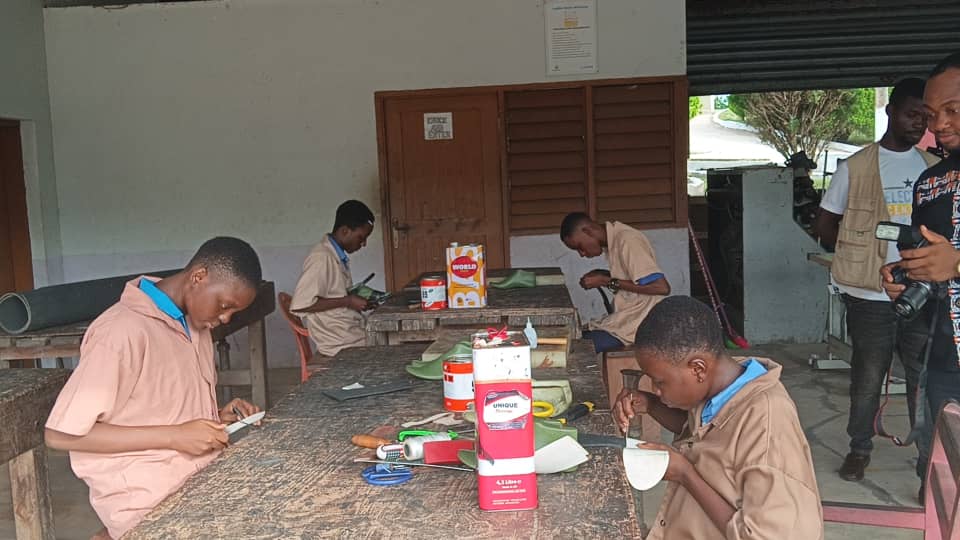
Authorities of the Institute first gave the delegation a detailed brief on the school’s transformational journey since 1974 as well as its operations before leading them on a tour of the various training facilities where students were busily undertaking practical works.
Mr Samuel Amegbor, the Principal of BTI, said the school was “the giant among the 18 pre-tertiary technical institutions in the Central Region,” and further highlighted an endless list of successes recorded over the years.
He explained that BTI, established in 1974 to address youth unemployment, had evolved into a modern technical institution through investments in infrastructure, workshops, curriculum development and staff capacity building.
He said reforms such as the establishment of the Ghana TVET Service and the implementation of the Free TVET Policy had expanded access to technical education and improved the quality of training in the school and across the nation.
Mr Amegbor, an engineer, noted that the institute currently offered 10 programmes and had trained more than 9,000 young people, with a current enrolment of 2,072 students pursuing skills in electrical engineering, motor vehicle engineering, welding and fabrication, fashion design, refrigeration and air conditioning, and leather works among others.
He indicated that enrolment had increased significantly under the Free TVET Policy, adding that between 2021 and 2026, the institute enrolled 2,088 students, with 1,906 graduating, representing a completion rate of 91 per cent.
“Biritech’s vision is to be a centre of excellence in the provision of sustainable demand-driven skills, and our mission is to provide the learners with gratifying TVET skills and services for sustainable livelihood and socio-economic development,” he said.
The Principal noted that graduate tracer studies showed many former students had secured employment, pursued higher education or established their own businesses, demonstrating the growing relevance of TVET to economic development and job creation.
Despite the gains, Mr Amegbor identified inadequate infrastructure, limited workshop equipment, large class sizes, insufficient learning materials and shortages of teaching staff as major challenges confronting the institute and the sector generally.
He, therefore, called for increased investment in classrooms, dormitories, workshops and training equipment to sustain the gains made under the Free TVET Policy and improve learning outcomes.
He said: “TVET is not a second-choice pathway. It is a catalyst for innovation, productivity and national development,” urging the government, industry and other stakeholders to work together to equip young people with the skills needed for the future economy.

Mr Paul Mumba, the Director of Planning and Research of the Zambian Ministry of Labour and leader of the delegation, impressed by the intensity and structure of the training system, applauded the school and indicated that they had picked up valuable lessons worth emulating.
He explained that the team was in Ghana to gain first-hand knowledge of the country’s achievements in TVET and observe practical training methods being implemented in institutions, reiterating his excitement with BTI system.
Mr Mumba noted that beyond policy discussions in Accra, the delegation was particularly interested in understanding how students were trained, supported and prepared for successful transition into employment and entrepreneurship.
The delegation described the visit as a valuable learning experience and reaffirmed the commitment of both countries to strengthen collaboration, share innovations and work together to equip young people with the skills needed to drive sustainable growth and national development.
For his part, Mr Gideon Mankralo, the National Project Coordinator of the European Union-funded Integrated Action on Green Jobs and Skills, emphasised that the initiative was facilitating knowledge and experience sharing between Ghana and Zambia to enable both countries to adopt best practices in skills development and tackle youth unemployment.
He observed that Ghana and Zambia shared similar demographic characteristics and labour market challenges, making collaboration essential for building responsive and inclusive TVET systems, stressing the need for South-South collaborations to learn from one another.
GNA
Edited by Alice Tettey/Benjamin Mensah
Reporter: Prince Acquah
[email protected]