By James Amoh Junior
Accra, June 20, GNA – Air Vice Marshal David Anetey Akrong, Commandant of the Kofi Annan International Peacekeeping Training Centre (KAIPTC), has called for collaborations among African countries to develop effective Artificial Intelligence (AI) and cybersecurity governance frameworks.
That, he said, would help to address emerging digital threats and safeguard peace and security on the continent.
Air Vice Marshal Akrong said while AI and digital technologies were creating unprecedented opportunities for governance, economic growth and public service delivery, they were also exposing African countries to increasingly sophisticated cyber threats that required coordinated continental responses.
He made the call at the launch of a project dubbed “Towards Collaborative Artificial Intelligence and Cybersecurity Governance in Africa,” being implemented by KAIPTC in partnership with the United Nations Development Programme (UNDP) and with support from the Government of Japan.
Speaking at the launch in Accra, the Commandant said the global security and governance landscape was being fundamentally reshaped by rapid technological advancement, making AI, data-driven systems and cyber technologies central to governance, security discourse, conflict management, economic development and public service delivery across Africa.
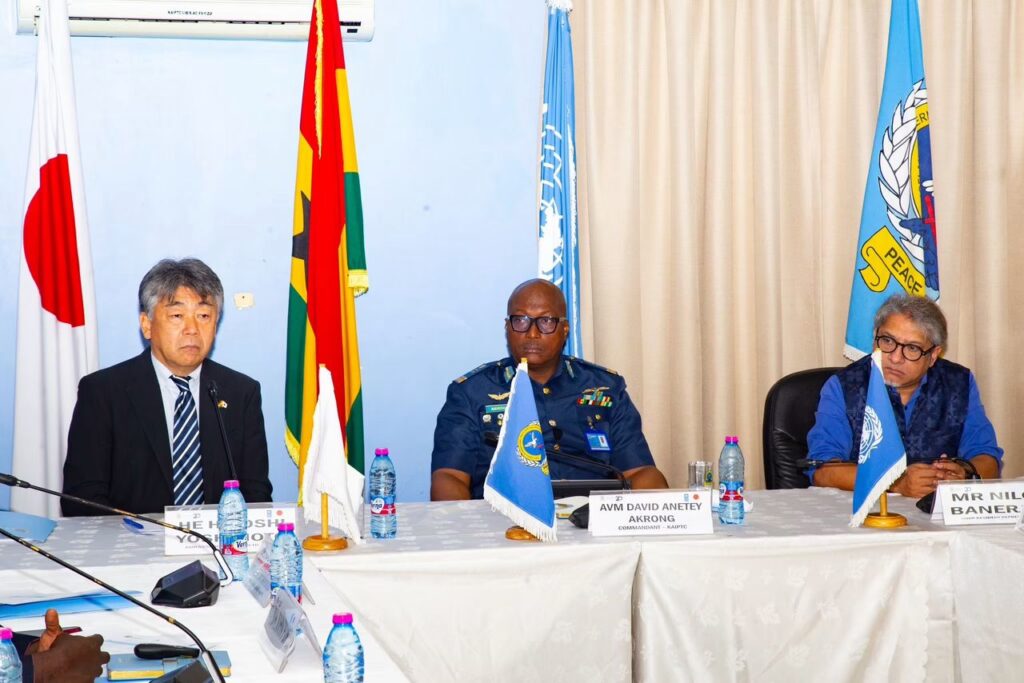
He noted that governments and security institutions across the continent were increasingly deploying AI-enabled systems for border management, surveillance, intelligence gathering, disaster response and administrative efficiency, while cyberspace had become a critical domain for national security, economic activity and political engagement.
“Artificial intelligence, data-driven systems and cyber technologies are no longer emerging tools of the future; they are now central instruments of governance and security across the continent,” he said.
Africa is experiencing a rapid expansion in the use of AI and digital technologies across governance, security and socio-economic sectors.
Governments and institutions are increasingly integrating cybersecurity into governance frameworks and deploying AI-enabled systems to strengthen governance effectiveness and support peace and security efforts.
However, the continent is also confronting evolving hybrid and non-traditional security threats, including cybercrime, ransomware attacks, deep fakes, misinformation and disinformation campaigns, and cross-border cyber threats, all of which pose significant risks to peace, security and stability.
Terrorist and extremist groups are increasingly leveraging digital technologies, online platforms and cyber tools to recruit, coordinate, finance and execute their operations, while many African countries continue to face substantial gaps in AI and cybersecurity governance frameworks, technical expertise, institutional coordination and operational preparedness.
Air Vice Marshal Akrong said these vulnerabilities had, in some instances, heightened regional tensions and undermined trust among states, particularly where advanced technologies were deployed without adequate governance safeguards.

“The transnational nature of these threats underscores the urgent need for coordinated regional and continental responses,” he said.
He noted that cyber threats and AI-related risks were inherently borderless and could not be effectively addressed through fragmented national efforts.
The Commandant said the project sought to strengthen coordination, institutional capacity and policy coherence on AI and cybersecurity governance among African Union Peace and Security Council Member States.
He explained that the initiative would promote a shared understanding of emerging risks, enhance cross-border collaboration and support the development of responsible, inclusive and context-sensitive governance frameworks for AI and cybersecurity across Africa.
Through research, policy dialogue and capacity development interventions, the project is expected to improve institutional readiness and strengthen cooperation among state and non-state actors across the continent.
Air Vice Marshal Akrong stressed the need for governments, regional organisations, development partners, academia and civil society to work together to develop harmonised governance frameworks that reflected African realities while aligning with global standards of responsible technology governance.
Mr Mitori Naoki, Chargé d’Affaires of the Embassy of Japan in Ghana, reaffirmed Japan’s commitment to supporting responsible technology governance and digital transformation initiatives across Africa.
He said Japan believed that technology should serve people and contribute to improving lives, a philosophy that aligned with the concept of human security, which Japan had been promoting globally alongside UNDP.

“Our support for this project is guided by our vision of Society, a human-centred society that leverages digital technology to improve lives and address social challenges,” he said.
Mr Naoki noted that Japan continued to advocate the principle of “Data Free Flow with Trust,” recognising that innovation flourished when the free flow of data was accompanied by trust, security and respect for privacy.
He also highlighted Japan’s leadership in shaping international discussions on emerging technologies through the Hiroshima AI Process launched by the G7 in 2023, which seeks to advance safe, secure and trustworthy AI governance globally.
The one-year project, which runs from March 2026 to March 2027, will engage stakeholders from the 15 member states of the African Union Peace and Security Council.
It seeks to improve the ability of state and non-state actors to promote responsible, coordinated and context-sensitive AI and cybersecurity governance frameworks while strengthening collaboration among national, regional and international stakeholders.
The launch also witnessed the inauguration of the project’s Steering Committee, which will provide strategic guidance and oversight for implementation.
GNA
Edited by George-Ramsey Benamba
Reporter: James Amoh Junior
Email: [email protected]