By D. I. Laary
Accra, May 01, GNA – Ghana’s Council for Scientific and Industrial
Research (CSIR) has urged industry leaders, investors and policymakers to work
with scientists to turn locally generated research into commercially viable
projects that create jobs and drive industrial growth.
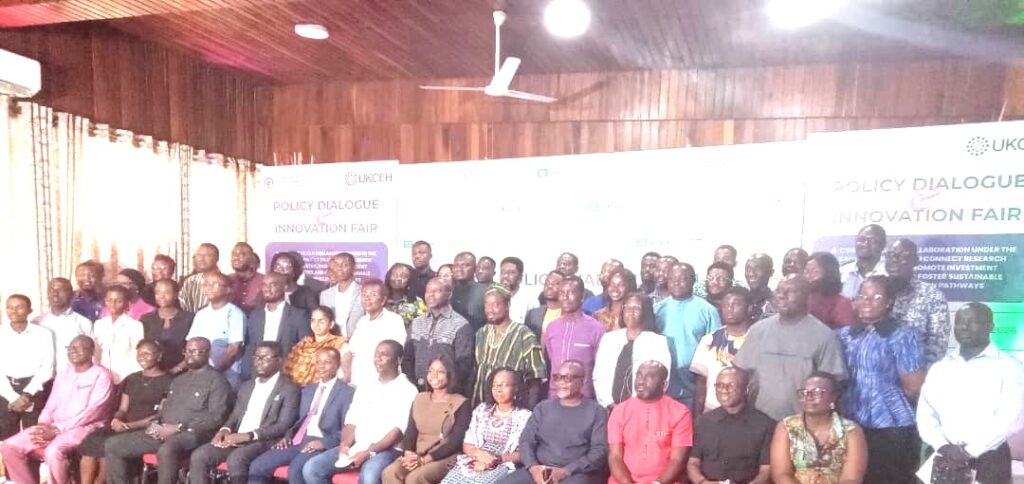
Speaking at the CSIR Policy Dialogue and Innovation Fair in Accra,
Professor Marian Dorcas Quain, Deputy Director-General of CSIR, said the forum
was designed to shift the national conversation from rhetoric to action by
strengthening linkages between research, industry, and investment.
“We are not here simply to hold another meeting to make speeches, but to
ignite a movement,” she told participants at the CSIR’s head office.
The event was held under the Sankore Project, implemented by the UK
Centre for Ecology & Hydrology (UKCEH) in partnership with UNESCO, with
funding from the UK Foreign, Commonwealth and Development Office.
Its goal, Prof Quain said, was “to transform research papers into
bankable projects.”
Welcoming directors, industry leaders, financiers, researchers,
development partners and the media, she said the initiative reflected a shared
belief that research must extend beyond laboratories and journals.
“Research, in its truest sense, must not remain confined to laboratories
or academic publications,” she stated. “Rather, it must serve as a catalyst for
economic transformation, industrial competitiveness, and societal progress.”
She indicated that the fair sought to connect research with industry,
promote investment opportunities and create “sustainable commercialisation
pathways,” stressing that CSIR could not work in isolation.
“We have learned that no single institution holds all the answers,” Prof
Quain noted, describing the CSIR as “Ghana’s engine of innovation.”
Drawing on personal experience, she recalled joining CSIR in 1996 with
expertise in tissue culture, also known as micropropagation, a technique for
producing disease-free planting material.
“The local adoption of this technique has not been easy,” she said,
adding that some private firms still import such planting materials despite
local capacity.
She noted that the main challenge was not science but engagement,
stressing, “The missing link has been communication, co-creation, cooperation
and collaboration.”
She said progress only began when farmers engaged directly with
researchers, citing a private firm, Precise Agro Farms, as an example of
successful collaboration.
“All we needed … was for one farmer to listen to us,” she said.
Prof Quain also stated that locally driven research could “set the pace,
provide solutions, create wealth and create jobs,” but only if findings were
translated into viable products, services and contract research.
“The value of research is fully realised only when it is transformed
into solutions that can be adopted, scaled, and sustained within the
marketplace,” she added.
That process, she indicated, required deliberate cooperation among
researchers, industry, investors and policymakers, supported by strong
intellectual property protection, technology transfer and incentives for
private sector participation.
Prof Quain appealed to partners, saying, “Listen to us, let us
co-create, let us raise funds together, let us own it together. Give CSIR a
chance,” the speaker said.
The Innovation Fair was designed to showcase “the ingenuity and
practical relevance” of CSIR’s work while allowing investors to identify
scalable solutions aligned with business growth and development needs.
Participants were urged to commit to an ecosystem where “research
informs policy, policy supports innovation, and innovation drives industrial
and economic transformation.”
In his remarks, emphasising the need to bridge research and commercial
farming, Mr Alfred Otoo, Engineer and Project Director of Precise Agro
Processing, reinforced Prof Quain’s message on how sustained collaboration with
the CSIR could translate research into commercial success.
He explained that Precise operates in the industrial cassava value
chain, applying data-driven and scientific principles to large-scale farming.
Over a three-year partnership with CSIR, Precise worked on tissue
culture, genotype development, and field piloting, resulting in twelve cassava
genotypes and the establishment of plantations using disease-free planting
materials.
Out of its 500 acres, 250 acres are already planted with CSIR-supplied
materials, delivering strong yields with minimal pesticide use.
Mr Otoo stressed that research-backed farming reduces uncertainty,
improves productivity, and supports investment decisions, but lamented that
research and development remain undervalued and underfunded locally.
He argued that Ghana risks losing economic opportunities when it
neglects R&D, noting that other countries invest in solutions they later
sell to African markets.
His experience, he said, proves that closing the gap between research
and commercialisation is essential for agro-industrial growth.
On strengthening commercialisation systems, Ms Adelaide Asantewaa
Asante, Head of the West Africa Office of UKCEH in Ghana, highlighted the
importance of institutional systems that support innovation uptake.
She explained that UKCEH partnered with CSIR under the Sankore Project
to strengthen science, technology, and innovation ecosystems in Ghana and
Nigeria.
As part of this effort, CSIR underwent an innovation and
commercialisation audit that identified clear opportunities to improve systems,
industry partnerships, and market readiness of research outputs.
While the audit confirmed that CSIR is already commercialising
technologies, it also produced 17 practical recommendations to enhance
efficiency and competitiveness, recommendations UKCEH and its partners have
committed to supporting.
Ms Asante emphasised that, beyond producing innovations, research
institutions must ensure their technologies are competitive in cost,
efficiency, and relevance to industry needs if they are to attract private
sector investment.
The event was designed to strengthen linkages between research and
industry, promote investment opportunities, and accelerate the
commercialisation of research outputs.
It brought together researchers, industry players, investors,
policymakers, and development partners to translate scientific knowledge into
scalable, market-ready solutions that support Ghana’s economic transformation.
GNA
Edited by Benjamin Mensah
By D.I. Laary reporting
Email: [email protected]