By Gilbert Azeem Tiroog, GNA
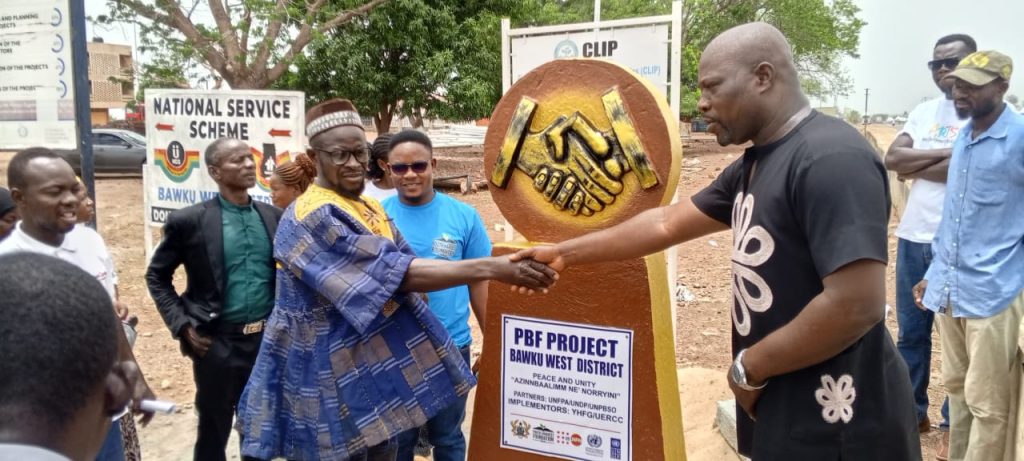
Zebilla, (U/E), April 11, GNA – The Youth Harvest Foundation Ghana (YHFG), a youth focused non-governmental organisation, has unveiled a peace monument in the Bawku West District to mark the successful completion of a two-year Peace Building Fund (PBF) project.
The monument, erected opposite the district assembly just off the Bolgatanga-Bawku- highway, is intended to serve as a lasting symbol of peace, unity, and community resilience, while reminding residents of their role in sustaining harmony and development.
It formed part of the completion of the Peace Building Fund (PBF) project being implemented with funding support from the United Nations Population Fund (UNFPA) and the United Nations Development Programme (UNDP) in the Upper East and North East Regions.
Mr David Ajebakwagane Baniyigane, Project Officer at YHFG, explained that the PBF project, implemented in partnership with the National Peace Council and the Regional Coordinating Council (RCC), sought to address both local and spillover conflicts across selected districts in the Upper East and North East Regions.
He said the intervention, which ran from 2024 to 2025, covered districts including Bongo, Bawku West, and Garu in the Upper East Region, and Chereponi, Yunyoo-Nasuan, and Bunkpurugu-Nakpanduri in the North East Region.
“In Bawku West, we worked in communities such as Sapeliga, Kopella, and Widnaba, focusing on empowering residents to actively contribute to peace and development,” he stated.
Mr.Baniyigane noted that the project emphasised inclusive decision-making, particularly promoting the participation of women and marginalised groups in community governance.
“Through our trainings, community members have gained the confidence to participate in district-level engagements, including budgeting processes, with many indicating it was their first time,” he said.
He added that the project had led to improved decision-making structures, increased access to farmland for women, and enhanced ownership of productive resources, including livestock.
According to him, the peace monument was conceived by the UN agencies as a permanent structure to sustain the project’s legacy.
“Whenever people see this monument, it should remind them of the importance of peace and encourage them to act as agents of change in their communities,” he said.
Madam Sarah Ibrahim, a women leader from Widnaba, expressed appreciation to the organisation for not only promoting peace but also fostering inclusivity.
“Unlike before, where opportunities were limited for girls, the narrative has changed because of the intervention of the YHFG. Both male and female children now have equal access to education, and everyone is involved in decision-making,” she said.
Mr Robert Anani, Assembly Member for the Kopella Electoral Area, said the project had strengthened unity and enhanced collective decision-making, leading to greater harmony within families and communities.
He, however, noted that conflict remained complex and called for continued engagement to sustain and build on the gains made.
Naba Avoka Ayeebo, a sub-chief and representative of the Widnaba traditional authority, in his remarks, said the intervention by the YHFG had significantly reduced cases of domestic violence and farmer-herder conflicts in the area.
He described peace as paramount to development and commended YHFG for leaving what he termed an “eternal legacy” in the community.
Mr James Ayamwego, the District Chief Executive for Bawku West, commended YHFG and its partners for what he described as a “priceless contribution” to peace and social cohesion in the district.
“Where there is no peace, development cannot take place. We are grateful to YHFG and its partners for their commitment to the cause of peace in our district,” he said, urging residents to uphold the values symbolised by the monument.
Mr Michael Zuure, Administrator at YHFG, expressed gratitude to community members and stakeholders for their cooperation throughout the project’s implementation.
He emphasised that the most significant achievement of the intervention was the sustainability of peace across beneficiary communities and urged residents not to relent in promoting dialogue and resolving disputes amicably.
GNA
Edited by Caesar Abagali /Kenneth Odeng Adade