By Stephen Asante
Accra, Feb. 26, GNA – Dr Henry O. Sintim, a Senior Research Fellow of the University of Ghana’s Institute of Applied Science and Technology, is urging the Government to upscale investment in climate-smart agriculture.
“If we can develop the technologies and innovations that address some of these emerging climate issues inhibiting agricultural productivity, then the country is likely to increase food production and security,” he told the Ghana News Agency (GNA) in an interview, in Accra.
This was on the sideline of a climate-smart agricultural dissemination forum, hosted by the British High Commission on the theme: “Driving Adoption of Climate-Smart Innovations for Ghana’s Agricultural Sector.”
The programme was jointly organised by the United Kingdom(UK) Agri-Tech Centre, Crop Intellect Limited, University of Ghana (UG), and Indigo, an agricultural technology company, targeting agribusiness leaders, distributors, processors, farmer organisations, agricultural extension providers, carbon programme stakeholders, policymakers, and investors.
The focus was on R-Leaf, a groundbreaking technology developed by the Crop Intellect that captures atmospheric nitric oxide pollutants and converts them into plant feed.
This process does not only reduce air pollution but also increases crop yield by providing essential nutrients, according to the researchers.
The technology, experimented at Ghana’s premier university in 2025, has proven to have the ability to significantly reduce the need for synthetic nitrogen fertilizers, potentially by up to 50 per cent, and to mitigate greenhouse gas emissions by breaking down harmful gases.
Consequently, the forum assessed the commercial overview of R-leaf, its benefits, and evidence from global trials, market and economic analysis, including adoption potential in Ghana.
Participants also discussed distribution and supply chain pathways for scaling climate-smart inputs, carbon finance opportunities, and carbon credits verification requirements.
Dr Sintim, who is also the Lead for the Validation of the R-Leaf in Ghana, said due to climate change, “we are having lesser and lesser rainfalls and then there is also soil depletion”.
Research scientists say, currently, the global agrifood system emits about one-third of all emissions, and that food systems are the leading source of methane emissions and biodiversity loss.
Emissions from agriculture are increasing in developing countries – a worrying trend which must be reversed, the World Bank warns.
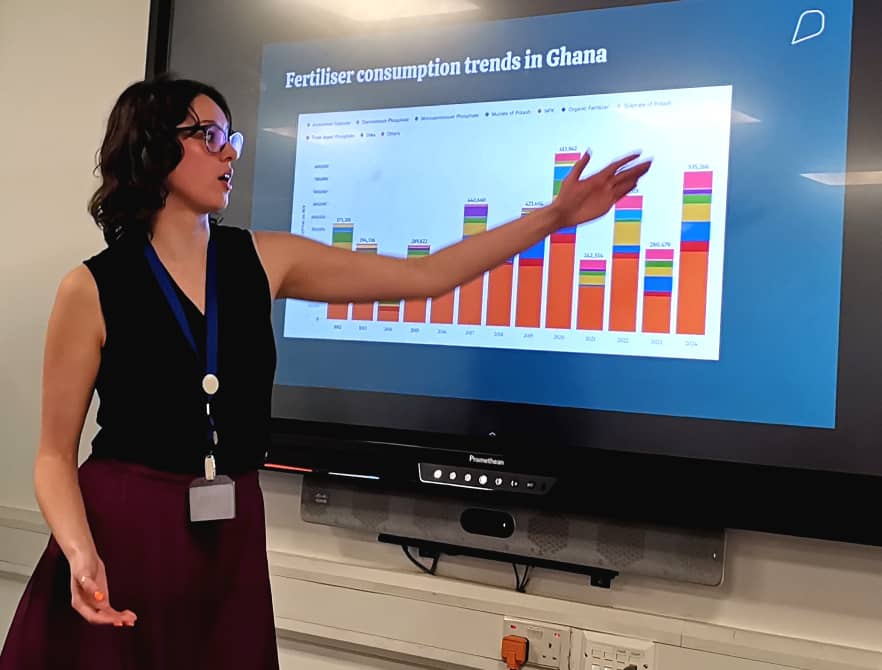
Dr Sintim said, so far, trials conducted on the R-Leaf technology on maize had been encouraging, describing them as good.
“For now, what we can say is we can reduce standard fertilizer by as much as between 20 and 60 per cent, if we are to use the R-leaf, which guarantees similar results as using 100 per cent synthetic fertilizer,” he told the GNA.
Dr Apostolos Papadopoulos, the Founder and Chief Executive Officer (CEO), Crop Intellect Limited, in a presentation, highlighted the agronomic impact of the new technology as experimented on a variety of crops globally.
“R-Leaf delivers an impressive average return on investment, providing value for every money spent, highlighting its cost-effectiveness and significant contribution to sustainable and profitable farming practices,” he stated.
GNA
Edited by Samuel Osei-Frempong