By Albert Allotey
Accra, June 27, GNA – Dr Bryan Acheampong, Member of Parliament for Abetifi says Ghana needs a national Artificial Intelligence (AI) strategy to uniquely reflect the country’s priorities of anticipating its demographic trend, and protect data sovereignty.
“We must define where we want AI to go in agriculture, education, finance, and governance and back that vision with infrastructure, policy, and talent development.
“This is how we move from reactive adoption to strategic leadership from digital dependency to digital sovereignty,” he stated.
Dr Acheampong made the remark at a lecture at UniMAC in Accra on the theme, “AI Disruption and the Future of Work: Readiness of our Youth,” organised by the UniMAC’s Institute of Journalism, the Faculty of PR, Advertising and Marketing (FoPAM).
He said Ghana could not afford to remain a passive consumer of AI technologies shaped elsewhere, adding, “We must become architects of our own AI ecosystem, grounded in national values, data sovereignty, and inclusive development.”
The MP said, “This readiness is not a destination; it is a developmental ethic – a sustained ability to align innovation with dignity and equity.”
“This is the strategic foundation upon which Ghana’s AI-driven future of work must rest; trust in our systems, adaptability in our people, and responsiveness in our institutions,” he pointed out.
Dr Acheampong called for a National AI Policy Framework to define sectoral priorities, guidelines for public-private investment, ethical deployment, and to protect data sovereignty.
“We should also establish an AI and Emerging Technologies Commission to coordinate cross-sectoral adoption conduct risk assessment, and lead strategic planning – modelled on existing regulatory institutions such as the National Communication Authority,” he stated
He said the Commission must include stakeholders from academia, civil society, business, and government.
He challenged the youth, especially the students to see AI not merely as a subject to study, but as a language to master.
“Use it to amplify truth, not misinformation. Use it to spotlight Ghanaian creativity, not supress it. Use it to advocate for inclusion, not amplify bias. Whether you enter journalism, advertising, PR, or filmmaking you must learn to wield these tools with ethics, courage and authenticity,” he advised.
He said AI was no longer an abstract concept or a distant innovation, but present reality reshaping the fabric of work in Ghana and that the changes were not happening in isolation – they were signalling a larger shift infrastructure value was created, decisions were made, and services were delivered in the country.
Dr Acheampong stated that the 21st century Ghanaian worker must not only be digitally aware, but algorithmically fluent – able to collaborate with machines, make data-informed decisions, and innovate in an environment shaped by constant technological change.
“AI will not eliminate work, but it will reshape it. The real question is: will we be ready? Readiness, as we’ve explored, is not just about technology. It is about trust, leadership, policy, infrastructure, and human capital.
“It’s about building institutions that can absorb change, fostering an education system that equips students for tomorrow’s economy, and creating a national culture that sees innovation not as a threat, but as a pathway to posterity,” he said.
He explained that “Readiness means involving young people in AI development, building ethical safeguards, and ensuring that rural and underserved communities are not left behind in this digital revolution.
“The time to act is now. Let us coordinate our national efforts through a Ghana AI Future Taskforce. Let us integrate AI literacy into our education system and build public trust in AI through clear, inclusive dialogue.
“Let us support innovation by investing in homegrown research and solutions. And let us empower our youth – not just to survive in the age of AI, but to lead it. AI is not our destiny. Our choices are. If we move with vision, unity, Ghana will not merely adapt to the AI revolution – it will help shape it,” he concluded.
Dr Acheampong promised to support UniMAC with 50 computers and AI tools to enhance teaching and learning of the students.
Professor Christiana Hammond, the Rector of the Institute of Journalism at UniMAC who delivered a keynote address on the topic, “The AI Era: The Role of Academic Institutions” described the as relevant and timely.
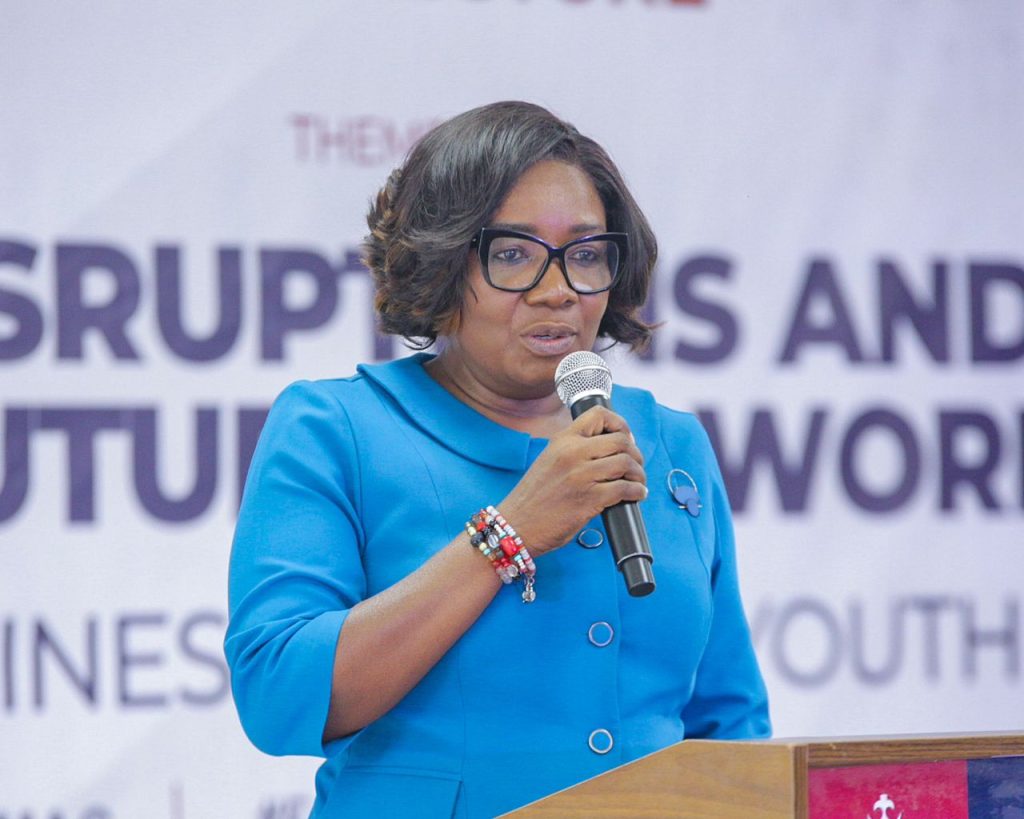
She said Ghanaian students were doing well in AI and must be supported, adding, “Like our adage, he who seeks to climb a good tree deserves a push.”
Prof Hammond expressed gratitude to Dr Acheampong, who was a former student of the Institute for the lecture and the support.
GNA
Edited by George-Ramsey Benamba