By Christopher Tetteh
Bibiani, (Western North), June 25, GNA – Mr Augustine Niber, the Executive Director of the Center for Public Interest Law (CePIL) has advocated empowerment of mining affected populations for them to seek redress through legal and institutional channels.
The CEPIL is a non-partisan and Non-Governmental Organisation (NGO) that works to make the pursuit of justice accessible and affordable to poor and marginalized communities and individuals.
It advocates and facilitates access to justice by poor communities against policies and actions (private and public), which adversely affect the interests of those communities.
Mr Niber said mining-affected communities ought to be more enlightened on laws, conflict, and Alternative Dispute Resolution (ADR) mechanisms.
He said those ADR tools of negotiation, mediation, and arbitration were not only effective alternatives to formal litigation but also vital for resolving disputes in a way that fostered harmony and sustainability, particularly, in mining-impacted areas.
Mr Niber made the call when speaking at the closing session of the third and final edition of the paralegal training workshop organized by the CEPIL and held at Bibiani in the Western North Region.
The training brought together 40 representatives from gold and bauxite mining communities of Nyinahin, Awaso, Saakrom, Kyekyewere, Mpasaaso, Apenimadi, and Kasotie in the Western North and Ashanti Regions.
It aims at empowering them with legal knowledge and practical skills to promote justice and protect human rights in their communities as well as strengthening their understanding on justice mechanisms as well as resolving disputes outside the formal court system.
Mr Niber reaffirmed CEPIL’s commitment to support and empower mining communities legally and building the capacity of local actors to tackle rights violations and advocate equitable and sustainable development within the mining-affected communities.
He lauded CEPIL’s consistent commitment to proving legal knowledge and enhancing capacities of mining communities in advocating justice within their respective areas.
Mr Niber said: “The final session is a crucial component of the broader training objective of empowering individuals in extractive communities with the legal tools necessary to protect human rights and pursue justice through appropriate and peaceful channels”.
Other topics including barriers like legal costs, and limited literacy were discussed alongside international redress options such as the African Commission and ECOWAS Court at the training.
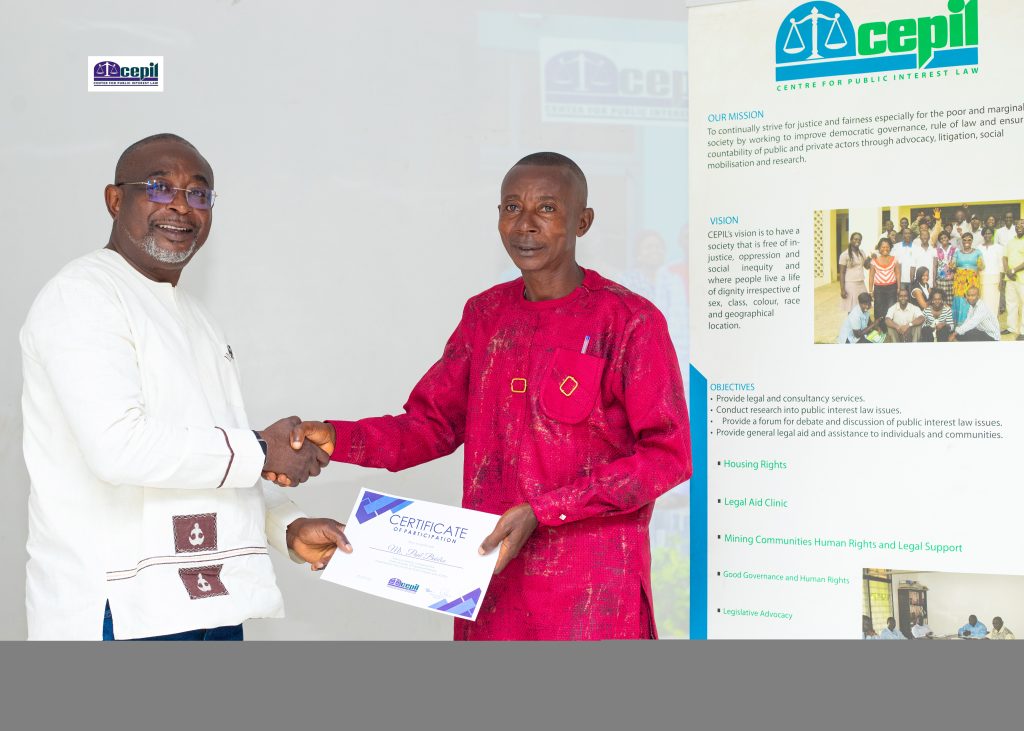
CEPIL presented certificates to each participant.
GNA
Edited by Dennis Peprah