A GNA Feature by Laudia Sawer
Sakumono(near Tema) June 17, GNA — Women are an integral part of the fishing industry of Ghana; they are the invisible hands powering the sector, from canoe-side processing to smoked fish marketing.
While most of the women in the fish processing sector are into smoking the fresh fish for the market, there is more potential in the fish processing industry, and this is what 61-year-old Mrs. Mabel Ibidun Quarshie is leveraging to change the narrative and bring out novel fish products for Ghanaians and beyond.
A former banker turned agripreneur, Mrs. Quarshie is the founder and chief executive officer of Acquatic Foods Limited, a fish processing business that is redefining how Ghanaians view, eat, and profit from fish.
Her journey, however, was not smooth; it began with loss, detoured through innovation, and today, continues with mentorship and empowerment.
From her FDA-certified facility, she churns out fish sausages, jerky, chips, and powdered tilapia spices, products once thought unimaginable in Ghana’s culinary space.
Turning business failure into innovation
“I used to work in a bank. When I left, I went into fish farming in Akuse,” she recalled. “It started well, but as an absentee farmer based in Accra, I couldn’t keep up with daily operations.”
Water contamination, net damage, and poor harvests eventually sank her aquaculture business. The collapse of her cage farming project on Volta Lake, due to water quality issues, equipment breakdowns, and poor management oversight, nearly ended her dreams in the aquaculture sector. But instead of quitting, she was determined to remain within the fish value chain.
A training trip to Uganda brought a new idea to her: the possibility of fish sausages.
“I was surprised to know you can get sausages from fish. I saw that in Uganda, and when I returned home, I began experimenting with it in my kitchen. The binding failed a few times, but that did not deter me.”
She disclosed that after having positive feedback at exhibitions where she grilled the fish sausage, she returned to Uganda to train in commercial processing, giving birth to her first commercial fish sausage.
Innovative fish products
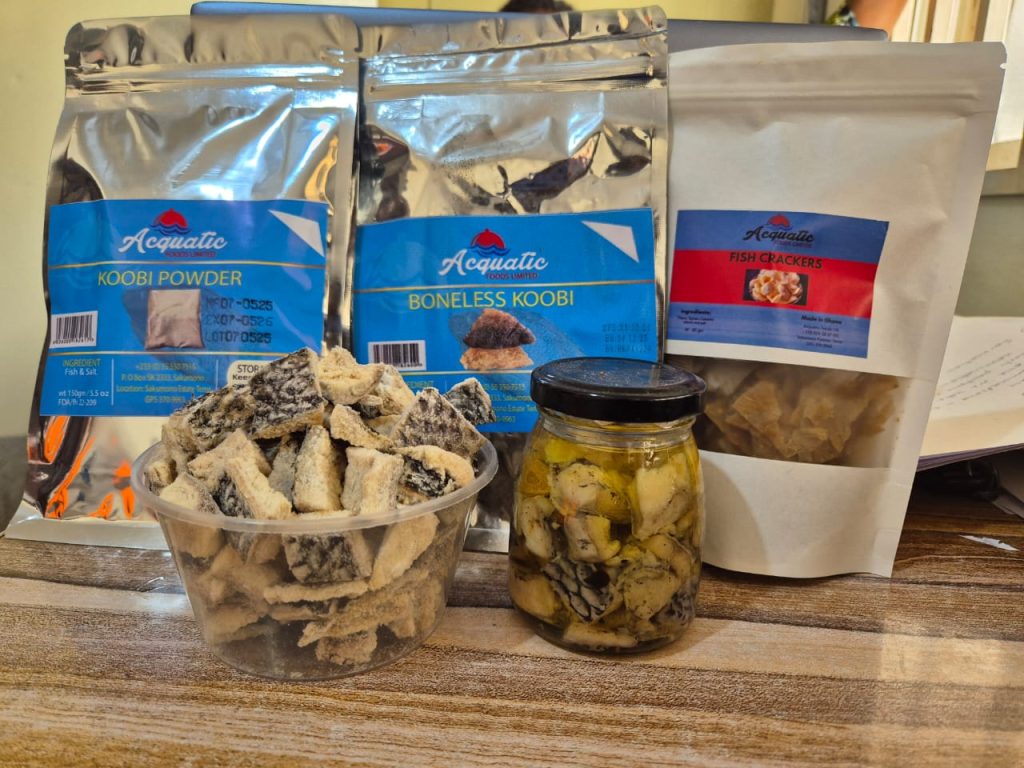
Over the years, Mrs Quarshie has developed an impressive line of over 10 fish-based products, each shaped by market feedback and innovation. When her survey on social media revealed consumers’ sentiment on tilapia having too many bones, she created boneless kobi (a dried salted tilapia).
When others complained about the fishy scent, she introduced grilled fish kebabs for events and spiced up jerky and chinchin (flour chips).
“I even created powdered kobi for people who just want the flavour in their stew. And for those who like to chew, I kept the chops version. I listen to the market,” she said.
From fish jerky to crackers, tilapia chips, and tilapia in oil (just like sardines), her brand is about making fish familiar and friendly, even to skeptical Ghanaian taste buds.
“I research what other countries do, like Asian prawn crackers. I tried it with fish, and it worked. I always ask myself, “What more can I do?”
Keeping afloat despite challenges
As a pioneer, she often had to pave her own way in the industry. She disclosed that when she was having challenges with the binding of her fish sausages, she turned to the Food Research Institute for help, but she was disappointed.
“When I first took my fish sausage idea to the Food Research Institute, they said they had never done it before. So, I should bring my equipment to their trail kitchen so we can experiment together.”
That collaboration eventually inspired further institutional interest. Today, food research bodies now train others on fish sausage production in Ghana, she disclosed.
Other challenges persisting are sourcing consistency from fish farmers; large-sized fish, especially catfish for fillets, remain difficult.
Staffing, too, is a tough challenge for most micro, small and medium-sized enterprises (MSMEs). “Some employees don’t understand the vision. You talk, train, and invest, but the drive is missing,” she shared, citing a case where a staff member’s lax attitude nearly collapsed a side sales outlet at her church.
“One of my biggest disappointments was trusting someone to manage and promote my fish sausage stand at my church premises. He sold his beef sausage instead of the fish, leading to dwindling sales,” she said, adding that “one staff member I had at the beginning preferred to sleep rather than stick to his duties to improve sales for us to meet our expenditure,” she said.
Mrs Quarshie states that despite investing in training, many employees either resisted change or failed to grasp the financial discipline and innovation the business.
Pulling others up
Now operating from her Business Incubation and Processing Centre in Sakumono, she mentors other entrepreneurs, especially women, on how to turn setbacks into success and create businesses with integrity and impact.
I want women to know that we are capable, not just of selling in the market, but of running factories, innovating, and transforming communities,” she said.
As a selfless entrepreneur, Mrs Quarshie is not content being a lone success. As President of the African Women in Agribusiness (AWIAB), she is spearheading a mentorship and incubation programme for young people and women.
“Not everyone can afford fish farming, but you can start processing with little capital,” she said. “We teach them how to make jerky, chips, and the other fish product. If they don’t have equipment, they can use our facility. It’s FDA-approved, so your product is ready for the market.”
She says competition is no threat, as it’s better to have many inventors and pull others up. “I’m over 60. If I die with these ideas, I’m sure Jesus himself will lash me,” she jokingly said. “Let others rise too. Let’s flood the market with good fish products.”
“There’s a lot inside me still,” she says. “I plan to stay ahead of the market. But my real joy will be to see a future full of women who took my ideas and went even further.”
Women empowerment
While she acknowledges there are many support programmes for women, Mrs Quarshie says most women are not taking full advantage.
“The opportunities are there, but women are not accessing them. Only about 20 per cent are ready to run with it. The rest are held back by fear of failure, culture, or lack of readiness.”
For her, giving women opportunities merely as quotas is not what will solve the problem. “I don’t want to be picked because I’m a woman. I want to be picked because I am qualified. Show that you have the capacity to do so. Be versatile. Be willing to learn.”
She calls on women to dialogue with societal barriers, not just fight them. “If your husband won’t support your work, talk to him. Explain why you need this. It’s not a fight between men and women. It’s a dialogue.”
Conclusion
Mrs Mabel Ibidun Quarshie’s story is a testimony to the courage and brilliance of Ghanaian women in the blue economy. From navigating technical limitations to managing difficult staff, she has turned her challenges into steppingstones for innovation and bringing up others. Today, she is not just producing value-added fish products; she is championing a powerful model of women-led innovation, resilience, and empowerment, and giving meaning to MSMEs in the fishing sector.
GNA
Edited by Benjamin Mensah