By Elsie Appiah-Osei, GNA
Accra, Oct. 13, GNA – Mr Alban Sumana Kingsford Bagbin, the Speaker of Parliament, has declared that the independence of parliamentary legal advice is not a technical detail but a democratic imperative.
As a result, he has charged Legal Counsel to Parliaments across Africa that their ultimate loyalty was to Parliament as a constitutional institution and not to any political party or individual.
Opening the 8th Africa Colloquium of Legal Counsel to Parliaments in Accra on Tuesday, he described legislative counsel and drafters as the quiet and indispensable architects of constitutional democracy.
The Speaker made the remarks in a speech read his behalf by Reverend Ebenezer Ahumah Djietror, the Clerk to Parliament.
He said politics was both a privilege and a profound institutional responsibility, and that they met not as isolated delegations, but as custodians of a shared constitutional aspiration and as joint architects of Africa’s democratic future.
The Colloquium, hosted by the Parliament of Ghana from Monday, October 12 to Friday, October 16, 2026, on the theme: “Ethics, Integrity and Legal Accountability,” had brought together legal counsels from across the continent, to review 15 years of the Nairobi Principles.
Speaking on impartiality, the Speaker said whether Parliament served the public or the powerful hinges on the independence of its legal advice: “Political eloquence alone has never built a durable nation, ordered national affairs or protected citizens from state overreach. That is where your work begins.”
He stated that although parliamentary legal practice began with impartiality, it did not mean indifference.
“It does not require counsel to feign neutrality or to pretend that all legal arguments are equally valid. It requires professional judgement without affection, ill-will, or partisan instruction,” he stated.
Quoting the judicial oath to do right to all manner of people without fear or favour, affection or ill-will, he said that is the standard for parliamentary legal services.
“Your advice must remain honest, even when it is unwelcome. A legal opinion that is welcomed by the majority may be correct. A legal opinion that frustrates the majority may also be correct. The test is not whether an advice pleases the institution at a particular moment, but it is whether it is legally written, professionally defensible, constitutionally sound and institutionally responsible,” he said.
He was emphatic on where loyalty must lie, saying “Your professional loyalty must not be reduced to the interest of the majority party or the minority part, nor should it be understood as personal loyalty to an individual presiding officer.
Your ultimate responsibility is to the institution of Parliament, the Constitution, and the public interest that Parliament exists to serve. In practical terms, your client is not a party nor a person. Your client is a constitutional institution,” he stressed.
He said such responsibility required moral courage to tell leadership that a policy objective may be commendable, but the law had not been properly crafted.
“Such advice is not disloyalty. It is the essence of constitutional responsibility,” he added.
On Integrity, the Speaker said it was more than the absence of impropriety; it was fidelity to truth, law, duty and institutional purpose.
He warned that Parliamentary counsel must resist the temptation to use legal reasoning to disguise political convenience, saying advice must not be shaped merely to produce the preferred answer.
The Speaker further cautioned members against selectively commissioning legal opinions until a favourable conclusion was obtained, noting that where one opinion flagged serious risks on a fast-tracked Bill affecting fundamental rights and another indicated that the risk was manageable, presenting only the second opinion to leadership does not serve the law, but amounted to short-circuiting it.
Touching on accountability and Artificial Intelligence (AI), the Speaker charged counsel to subject every Bill, amendment, application for constitutional validation, Private Member’s bill and subsidiary legislation to objective and analytically consistent scrutiny, regardless of political interest.
“Every Bill drafted, every amendment written and every item of subsidiary legislation reviewed will have an encounter in the real world. In drafting, lack of precision creates ambiguity. In subsidiary legislation, absence of quality control means executive agencies may exercise powers Parliament never intended to confer,” he said.
He explained that accountability meant being prepared to say in writing when a law was likely to be challenged, when delegation was too broad, or when procedure may not survive judicial review, and that parliamentary legal services themselves must be subject to codes of conduct, integrity training, annual reports, and transparent quality assurance.
“We cannot demand accountability from the executive while insulating parliamentary legal services from legitimate institutional scrutiny,” he said.
He warned that AI may assist in research and drafting but introduced risks of confidentiality breach, fabricated authorities, hidden biases, and weak audit trails.
“Technology may accelerate the preparation of legislation, but it cannot determine whether the process is just, whether discretion is excessive or whether the legal framework will protect the vulnerable or empower the predator. That responsibility remains human,” he said.
He therefore charged the Colloquium to adopt principles ensuring that no authority is drafted by AI that no human has reviewed; no draft is uploaded to insecure systems, and every use of AI can be audited.
Proposing a forward agenda, the Speaker, urged delegates to strengthen respect for each country’s constitutional position, establish minimum standards on conflict of interest and confidentiality, institutionalise quality assurance through plain language drafting and post-legislative review, adopt a protocol for responsible AI use, and invest in continuous professional development.
“You are guardians of constitutional boundaries, protectors of public resources and custodians of the legal processes through which citizenship can be lived with dignity and confidence,” he charged.
“When you leave this court, let your measure not be how much was passed but how clearly it was written, how fairly it was processed and how justly it will operate,” he added.
Dr Dominic Akuritinga Ayine, the Attorney-General and Minister for Justice, urged Legal Counsel to Parliaments across Africa to use the ongoing 8th Africa Colloquium to develop practical protocols on the use of AI and the handling of improper instructions.
“I urge you to take advantage of these days to share how our respective offices handle improper instructions, work towards a practical protocol for the use of AI in legislative work, give the principles a measurable self-assessment and strengthen training and mentorship for the next generation of legislative counsel,” he said.
He charged delegates to take the answers home to their respective Parliaments to make them responsive to the needs of citizens across the continent.
He thanked counsel for their service to various Parliaments, including the support being provided to the Parliament of the Republic of Ghana.
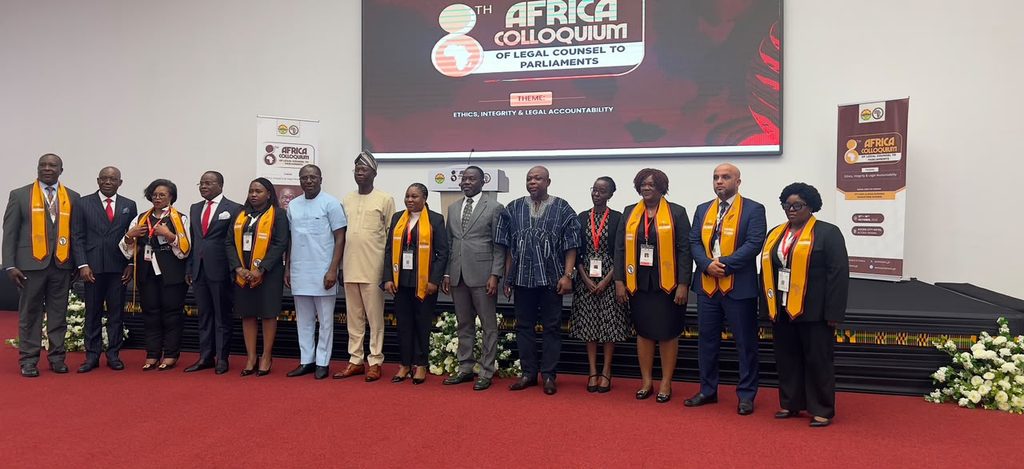
Mr Alexander Kwamena Afenyo-Markin, the Minority leader, said professional integrity demands that parliamentary lawyers refuse to draft legislation inconsistent with constitutional requirements.
He said it also requires advising the Speaker and Committee Chairs with candour and intellectual honesty, even when that advice goes against the ambitions of influential political actors.
“Professional integrity requires resistance to attempts to manipulate parliamentary procedures to marginalise minority voices, restrict legitimate scrutiny or suppress dissent,” he said.
Mr Afenyo-Markin cited Principle Eight of the Nairobi Principles, which requires parliamentary legal offices to remain impartial and non-partisan.
He stressed that non-partisanship must not be confused with neutrality, explaining that it entails a principled commitment to procedural justice.
“The Constitution and the Standing Orders guarantee minority rights to ask questions, participate in debate, examine evidence and propose amendments. Parliamentary counsel has a responsibility to ensure that parliamentary majorities do not extinguish democratic fairness,” he stated.
He said the 15-year review of the Nairobi Principles should not be an exercise in institutional self-congratulation but a rigorous, honest and fearless self-assessment.
“We must ask ourselves deeper questions: In how many of our parliaments are legal counsel genuinely autonomous? Where has executive influence gradually reasserted itself to weaken parliamentary legal offices? Where are counsel being marginalised, under-resourced or denied the institutional authority necessary to fulfil their mandate?” he queried.
He told delegates that as they return to their respective capitals, they carry the expectations of millions of African citizens who regard Parliament as the final institutional bulwark against authoritarianism, corruption, arbitrariness and abuse of power.
“Be independent, be ethical, be courageous. Our parliaments will endure only on the foundations of integrity, constitutionality and accountability,” he said.
Mr James Agalga, the Majority Leader, said good governance rests on certainty, institutional stability and fidelity to law.
“Government programmes can endure only when their legislation is grounded in constitutional principle and sound legal principle. Legislation arising from complex reforms, fiscal policy or bilateral investment agreements must not receive uncritical approval or superficial scrutiny,” he said.
He said what the majority requires and what the national interest demands is a parliamentary counsel capable of subjecting legislation to rigorous technical scrutiny, identifying constitutional vulnerabilities candidly, and improving legislative language to withstand judicial scrutiny.
“Your foremost obligation is to the law, the Constitution and the integrity of the legislature,” he charged counsel.
He said rigorous legal analysis during committee considerations does not obstruct government policy but rather strengthens it by identifying legal and constitutional risks, thereby preventing procedural invalidation, unnecessary litigation and constitutional uncertainty.
Reflecting on the Nairobi Principles established 15 years ago in 2011, when parliaments assembled in Nairobi articulated a far-sighted vision for Africa’s parliaments to develop autonomous, professional and ethical in-house legal expertise, he commended the progress made across the continent.
“From regional assemblies to national parliaments and county legislatures, the office of parliamentary legal counsel has evolved from an experimental administrative reform into an indispensable institution for legislative governance,” he said.
On the theme of the Colloquium, “Ethics, Integrity and Legal Accountability”, he said it touches the very foundations of responsible statecraft at a time of rapid socio-economic transformation, heightened public expectations and complex international realities.
“Ethical integrity cannot be treated as an abstract idea. It anchors public confidence and democratic legitimacy,” he added.
GNA
Edited by Christabel Addo
Reporter: Elsie Appiah-Osei, GNA
Email: [email protected]