By Benjamin Adamafio Commey, GNA
Accra, Aug. 15, GNA – Mrs Mary Addah, Executive Director of Transparency International-Ghana, has called for sustained action against corruption, saying Ghana’s progress in combating the practice remained inconsistent.
She said the country’s performance on the Transparency International Corruption Perceptions Index (CPI) remained below the level required to achieve meaningful and sustained gains in fighting corruption.
Ghana’s CPI score peaked at 48 points in 2014 but declined to 40 points in 2017, Mrs Addah said at a Youth-Led Dialogue Session organised by the National Commission for Civic Education (NCCE) in Accra on Friday.
She said the score recovered to 43 points in 2020 and remained at that level through 2023 before falling to 42 points in 2024 and marginally recovering to 43 points in 2025.
The figures, Mrs Addahe said, showed that although Ghana was not collapsing, it had failed to make sustained progress in combating corruption and strengthening integrity in public life.
“Ghana is not collapsing in any way. We are not saying that we are doing so badly that nobody can come and learn anything good from us. No, that is not the case. But then it is not making any sustained progress,” she said.
Mrs Addah said the stagnation in Ghana’s CPI performance should concern citizens, particularly the youth, who had an important role to play in reversing the trend.
She urged young people not to become apathetic or disillusioned with the governance system but to demand accountability and uphold ethical standards in their own conduct.
Mrs Addah said corruption was not confined to high-level political activities but also manifested in everyday practices, including bribery, attempts to circumvent administrative procedures, favouritism and abuse of influence.
She said the rule of law required the exercise of power to be restrained by law, subject to accountability and guided by ethical considerations.
Mrs Addah said public officials must act in the public interest, avoid conflicts of interest and be prepared to justify decisions taken in the course of their duties.
She cited Chapter 24 of the 1992 Constitution, the Public Procurement Act, the Public Financial Management Act, the Whistleblower Act and the Right to Information law as key components of Ghana’s integrity framework.
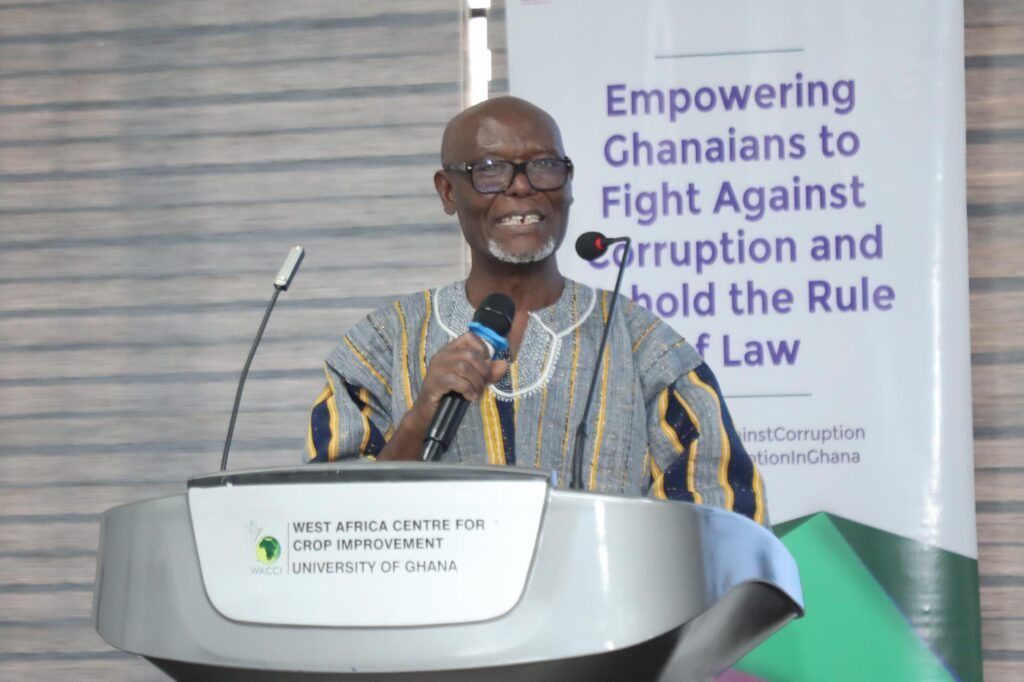
Mrs Addah urged young leaders to uphold integrity by doing what was right even when there was no external pressure to do so.
She said ethical leadership required selflessness, transparency and the courage to follow due process, particularly when confronted with pressure from powerful individuals.
“Doing the right thing, knowing there will be consequences for my actions,” she said, was how integrity was defined.
The dialogue, supported by the European Union and GIZ under the “Rule of Law and the Fight Against Corruption Project,” sought to strengthen the capacity of youth leaders to promote transparency, accountability, ethical leadership and respect for the rule of law.
It brought together students from civic clubs and selected tertiary institutions, including the University of Ghana, University of Media, Arts and Communication (UniMAC), University of Ghana Medical School, Korle Bu Campus, University of Professional Studies, Accra (UPSA), Ghana Communication Technology University and Heritage Christian University.
Mr Samuel Asare Akuamoah, Deputy Director in charge of Operations at the NCCE, said the economic cost of corruption made combating the practice an urgent national concern.
He said data from the Ghana Anti-Corruption Coalition (GACC) indicated that Ghana lost about three billion dollars annually to corruption, resources that could otherwise be invested in education, healthcare, infrastructure and community development.
“The corruption alone is taking $3 billion from us, and our economy falls into a coma,” he bemoaned.
Mr Akuamoah said the development challenges confronting communities underscored the need to prevent public resources from being lost through corrupt practices.
He cautioned against treating the engagement as another talk shop, saying the ideas and lessons generated should translate into practical action to strengthen the fight against corruption.
GNA
Edited by Kenneth Sackey
Reporter: Benjamin Adamafio Commey