By Edward Acquah
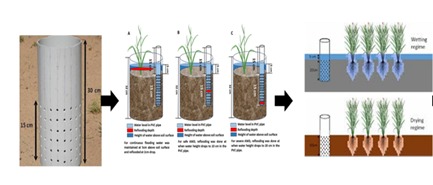
Accra, Aug. 3, GNA – Researchers have found that Ghanaian rice farmers can reduce irrigation water use by more than 30 per cent without sacrificing yields by adopting an improved irrigation technique known as Alternate Wetting and Drying (AWD).
The approach can offer a potential solution to water scarcity and boost domestic rice production.
The findings, published by a team of researchers from the CSIR-Crops Research Institute, Lancaster University and partner institutions, followed several years of field trials and farmer demonstrations at the Weta Irrigation Scheme in the Volta Region.
The study showed that instead of keeping rice fields continuously flooded, farmers could allow fields to dry intermittently before re-irrigating, resulting in significant water savings while maintaining or even increasing yields when combined with suitable rice varieties.
The researchers said the technology challenged the long-held belief among many Ghanaian farmers that rice must remain submerged throughout its growing period.
“Rice does not always need to be submerged to thrive,” the researchers said, explaining that AWD “can save water, improve efficiency and, if paired with the right varieties and practices, maintain or even increase yields.”
The research began between 2018 and 2021 under the UK Government-funded Global Challenges Research Fund (GCRF) Recirculate Project, led by the CSIR-Crops Research Institute in collaboration with Lancaster University.
Subsequent studies under the GCRF AgriFood Africa Innovation Challenge and the Africa Agriculture Knowledge Transfer Partnerships (AAKTP) project expanded the work by evaluating how different rice varieties performed under AWD and promoting its adoption among farmers.
Researchers screened 12 Ghanaian rice varieties under controlled AWD conditions and found that while some varieties struggled under alternating wet and dry cycles, CRI Agra and Ex-Baika consistently performed best.
The trials recorded more than a 30 per cent reduction in water use alongside improved water-use efficiency, demonstrating that water savings did not necessarily come at the expense of production.
To support adoption, researchers introduced the Automated Water Table Alert (AWATA), a locally developed monitoring system that enables farmers to track water levels in real time and determine the appropriate time for irrigation.
The project also trained 10 lead farmers at Weta in water management and the use of the monitoring technology.
Fields managed under AWD recorded increased tillering, larger panicles, heavier grain heads, stronger root systems and healthier green leaves compared with conventional flooding methods.
One participating farmer said: “At first, I thought the rice would suffer without water all the time. But then I saw more tillers and panicles. My yield went up, and I didn’t have to water as much.”
Another farmer said: “Before, we just watered on autopilot because that’s what everyone taught us. Now we water only when the rice really needs it.”
The researchers reported that eight of the 10 trained farmers had already adopted the technology on their own farms, describing the shift as evidence that practical demonstrations, technical support and accessible technologies could accelerate the uptake of climate-smart agricultural innovations.
The success of the demonstrations has also attracted the attention of managers of the Weta Irrigation Scheme, who have expanded demonstration plots across several sections to allow more farmers to compare AWD with traditional irrigation methods.
The researchers said the scheme’s decision to integrate AWD into its routine operations represented an important step towards long-term institutional ownership and wider adoption.
The paper urged policymakers to support the scaling up of AWD nationwide, arguing that wider adoption could improve water-use efficiency across irrigation schemes, enable double cropping and strengthen Ghana’s drive towards rice self-sufficiency without placing additional pressure on scarce water resources.
GNA
Edited by Agnes Boye-Doe
Reporter: Edward Acquah
[email protected]