By Michael Foli Jackidy
Ho (V/R), Aug 01, GNA – The National Commission for Civic Education (NCCE) has organised a youth-led dialogue for student leaders of three tertiary institutions in the Volta Region to strengthen their understanding of the rule of law, ethical leadership and the fight against corruption.
The institutions are the Ho Technical University (HTU), the University of Health and Allied Sciences (UHAS) and the School of Hygiene
The programme, held in Ho on Thursday under the theme “Strengthening the Rule of Law and the Fight Against Corruption in Ghana,” forms part of the Participation, Accountability and Integrity for a Resilient Democracy (PAIRED) Programme. It is supported by the German Development Cooperation and co-funded by the European Union.
Mr Kenneth Kponor, the Volta Regional Director of the NCCE, said ethical leadership, transparency and accountability remained indispensable to strengthening democratic governance and sustaining public confidence in state institutions.
He noted that despite the existence of legal and institutional frameworks to promote accountability, corruption, conflict of interest, influence peddling and weak adherence to ethical standards continued to undermine national development.
Mr Kponor said the dialogue was intended to empower student leaders, who occupy influential positions within their institutions, to become advocates for accountability and integrity among their peers.
He explained that the engagement built on earlier civic education programmes involving Civic Education Clubs, out-of-school youth, women’s groups and social audit meetings organised under the PAIRED Programme to deepen citizen participation in governance and promote transparency in public service delivery.
According to him, investing in student leaders would create a multiplier effect, enabling them to influence attitudes and decision-making within their institutions and contribute to building a culture of integrity in society.
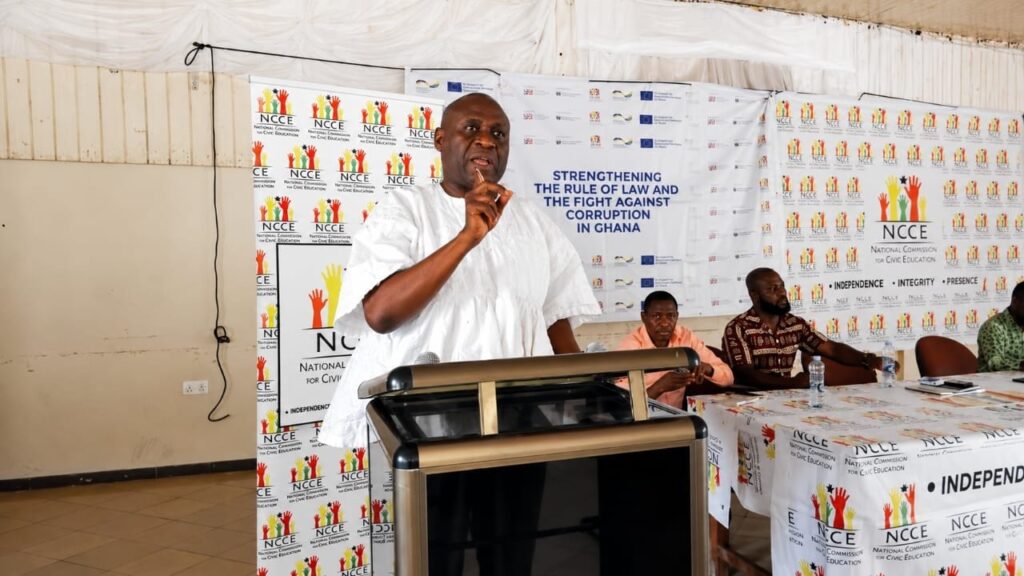
Rev Israel Aklorbortu, the Volta Regional Director of the Department of Children, speaking on “Youth Leadership as a Catalyst for Good Governance,” urged young people to embrace integrity, accountability and responsible leadership.
He described good governance as the foundation of a peaceful, democratic and prosperous society, stressing that it thrives on transparency, accountability, respect for the rule of law and efficient public service delivery.
Rev Aklorbortu reminded participants that with young people constituting more than half of Ghana’s population, they were not only the nation’s future leaders but also today’s decision-makers.
He encouraged student leaders to uphold transparency by properly accounting for student funds, involving colleagues in decision-making and promoting inclusive leadership that accommodates women and persons with disabilities.
He further called on them to reject bribery, examination malpractice and all forms of corruption, while championing integrity campaigns and whistleblowing within their institutions.
The speaker acknowledged challenges confronting youth leadership, including political interference, financial constraints, peer pressure, misinformation, corruption and inadequate leadership training, and recommended continuous capacity building, mentorship and civic education.
Mr Eric Oduro-Danso, the Principal Registrar of the Commission on Human Rights and Administrative Justice (CHRAJ) in the Volta Region, educated participants on conflict of interest, influence peddling and abuse of office.
He explained that conflict of interest arises when an individual’s personal interests interfere with or influence official responsibilities and advised participants to understand the scope of their duties and adhere strictly to institutional rules and ethical standards.
Mr Oduro-Danso described influence peddling as the improper use of one’s position, authority or personal connections to influence decisions for personal or third-party benefit.
He stressed that corruption goes beyond bribery and includes any abuse of public office or entrusted authority for personal gain.
Mr Yaw Amu, Historian and African Studies Lecturer at HTU, speaking on “Rule of Law and Ethical Leadership Standards,” argued that building a just society required moral transformation rather than simply enacting more laws.
Delivering a presentation titled “Moralising Rather than Legalising Society: A Philosophical Reflection on Justice, Virtue and Leadership,” he said laws alone could not create honesty, integrity or responsibility.
According to him, although the rule of law guarantees equality, accountability and justice, legal systems can only function effectively when administered by ethical and principled leaders.
Drawing on the philosophies of Aristotle, Thomas Aquinas, Immanuel Kant and John Locke, he noted that laws should serve justice and the common good, while leadership should be viewed as stewardship rather than the exercise of power.
He distinguished between a society that obeys laws out of fear of punishment and one that acts out of moral conviction, arguing that sustainable development depends on citizens who choose what is right because of conscience.
Mr Amu further described corruption as fundamentally a moral crisis, insisting that the fight against it must begin in families, schools, universities, workplaces and communities where values are nurtured.
Referencing the African philosophy of Ubuntu, he urged leaders to demonstrate compassion, fairness, wisdom and selfless service.
He said the strongest societies are not those with the greatest number of laws but those whose citizens require the fewest reminders to do what is right.
Participants pledged to apply the knowledge acquired during the dialogue to promote ethical leadership, accountability and transparency within their respective institutions and communities.
GNA
Edited by Maxwell Awumah/Benjamin Mensah