By Anthony Adongo Apubeo, GNA
Zuarungu (U/E), June 19, GNA – Ms Maria Mahama, the Bolgatanga East District Director of Ghana Health Service, has called for collective support for the implementation of the Government’s Free Primary Health Care (FPHC) Policy.
According to her, when the critical stakeholders worked together, the policy had the greatest potential of transforming the health sector and improving access to essential healthcare services at the community level and accelerate the attainment of Universal Health Coverage (UHC) agenda.
“Policies alone are not enough. For the Free Primary Health Care Policy to work, it must be owned by all of us, the District Assembly, traditional authorities, assembly members, religious leaders, civil society organisations and community members,” she stated.
The District Director made the call during a stakeholder sensitisation and engagement meeting organised by the Bolgatanga East District Health Directorate to deepen public understanding of the policy and clarify the roles of key actors in ensuring its successful implementation.
Ms Mahama said the policy sought to remove financial barriers at the primary healthcare level and guarantee access to essential health services for all residents regardless of their socio-economic status.
She explained that the district currently had 22 health facilities comprising 16 Community-based Health Planning and Services (CHPS) zones, three health centres and three private health facilities, all supported by trained health personnel.
Ms Mahama traced the evolution of primary healthcare in Ghana, noting that the country’s CHPS strategy originated from the Navrongo Health Research Centre’s Community Health and Family Planning Project in the Upper East Region in 1994 before being adopted as a national policy in 1999.
She said despite significant progress in expanding healthcare coverage over the years, challenges including inadequate funding for preventive and promotive health services, weak referral systems and gaps in continuity of care continued to adversely affect service delivery.
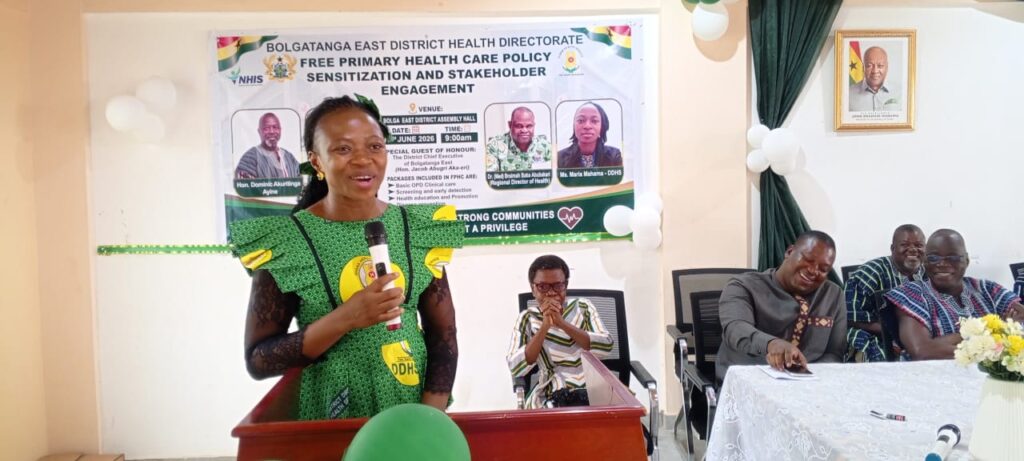
Ms Sheila Agandaa, the Bolgatanga East District Health Information Officer, who made a presentation on the policy, noted that more than 25 per cent of healthcare expenditure in Ghana was still financed through out-of-pocket payments, creating barriers to healthcare access, especially for vulnerable populations.
She explained that the policy aimed to ensure universal access to quality primary healthcare services without financial hardship and was aligned with the National Health Insurance Act, Ghana’s Universal Health Coverage Roadmap, Sustainable Development Goal three and other international health commitments.
According to her, all residents were eligible to benefit from the policy regardless of gender, social status or geographical location, and no National Health Insurance Scheme (NHIS) card was required to access designated preventive, promotive and basic curative services at the primary care level.
The package includes annual blood pressure and blood glucose screening, maternal and child health services, family planning, immunisation, mental health screening, nutrition counselling and health education services.
Mr Roland Abane Ayine, the Bolgatanga Municipal Director of the National Health Insurance Authority (NHIA), said the authority remained committed to supporting the policy through public education, community outreach and monitoring of implementation.
Mr Jacob Abugre Aka-Eri, the District Chief Executive for Bolgatanga East, described the initiative as a major step towards improving healthcare access and outcomes.
He reiterated the commitment of the District Assembly to supporting quality healthcare delivery through the rehabilitation of nurses’ quarters at Zuarungu, construction of additional CHPS facilities and the provision of maternity and surgical units at selected health facilities.
Mr Aka-Eri emphasised that the success of the policy would depend on the collective efforts of government, healthcare providers, traditional leaders, assembly members and community members and urged them to champion public awareness campaigns.
GNA
Edited by Caesar Abagali/ Kenneth Odeng Adade
Reporter: Anthony Adongo Apubeo, GNA
Email: [email protected]