A GNA feature by Anthony Adongo Apubeo, GNA
Navrongo (U/E), June 25, GNA – In 1906, three weary missionaries crossed into the Northern Territories of the then Gold Coast (present-day Ghana) in search of a place to establish a Catholic mission.
For 33 days, they wandered from community to community, pleading with chiefs and colonial authorities for permission to settle.
What they eventually received in Navrongo, in the Kassena-Nankana Municipality of the Upper East Region, was hardly a warm welcome.
The land allocated to them by the chief of the area was a dreaded patch of forest believed to be haunted by witches and evil spirits, a place where no local resident dared to build a home.
Yet, what was considered an uninhabitable “evil forest” would become the cradle of Christianity in Northern Ghana and the birthplace of one of the country’s most influential Catholic dioceses.
Today, 120 years later, the Catholic Diocese of Navrongo-Bolgatanga stands as a living testimony to faith, perseverance and transformation.
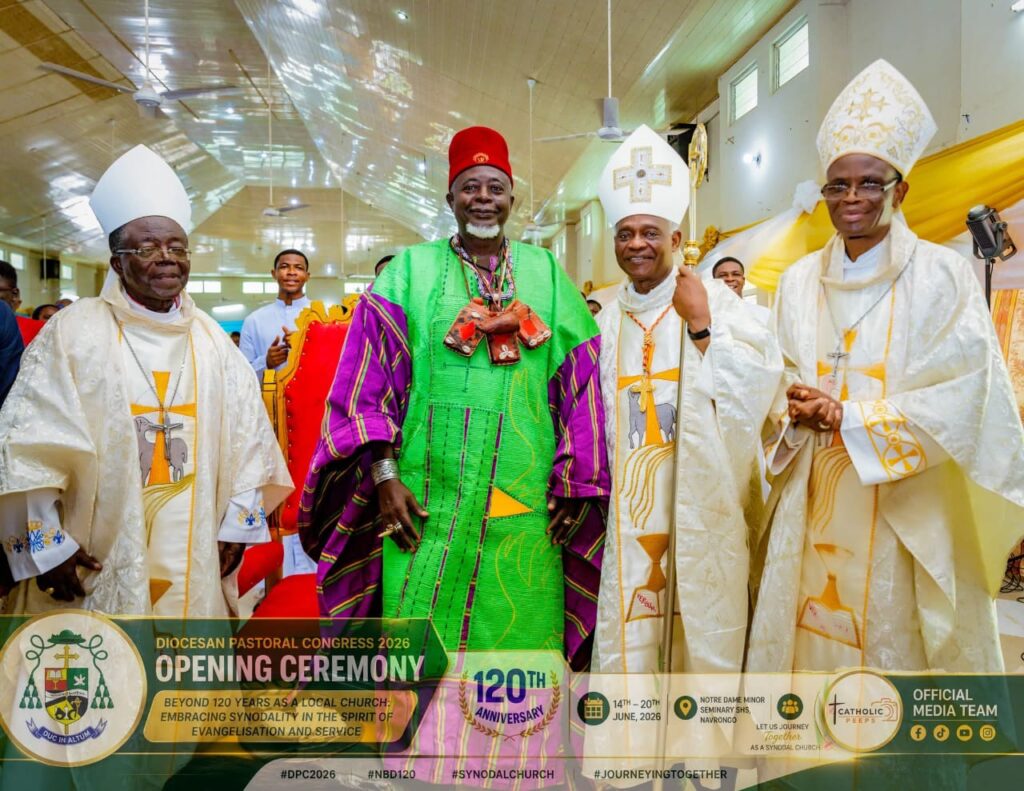
As the Diocese celebrates its 120th anniversary under the theme, “Beyond 120 Years as a Local Church: Embracing Synodality in the Spirit of Evangelisation and Service,” the occasion is not only a commemoration of history but also a reflection on a remarkable journey that has shaped the spiritual, educational, social and developmental landscape of Northern Ghana.
The beginning of a historic mission
The story began when Missionaries of Africa, commonly known as the White Fathers, namely Reverend Father Jean-Marie Chollet, Reverend Father Oscar Morin, and Brother Eugene Call, arrived in Navrongo from present-day Burkina Faso.
Their arrival came at a time when missionary activities in parts of French West Africa were facing challenges.
Seeking new opportunities for evangelisation, they ventured into the Northern Territories of the then Gold Coast; however, they faced enormous challenges.
The British colonial authorities viewed the French missionaries with suspicion, fearing they might be agents of French imperial interests, while local communities were equally cautious about the foreigners who spoke unfamiliar languages and practised an unfamiliar faith.
Yet, the missionaries remained steadfast.
On the very grounds where the majestic Our Lady of Seven Sorrows Minor Basilica now stands, they established the first Catholic mission station in Northern Ghana.
What began as a tiny outpost would eventually become the centre from which the Gospel spread across the northern savannah territories.
From a single mission station to a flourishing local church
Between 1926 and 1934, the Missionaries of Africa felt accepted by the local people and gained confidence. Starting as an outstation of Ouagadougou in Burkina Faso, the growth of the Church over the past century has been extraordinary.
From Navrongo, missionary activities expanded steadily to Bolgatanga, Wiaga, and Binduri in the Upper East Region; and Jirapa, Kaleo, Nandom and other communities in the Upper West Region.
In 1977, the Diocese played a significant role in the birthing of the Tamale Ecclesiastical Province, which currently comprises the five dioceses of Northern Ghana, including the Archdiocese of Tamale, the Navrongo-Bolgatanga Diocese, the Damongo Diocese, the Wa Diocese and the Yendi Diocese.
In 1926, the mission attained the status of an Apostolic Prefecture, marking its emergence as an independent ecclesiastical jurisdiction.
In 1934, the Prefecture of Navrongo was raised to a Vicariate Apostolic, granting it greater autonomy from Ouagadougou, with Monsignor Oscar Morin (Missionary of Africa) becoming the first Apostolic Prefect.
In 1956, the Diocese of Navrongo was formally erected, with Our Lady of Seven Sorrows as its Patroness.
On April 12, 1957, the Most Reverend Gerard Bertrand (Missionary of Africa) became the first Bishop of the Diocese of Navrongo.
Equally significant was the gradual emergence of indigenous leadership with the ordination of Reverend Father Alexis Abatey in 1946 as the first indigenous priest from northern Ghana, symbolising a turning point.
Subsequent decades witnessed local clergy assuming greater responsibility, culminating in the appointment of Bishop Rudolph Akanlu as the first indigenous bishop of the Diocese in 1973.
Another major milestone occurred in 1977 when the Diocese was renamed the Navrongo-Bolgatanga Diocese following the transfer of the Episcopal See (Seat of the Bishop) to Bolgatanga and the elevation of Sacred Heart Parish in Bolgatanga as a Co-Cathedral.
The Most Reverend Lucas Abadanloora succeeded Bishop Akanlu on March 14, 1994.
On May 27, 2006, His Holiness Pope Benedict XVI elevated the Our Lady of Seven Sorrows Cathedral in Navrongo to the status of a Minor Basilica, with Very Reverend Father Moses Yaboah becoming the first Rector of the Basilica.
In 2009, the bishop died, and on June 29, 2011, the current Bishop, the Most Reverend Alfred Agyenta, was ordained in Bolgatanga as the third indigenous bishop of the Navrongo-Bolgatanga Diocese.
A church that builds communities
The story of the Navrongo-Bolgatanga Diocese cannot be told solely through statistics of baptisms, parishes or priests, as its influence extends far beyond church walls.
Over the decades, the Diocese has become one of the most important partners in the development of Northern Ghana, particularly in education, healthcare, social welfare, agriculture, peacebuilding, and women’s empowerment.
According to Bishop Alfred Agyenta, the Diocese currently has a Catholic population of about 195,944 in 27 parishes and rectorates.
It has 80 diocesan priests, 19 missionary priests, 49 consecrated men and women, and 138 catechists.
In social and human development efforts, the Navrongo-Bolgatanga Diocese owns and manages 13 health facilities, one college of education, five senior high schools, and more than 378 basic schools in partnership with the state.
The Diocese also operates two children’s homes, livelihood programmes, women’s empowerment initiatives, and agricultural development projects that continue to improve lives across the Upper East and North East Regions covered by the Diocese.
Looking beyond the past
While the 120th anniversary celebrates an illustrious history, Church leaders insist that the focus is not merely on remembering the past; instead, it is about discerning the future.
This conviction inspired the Diocese to organise its maiden Diocesan Pastoral Congress, bringing together more than 250 delegates from all 27 parishes, rectorates, chaplaincies, and diaspora communities.
The congress reflects the Church’s embrace of synodality, a concept strongly promoted by the late Pope Francis and now central to contemporary Catholic life.
Synodality calls for listening, dialogue, participation, and shared responsibility in the mission of the Church.
Addressing delegates during the opening ceremony, Bishop Agyenta explained that the congress seeks to evaluate the Diocese’s journey and chart a new path forward.
The deliberations focus on five key areas: evangelisation, education, liturgy and sacramental life, integral human development, and social communication.
The objective is simple but profound: to ensure that the Church remains relevant and responsive in an era marked by rapid social, cultural, and technological change.
Cardinal Turkson’s challenge
One of the highlights of the anniversary celebration was the keynote address delivered by Cardinal Peter Kodwo Appiah Turkson, Chancellor of the Pontifical Academy of Sciences and the Pontifical Academy of Social Sciences.
Reflecting on the Diocese’s 120-year journey, Cardinal Turkson drew a symbolic comparison with Moses, who, according to Scripture, lived for 120 years.
For the Cardinal, the Diocese has reached a significant biblical milestone, yet its mission is far from complete.
He reminded participants that the essence of synodality lies not merely in structures and meetings but in transformed people who listen to one another, respect human dignity and work together in the service of the Gospel.
The Church, he emphasised, must continue to draw strength from its diversity while remaining united in faith and mission.
His message resonated deeply with a Diocese that encompasses multiple ethnic groups, languages, and cultures, yet has remained united by a common Christian identity.
The Legacy of 120 Years
The Navrongo-Bolgatanga Diocese occupies a unique place in Ghana’s ecclesiastical history.
As the birthplace of Catholicism in Northern Ghana, it laid the foundation for the establishment of several dioceses that now form the Ecclesiastical Province of Tamale.
Its influence stretches far beyond the Upper East Region
The Diocese has produced priests, bishops, religious men and women, educators, healthcare professionals and community leaders who continue to serve across Ghana and beyond.
The elevation of the Our Lady of Seven Sorrows Cathedral to a Minor Basilica by Pope Benedict XVI in 2006 further underscored its historical and spiritual significance within the universal Church.
Yet perhaps its greatest achievement lies not in buildings or institutions but in the countless lives transformed through faith, education, and service.
The road ahead
As the Diocese moves beyond its first 120 years, it faces new realities.
Rapid urbanisation, digital transformation, changing family structures, youth migration, and evolving social values present challenges unimaginable to the pioneer missionaries who arrived in Navrongo in 1906.
The question before the Church is no longer whether Christianity can take root in northern Ghana because that question was answered long ago; the challenge now is how to sustain and deepen that faith in a changing world.
The theme of the anniversary celebration provides a clue. “Beyond 120 Years as a Local Church: Embracing Synodality in the Spirit of Evangelisation and Service” is both a celebration and a mission statement.
It calls on the Diocese to preserve its rich heritage while embracing new ways of listening, evangelising, and serving humanity.
This is why the Most Reverend Julien Kaboré, the Apostolic Nuncio to Ghana, while presiding over the closing Mass marking the 120th anniversary of the Diocese, urged the priests and lay faithful to help proclaim the Good News to the people.
He also asked the Diocese to continue the teachings of Jesus Christ by maintaining its care for the people, especially the vulnerable, to ensure dignity and growth in order to walk together in the light of God.
From an abandoned forest feared for its spirits to a thriving local Church that touches hundreds of thousands of lives, the journey of the Navrongo-Bolgatanga Diocese remains one of the most remarkable stories of faith and transformation in Ghana.
And as the Diocese looks beyond 120 years, its history suggests that its most impactful chapters may still lie ahead.
GNA
Edited by Caesar Abagali/Benjamin Mensah
Writer: Anthony Adongo Apubeo
Writer’s email address: [email protected]