By Christiana Afua Nyarko, GNA
Accra, June 03, GNA – As dark clouds gather more often over the capital and the rainy season asserts itself through floods across parts of the country, thousands of workers in Accra are facing a familiar, but deepening ordeal: the daily battle just to get to work and back home.
From Teshie and Nungua through Ashaley Botwe, Madina, Anyaa School Junction and other densely populated suburbs, commuters are locked in a daily struggle with endless queues, vehicle shortages, choking traffic, and rising fares.
This has become their reality. For many workers, the journey to work begins long before dawn — not because of distance, but because of the fear of being stranded.
At bus stops and transport terminals across the city, men, women, and students wait for hours under grey, drizzling skies, hoping for a seat in one of the few, often rickety commercial vehicles serving their routes.
Ms Matilda Owusu, a national service personnel from Ashaley Botwe who works at a state agency near Accra’s central business district, said the situation has grown worse since the rains began.
“For some time now there has been a shortage of vehicles, but since the rains started it has intensified. Sometimes you stand by the roadside for hours before a vehicle arrives,” she said.
She blamed poor road conditions and heavy traffic, which delay vehicles from completing trips and returning to pick up stranded passengers.
The shortage often turns orderly queues into scenes of desperation. When an empty vehicle finally appears, restraint disappears.
At stops without formal queues, passengers abandon all decorum and surge forward. Men, women, children, and mothers with babies strapped to their backs shove, squeeze, and scramble for doors. The chaos sometimes ends in injuries.
The struggle gets so fierce that some commuters climb through windows and tear down vehicle doors in a desperate bid to get in.
“It is survival of the fittest,” Ms Owusu said. “When a vehicle comes, whoever is strong enough enters first. If you cannot push through the crowd, you may miss the vehicle.”
She recalled how a colleague sustained a deep cut on his finger while fighting with other passengers to board a rickety vehicle after work.
Beyond the physical battle, commuters say some drivers exploit the rainy season to impose arbitrary fare hikes.
Routes that ordinarily cost GH₵7 sometimes cost more, under the excuse of “bad roads” or “altered destinations.”
Others complain of “loading in pieces,” where drivers break journeys into segments, forcing passengers to pay multiple fares before reaching home.
Though condemned by commuters and transport unions, the practice thrives during heavy traffic and bad weather.
Mr George Agboklu, a resident of Nungua, said timing is now everything.
“Commuters who arrive at bus stops before 6:30 a.m. generally have a better chance. After that, passenger numbers increase sharply while available vehicles remain limited,” he said.
“After 7:00 a.m., you can stand there much longer because there are more people and fewer vehicles,” he added.
The nightmare repeats in the evening.
“Once it is after 4:30 p.m., queues begin to form. Sometimes you wait between 45 minutes and an hour before getting a vehicle home,” he said.
For many, getting a seat is only half the battle. Once aboard, they endure hours in traffic caused by flooded roads, broken-down vehicles, and rain-soaked congestion.
A journey that should take less than an hour can stretch into three, leaving workers drained before they even reach their desks.
Ms Esther Mensah recounted one such morning after heavy rains. Vehicles arrived late while queues swelled. When one finally came, crowds rushed it, fearing no other would come.
“I left home around 5:15 a.m. but was unable to secure transport until nearly 8:00 a.m. I even had to leave my usual station and join another queue elsewhere before I eventually got a vehicle,” she said.
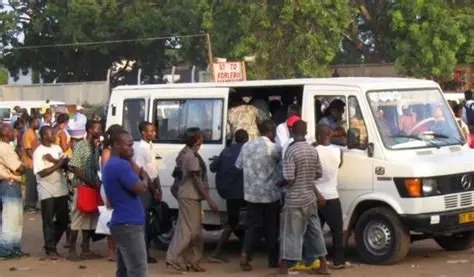
The return trip is no kinder. Workers leaving offices in Accra Central, Ridge, and other commercial hubs face packed terminals and queues snaking onto pavements.
Some spend hours just to get home after an exhausting day. Mrs Hilda Mensah said she walked between several bus stops searching for transport after finding impossible queues at her regular station.
“The queue curved from one side to another. I had to move from one stop to another before I finally got a vehicle,” she said. The delay made her late for an important meeting.
These voices echo the pain of millions of urban commuters whose transport struggles worsen each rainy season in Ghana’s capital. Poor drainage, flooded roads, and traffic congestion cripple private commercial transport — the backbone of public movement here.
The crisis is deepened by Accra’s growing population and a public transport system many believe has not expanded fast enough to meet demand.
Transport analysts, including Dr Bernard Abeiku Arthur, an urban transport planning expert, argue that Ghana’s transport troubles are rooted in poor city planning. He and others have repeatedly called for stronger mass transit, strict enforcement against illegal fare hikes, and investment in roads to cut delays.
Sadly, these circumstances do not feed into the calculations of emoluments and even productivity. The elite class will as usual drive home in air conditioned four by four vehicles which hardly feel the depth and contents of the many potholes awaiting on the poor roads. They are the ones who will demand punctuality.
Logically, one would have thought government whose poor planning has resulted in the urban transit issues will be flexible on reporting time and closing time for workers. But no cares about whether the worker gets drowned or drenched. It is business as usual.
Until a firm plan is executed for urban transportation, thousands of commuters will continue to face the daily, stark reality of crowded bus stops, fierce fights for seats, endless traffic, and rising costs — every time the rains fall over Accra and other major cities.
GNA
Christiana Afua Nyarko
[email protected]
Edited by Samuel Osei-Frempong