By Eric Appah Marfo
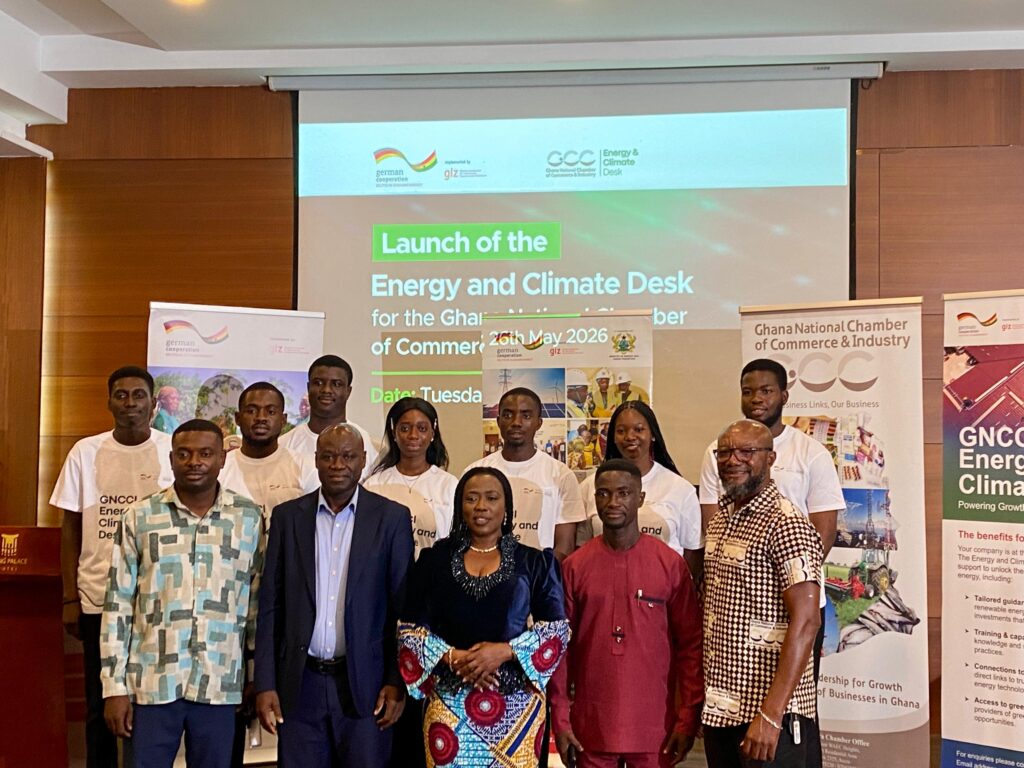
Accra, May 26, GNA – The Ghana National Chamber of Commerce and Industry (GNCCI) has established an Energy and Climate Desk to support businesses to adopt renewable energy and energy efficiency solutions to advance Ghana’s green transition agenda.
The initiative, launched under the Sustainable Energy for Climate Protection in Ghana (SE4C II) Programme in partnership with GIZ and the Ministry of Energy and Green Transition, will help businesses reduce operational costs, improve competitiveness, and strengthen climate resilience amid rising energy costs and growing global demands for sustainable production systems.
The Desk will provide technical and advisory support to businesses, facilitate access to green financing opportunities, promote energy efficiency awareness, and connect companies to renewable energy service providers.
Speaking at the launch in Accra, Dr. Robert Sogbaji, Deputy Director of Renewable Energy at the Ministry of Energy and Green Transition, said the establishment of the Desk was timely as Ghanaian businesses continued to grapple with high operational costs, power supply challenges, and increasing pressure to align with global sustainability standards.
In a speech delivered on behalf of the Minister of Energy and Green Transition, he said energy remained the first input for every sector of the economy and that unreliable power supply and expensive backup systems negatively affected productivity, innovation, and competitiveness.
“Carbon footprints are no longer just an environmental concern; they are a fundamental business metric. The message is clear: businesses that fail to integrate sustainable practices risk being left behind,” he said.
Dr. Sogbaji noted that although many businesses desired to transition to renewable energy and energy-efficient systems, concerns over upfront costs, appropriate technologies, and technical expertise often discouraged them.
He said the Energy and Climate Desk was therefore created to bridge that gap by providing expert guidance on the design, procurement, and implementation of renewable energy and energy efficiency projects tailored to businesses.
The Deputy Director said the Desk would also undertake targeted awareness campaigns and capacity-building programmes to equip businesses with the knowledge and technical skills required to sustain green interventions.
He highlighted the importance of sustained investments in renewable energy and energy efficiency, saying such investments were crucial to reducing operational costs, improving energy use, and enhancing environmental sustainability.
Mr. Stephane Miezan, President of the GNCCI, in a speech read on his behalf, said sustainability had evolved from being merely an environmental ideal into a critical business necessity and driver of economic growth.
He said businesses in Ghana continued to face serious operational challenges due to dependence on traditional energy sources and exposure to tariff fluctuations.
According to him, data from the Energy Commission indicated that more than 60 per cent of Ghana’s electricity generation came from thermal sources, leaving businesses vulnerable to global fuel price shocks.
Mr. Miezan referenced recent electricity tariff adjustments by the Public Utilities Regulatory Commission (PURC), including a 9.86 per cent increase in January 2026, followed by a 4.81 per cent reduction in April due to a stronger cedi and falling inflation.
He added that such fluctuations continued to affect the productivity and growth of small and medium-sized enterprises.
Mr. Miezan said the establishment of the Desk aligned with Ghana’s Renewable Energy Master Plan, which sought to achieve a 10 per cent renewable energy mix by 2030.
He noted, however, that achieving the target would require deliberate collaboration between government and the private sector.
“The Desk will serve as a dedicated hub for energy efficiency, renewable energy adoption, and climate resilience,” he stated.
Mr. Gunnar Wegner, Head of GIZ Ghana’s Energy and Climate Portfolio, said renewable energy and energy efficiency offered enormous economic benefits to businesses and governments globally.
He said renewable energy now accounted for about 92.5 per cent of all newly added electricity generation capacity globally in 2024, reflecting the world’s increasing shift towards cleaner energy systems.
Mr. Wegner noted that solar photovoltaic prices had dropped by about 90 per cent since 2010 and would continue to decline, making solar energy increasingly affordable for businesses.
“We know from theory and from practice that energy efficiency reduces cost. And cost reduction, in turn, improves profitability, which, in turn, improves competitiveness,” he said.
He added that renewable energy and energy efficiency would help businesses reduce electricity bills, lower exposure to tariff hikes and power outages, while also contributing to national energy security and climate commitments.
Mr. John Agyei, representing the Energy Commission, urged businesses to rely on certified professionals and licensed companies for energy audits and renewable energy installations.
He said the Commission had already certified several energy auditors, solar installation companies, and wiring professionals to ensure quality and safety standards within the energy sector.
Mr. Agyei encouraged businesses to engage the Commission and utilise its existing technical resources and support systems instead of “reinventing the wheel.”
He assured stakeholders that the Commission remained committed to supporting businesses with technical guidance and expertise to facilitate the transition towards sustainable energy systems.
The SE4C II Programme is being implemented by GIZ on behalf of the German Federal Ministry for Economic Cooperation and Development (BMZ) in collaboration with Ghana’s Ministry of Energy and Green Transition.
The programme supports Ghana’s efforts to strengthen renewable energy integration, improve energy efficiency, and accelerate climate protection initiatives.
As part of support for the operationalisation of the Desk, the team received equipment and office items, including laptop computers, office cabinets, whiteboards, printers, monitors, and workstations.
GNA
Reporter: Eric Appah Marfo
[email protected]
Edited by Samuel Osei-Frempong