By Dennis Peprah, GNA
Odomase, (Bono), April 17, GNA-Alhaji Ibrahim Habila, the Sunyani West Municipal Coordinating Director in the Bono Region has faith-based organisations and traditional authorities to remain accountable to the people.
“In fact, accountability covers every aspect of social life”, he stated, explaining deepened accountability and transparency motivated people to contribute to decision making and thereby facilitate accelerated national development.
Alhaji Habila also advised the local communities to own and contribute to the decision-making process of the various Metropolitan, Municipal, and District Assemblies (MDAs).
He emphasised that the MDAs were established for the people, saying that their active contributions in decision making would not only strengthen the decentralization concept, but also push forward the holistic development of the local communities.
Alhaji Habila gave advice when speaking at a social accountability forum at Odomase, organised by the MIHOSO International Foundation (MIHOSO), a Non-governmental Organisation (NGO).
The day’s forum was attended by representatives from faith-based organisations, government agencies and departments, market women, and traders as well as the civil society community and chiefs and queens.
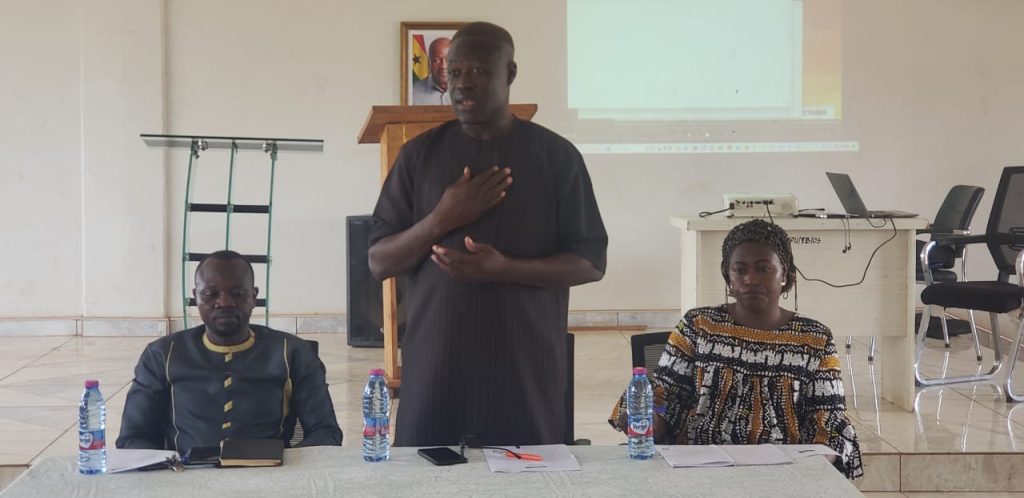
Alhaji Habila emphasised that the Sunyani West Municipal Assembly remained dedicated to engaging the local communities extensively in the decision making process and execution of development projects.
Madam Gladys Ali Bawiah, the Sunyani West Municipal Planning Officer said the Assembly required the active participation of the community members in its fee fixing resolutions, urging them to also participate in budget hearings and the General Assembly Meetings.
Earlier in a welcoming address, Mr Thomas Benarkuu, the Deputy Chief Executive Officer in-charge of Operations, MIHOSO, emphasised that transparency, active participation in decision making, accountability remained the key pillars of good governance.
He expressed concern that citizens had little or no access to information as well as poor systems and perceived financial malpractices at the various MMDAs.
“Few citizens are involved in the fee fixing, town hall meetings and general assembly meetings of the assemblies”, he stated.
Mr Benarkuu noted that: “Most of the vulnerable groups (PWDs, Women groups, people with mental health, People Living with HIV and AIDS, and artisans aren’t part of the decision-making process of the assemblies”.
He explained that it was against that background that MIHOSO sought to address the bottlenecks by seeking funds from the GIZ for the implementation of the Social Accountability for Resilient Democracy (SARD) project.
The project is under the GIZ’s Participation, Accountability, And Integrity for a Resilient Democracy (PAIReD) programme, and sought to strengthen the capacities of public institutions in Ghana to effectively implement citizen-oriented, trustworthy and accountable governance at national and local levels.
It is commissioned by the German Federal Ministry for Economic Cooperation and Development (BMZ) and co-funded by the European Union (EU) and the Swiss State Secretariat for Economic Cooperation (SECO).
Mr Benarkuu said the project was being implemented in five districts, comprising Asutifi North and Asunafo South Districts and Tano North Municipality of Ahafo as well as Sunyani West Municipality and Dormaa West District of the Bono Region.
The project aims at promoting citizens participation in local governance, empower them to demand accountability from local government/public actors at the district levels and as well as to support implementing district assemblies to boost their revenues through internally generated funds (IGF).
GNA
Kenneth Odeng Adade