By Nii Martey M. Botchway
Accra, Feb. 27, GNA – Accra Metropolitan University (Accra Met) has inaugurated a Legal Advisory Board as part of preparations toward the introduction of its Bachelor of Laws (LLB) Programme.
The move marks a significant milestone in the university’s academic expansion and its efforts to strengthen legal education through collaboration with the Bench, the Bar, academia and public service.
The eight member board which has Sir Dennis Dominic Adjei, a Justice of the Supreme Court, include Justice Jones Victor Mawulorm Dotse, a retired Justice of the Supreme Court; Justice Alexander Osei Tutu, a Justice of the Court of Appeal; Lawyer Victor Kwadjoga Adawudu, a Legal Practitioner and Regulatory Strategist; and Prof. Justice Olivia Anku-Tsede, a Ghanaian Juror and Legal Academic.
The rest are Prof. Abubakar Isa Umar, a Legal Practitioner and Academic Leader; Lawyer Thaddeus Sory, a Legal Practitioner and Fellow of the Chartered Institute of Arbitration; and Ms. Naomi Alabi, who serves as Secretary to the Board.
Speaking at the inauguration ceremony, Mr Victor Kojoga Adawudu, Director of Accra Met, assured prospective and newly admitted students that the study of law should not be viewed with fear or intimidation.
He described law as a discipline that rewarded consistency, determination and persistence.
“Law is not difficult. With consistent practice, it transforms and excellence follows,” he said.
Mr. Adawudu noted that the programme would incorporate a strong mentorship structure, enabling students to benefit from the guidance of experienced judges and seasoned legal practitioners who serve on the Advisory Board.
He said beyond academic excellence, the School of Law would emphasize core values such as integrity, transparency, accountability and ethical responsibility.
He urged students to embrace diligence and accountability, assuring them that the institution was committed to nurturing both skilled legal practitioners and principled leaders capable of serving society.
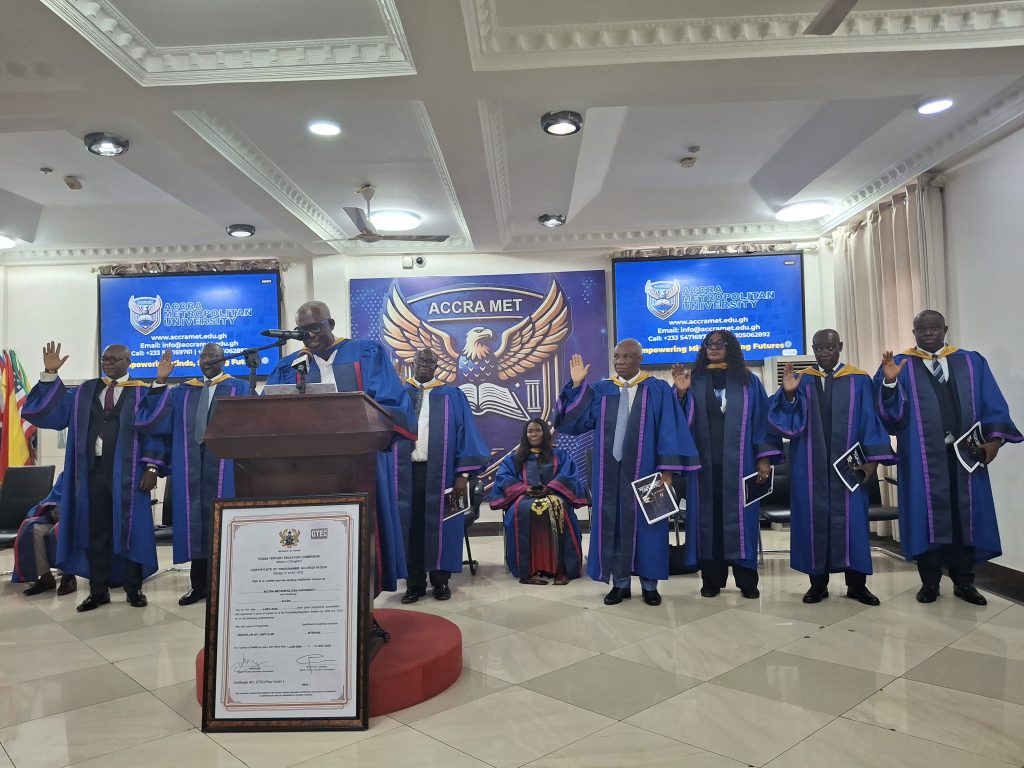
In his address, Sir Dennis Dominic Adjei, reaffirmed the Board’s commitment to upholding academic and professional excellence, noting that the study of law becomes manageable when approached with discipline and the benefit of proper mentorship.
He said the Board would support curriculum development, strengthen faculty governance and promote internship opportunities, mentorship programmes and career development pathways for students, while stressing the importance of practical exposure, including local and international internship opportunities, to complement classroom learning.
Sir Justice Adjei expressed optimism that the School of Law would grow into one of the most reputable legal institutions in Ghana and beyond.
For her part, Prof Goski Alabi, the Acting Vice-Chancellor, described the inauguration of the Board as a landmark moment in the university’s pursuit of academic excellence.
She said the Board had been carefully constituted to provide strategic leadership, professional oversight and ethical direction for the School of Law.
According to Prof. Alabi, the Board would help safeguard academic standards, ensure the curriculum remained rigorous and globally relevant, and promote innovation in teaching, research and clinical legal education.
She explained that the Board would also serve in an advisory capacity to the Vice-Chancellor and the Governing Council, offering independent counsel on programme development, research advancement and international partnerships.
“The ultimate objective is to nurture graduates who combine intellectual competence with strong moral character and a commitment to national development,” she said.
GNA
27 Feb. 2026
Edited by Samuel Osei-Frempong