By Solomon Gumah, GNA
Borgbaln (N/R), Jan. 10, GNA – Ugbembor Maakopu Mawukbi IV, Chief of Borgbaln in the Saboba District of the Northern Region, has called on community members, to champion environmental sustainability for food security, dignity, and long-term development.
“Our forests are our shield, our farms are our sustenance, and our rivers are our hope,” the chief said and urged residents to desist from careless burning and reckless tree felling to become responsible custodians of the environment for future generations.
Ugbembor Maakopu Mawukbi IV made the call at the 2026 Ndipoandan Festival held at Borgbaln, a farming community in the Saboba District.
He expressed concern about the growing incidence of bushfires and indiscriminate logging, and said such phenomena threatened forests, farmlands, and water bodies that generations of Konkombas had depended on for survival.
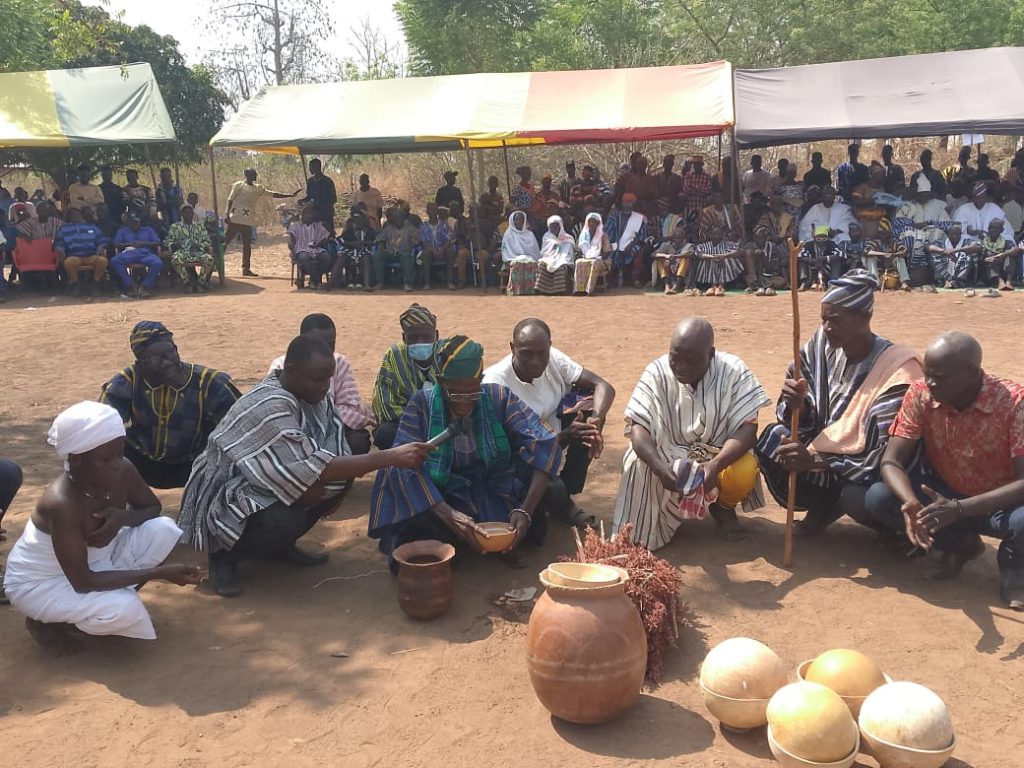
The annual event was organized by the Ngbin clan of the Konkomba ethnic group under his auspices, and attended by sons and daughters of the clan from far and near, other Konkomba clans, government officials, traditional and religious leaders, students, youth groups, and the media.
The festival, celebrated under the theme “Providing Holistic Education in Kikpakpaan: The Role of Ugbembor,” is traditionally held to mark the harvest of guinea corn, one of the staple crops for the Konkombas, signifying the end of a farming season and the beginning of a new agricultural cycle.
Ndipoandan, literally translated from the Konkomba dialect as “new guinea corn festival,” is characterized by libation to thank the gods for bumper harvest, cultural displays, and the carrying of bundles of guinea corn to symbolize hope, resilience, survival, and abundance.
It is also celebrated to promote peaceful coexistence among clan members and other ethic groups, while serving as a platform to advocate government and other stakeholder support for sustainable development of their communities.
Ugbembor Mawukbi IV stressed that sustainable development could only be achieved through holistic education that blended formal learning with cultural values, moral discipline, leadership training, and practical skills.
He said while the youth were torchbearers of modern knowledge, traditional authorities remained custodians of ancestral wisdom, and called for closer collaboration between the two to drive progress in Kikpakpaan.

“Education must not only be about books and classrooms; it must also teach cultural identity, moral values, and responsibility to society,” he stated, adding that festivals such as Ndipoandan could serve as “living classrooms” for teaching history, leadership, and environmental stewardship.
He appealed to the government and other stakeholders to deepen investment in the education sector by establishing a Community Day Senior High School at Kujoni to serve the growing youth population in the area.
He called for the expansion of rural electrification project from Kujoni to Wangban to cover about 13 surrounding communities without electricity, and the upgrading of the Borgbaln CHPS compound to a health centre to improve healthcare delivery within the Ngbin enclave.
Ugbembor Maakopu Mawukbi IV, however, commended the government for a number of ongoing development projects in the district, including the construction of the Janbuabuni Bridge on the Wapuli–Saboba road, the Wadiik CHPS compound, the Buakpalb–Salado rural electrification project, and the construction of Junior High School blocks at Borgbaln and Kujoni.
He said those interventions were contributing significantly to improving access to education, healthcare, and economic opportunities in the district.
Ubor John Mateer Sakojim IV, Paramount Chief of the Saboba Traditional Area called on the youth to engage in productive economic activities and avoid violence and destructive behaviours that undermined development.
He urged parents to prioritise formal education for their children, noting that education remained a critical tool for empowering the youth with the skills and knowledge required to function effectively in modern society.
The Paramount Chief appealed to chiefs and leaders within Kikpakpaan to resolve their differences and embrace forgiveness, unity, and peace, stressing that unity and peaceful coexistence were the foundation for sustainable development.
Mr Jawol Bisunna Titus, President of the Konkomba Youth Association (KOYA) called for the responsible use of social media, cautioning the youth against the spread of content that could incite conflict or violence.
He appealed for unity and peace among the people of Kikpakpaan and urged the youth to channel their energies into productive ventures that would promote development rather than disrupt the prevailing peace.
Mr Jawol advocated a unified Ndipoandan Festival for all Kikpakpaan instead of clan-based celebrations, saying such an approach would strengthen cohesion and solidarity among the Konkomba people.
Mr George Wumbei, District Chief Executive for Saboba who represented the Member of Parliament for Saboba Constituency as well as the Northern Regional Minister, commended the Chief and Elders of Borgbaln and the organizing committee for hosting a successful and peaceful festival.
He said the relative peace in the area had enabled the district to attract and implement some development projects and assured the people of additional classroom blocks for Kujoni, as well as other forthcoming projects, including the provision of potable water.
GNA
Edited by Eric K. Amoh/George-Ramsey Benamba