Accra, Dec 22, GNA – Mr. Robert Appiah, Senior Product Specialist for Talent and Learning at SAP, has called for a critical focus on preparing young people for the workforce by closing the gap between education and industry.
By advocating for transformative solutions that align academic learning with industry intelligence, Robert aims to reduce high unemployment and unlock opportunities for graduates.
During an interview with the Ghana News Agency (GNA), he was asked, “How do you build a learning system that actually changes someone’s career, not just show a certificate?” He replied, “It’s something I think about often, and not just in meetings.”
Robert’s journey began in Ghana, where he observed a persistent missing link between the talent of local graduates and the labor market’s specific requirements.
“You could see the talent,” he recalled, “but there was a gap between what they learnt and what employers needed. That discomfort became the backbone of my career.”
His academic path reflects a commitment to building robust infrastructures for growth. Supported by a Commonwealth scholarship, he earned a master’s degree in software systems at the University of Bath, focusing on systems thinking.
He later completed another advanced degree at the University of British Columbia (UBC), specializing in AI and blockchain.
“Bath taught me how to think in systems,” he said. “UBC taught me how to think in intelligence and trust. Those two ideas, systems and intelligence, are basically what the next generation of workforce training needs.”
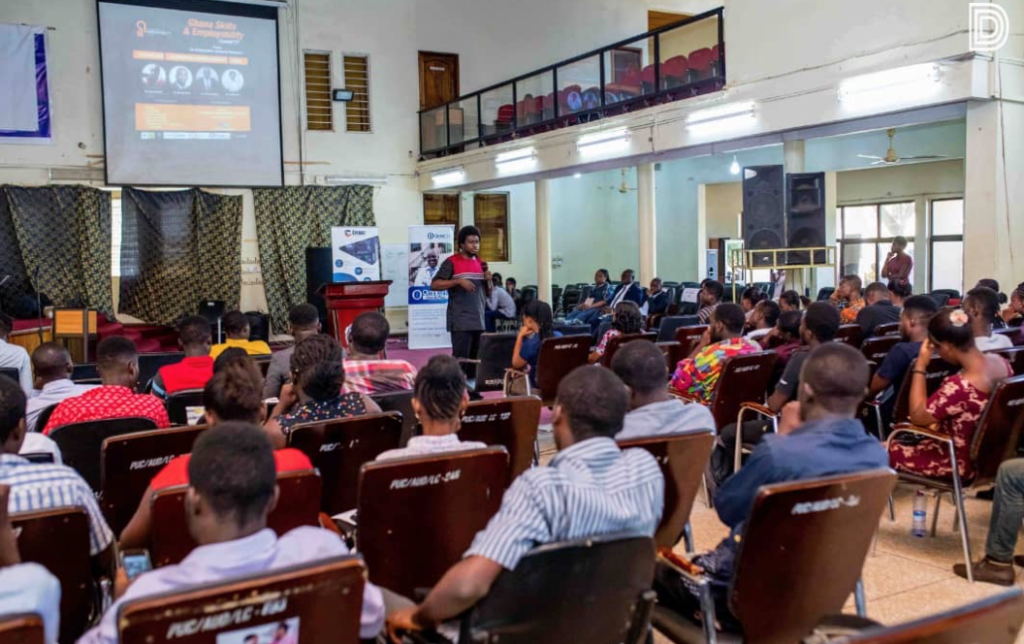
Since 2017, Robert has been the driving force behind the Ghana Skills and Employability Summit. This event, hosted with partners such as Pentecost University and other organizations is an established platform designed to bridges the gap between university education and industry expectations.
“We wanted to stop talking about ‘employability’ as a buzzword and start treating it like a product problem; Who are the beneficiaries? What do they need to be able to do the job from day one? How can they prove they have the right skills and credentials for the role?” he explained.
The summit utilized panels, workshops, and mentoring to walk students through the skills that actually matter to recruiters. “The same questions I ask when designing a learning solution for a multinational, I ask for a first-year student in Accra,” he noted.
Today, Robert applies this philosophy at SAP, specifically within SAP SuccessFactors Learning, a platform used by over 40 million users globally. He architects transformative solutions through integrated learning pathways deeply embedded into the talent and learning ecosystem.
He addresses the critical gap between “acquiring a skill” and “driving real performance.” By integrating sophisticated learning interventions directly into human resource tools, he helps the world’s largest companies move away from “tick-box” training toward a model of continuous development.
“In many ways, it’s the same problem,” he explained. “For students, the challenge is moving from theory to practice. For companies, it’s moving from training to real performance on the job. When you are aware of these problems, you do not just build learning tools and features; you build solutions that can shape how the next generation of innovators, leaders, and practitioners develop the skills they need for the future of work.”
He partners with teams and customers to translate messy realities from the field, such as overworked HR teams and fragmented content, into impactful solutions and learning outcomes. The goal is to ensure that skill development translates into productivity, quality, and retention across a global user base.
Robert’s research in AI is the engine behind his vision of the future of work. He is currently involved in efforts to evolve learning systems into proactive “Co-pilots” that act as companions rather than just course hosts.
“We’re moving from platforms that just host lists of courses to learning systems that act as co-pilots,” he said.
“That means the system should know your role, your skill gaps and your career ambitions, while quietly doing a lot of the heavy lifting in the background.”
Robert also highlights how AI is democratizing education, fundamentally changing the relationship between the learner and the expert.
He notes that students and professionals no longer need to wait for a professor or a scheduled session to learn new concepts. Instead, they can learn new skills and conduct deep research on the fly using AI tools such as Gemini, Claude, and Perplexity.
However, he emphasizes that AI must be treated as critical infrastructure. “You can’t just throw AI at people’s careers without thinking about trust, bias and data protection,” he cautioned.
For Robert, AI-powered learning is most useful when it helps students build relevant skills autonomously while helping employers develop the specific capabilities their organizations need next.’
What distinguishes Robert’s approach is its universal applicability. He applies a two-sided test to every idea, “My test for any idea is simple,” he said. “Would this help a graduate in Accra and an employee in a global enterprise, not just one of them?”
“When we get learning and AI right,” Robert concluded, “we don’t just make companies more productive. We make people more mobile, globally competitive, more confident, and in control of their future. That’s the kind of impact I want my career to reflect.”
GNA
Edited by George-Ramsey Benamba