By Albert Oppong-Ansah
Accra, May 8, GNA – A technical team report has found that while the Volta River Authority’s 2023 Akosombo Dam spillage was necessary, improved floodplain control measures were needed to minimise downstream impact.
A designated floodplain should be delineated to manage spill discharges in the short, medium, and long term, considering climate change uncertainties.
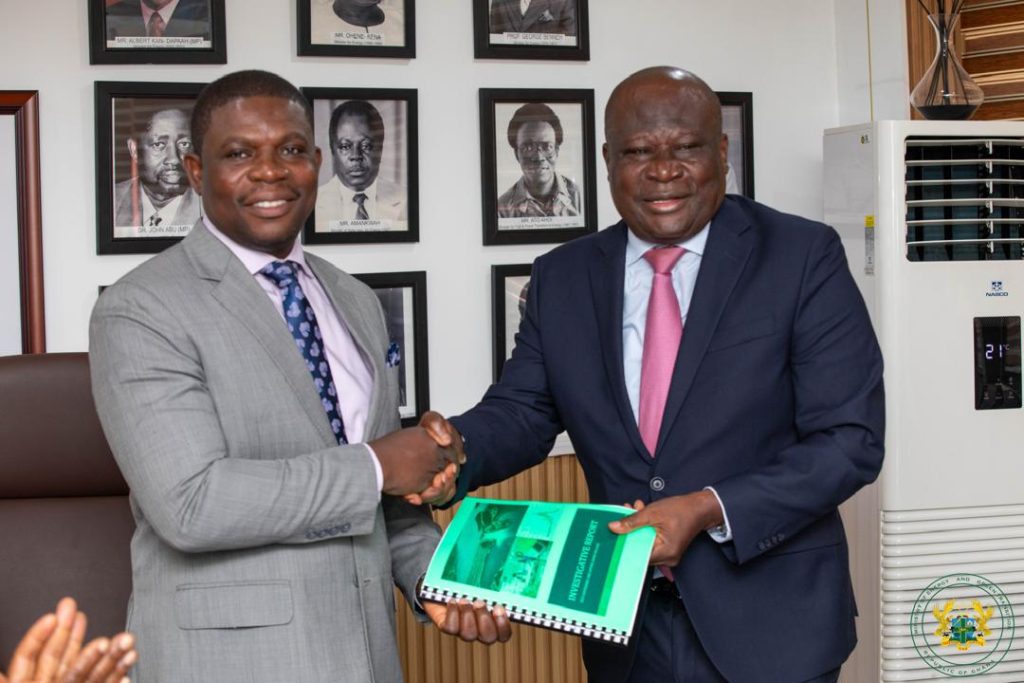
Mr Kirk Koffi, the Chairman of the teachnical team, who presented the report to the Deputy Minister of Energy and Green Transition in Accra, said that resilience improvement projects should include upgrades to critical public infrastructure located within the floodplain, such as the Sogakope Bridge and hospitals.
The Ministry of Energy and Green Transition appointed a five-member committee on March 13, 2025, to review the flooding caused by the Akosombo and Kpong Dam spillages in September 2023.
Mr. Koffi emphasised the urgent need for a Legislative Instrument to define the downstream floodplain and prevent settlement or construction in affected areas.
The Committee identified weak emergency preparedness at the district level and recommended simplifying the Volta River Authority’s Emergency Preparedness Plan (EPP) into infographics and local languages for better community awareness and response.
To address coordination gaps and the high turnover of political appointees, the report suggested forming a multi-stakeholder disaster task force, including Members of Parliament, Metropolitan, Municipal and District Chief Executives, and traditional leaders, supported by regular public accountability reporting.
The Committee proposed engineering solutions, such as improving river channels and creating vegetative buffer zones with mangroves downstream and bamboo plantations upstream, to enhance water conveyance and reduce flooding.
The report recommended developing multi-purpose safe havens on elevated land that could serve as schools or community centres and be converted into shelters during emergencies.
These facilities should be complemented by psychosocial support and feedback mechanisms to document community experiences.
On compensation, the Committee called for a transparent process, including district-level accounts managed by the Ministry of Finance, local MPs, and Assemblies.
Verification would involve traditional and local opinion leaders.
“Compensation is a critical issue for affected communities, especially farmers, fishers, and business owners who have lost livelihoods,” the report emphasised.
It urged a comprehensive damage audit and timely disbursement of funds allocated in the 2025 national budget.
The report is part of efforts to address the 2023 dam spillage, which displaced thousands and caused widespread destruction in parts of the Volta, Eastern, and Greater Accra regions.
Mr. Mensah, who received the report on behalf of Mr. John Jinapor, Minister of Energy and Green Transition, commended the team for their work and pledged the government’s commitment to implementing the recommendations.
“This report is crucial in our efforts to address the impact of the dam spillage. We are determined to turn these recommendations into actionable solutions that prioritise the well-being of our citizens,” he said.
Rising water levels at the Akosombo Dam in late 2023, driven by heavy inflows during the rainy season, necessitated controlled spillage to protect the dam’s integrity and mitigate downstream effects.
The controlled spillage from Akosombo and Kpong Dams lasted 46 days (September 15 – October 30, 2023), flooding communities across nine municipalities and districts in the Volta, Eastern, and Greater Accra regions.
Approximately 192 towns and villages were affected, displacing 39,333 individuals, including 48 per cent children.
A total of 9,160 displaced persons were relocated to 31 designated safe havens.
GNA
KAS