By Stephen Asante
GNA Special Correspondent, Beijing, China
Beijing, May 18, GNA – Long life is one of humanity’s greatest desires and pursuits.
In many societies, it is considered as a divine or mundane blessing and symbol of dignity, representing a flourishing and fulfilling life.
It is a subject which has for many years provoked interest and research in academia given the multiplicity of factors resulting in one’s longevity on earth.
Within the context of the Chinese society, there are diverse theories on how to achieve the goals of longevity, dubbed the Longevity Theory.
The concept encompasses the movement theory (exercising), quietism theory (resting and meditation), rhythm and harmony of life pattern, as well as the vitality of life.
Generally, varied studies demonstrate that individuals’ life expectancies are determined by a combination of different factors, including genetics, lifestyle, diet, healthcare level, socio-economic status, heredity, and environment.
“Among these factors, the environment is extremely important,” says Professor Wuyi Wang, a researcher at the Institute of Geographic Sciences and Natural Resources Research of the Chinese Academy of Sciences, and co-Director of FORHEAD.
It is worth noting that the ancient Chinese appreciated and explained the relationship between human lifespan and natural environment as far back as 2000 years ago.
Contemporary studies have found that climate, longitude, soil type and crop agrotype are the leading environmental factors influencing regional population longevity in China.
An integrated study on the environment of China’s typical longevity areas has been conducted by researchers using comprehensive methods of health geography.
Led by some of the Asian giant’s leading scientists, including Wuyi Wang, Yonghua Li, Hairong Li, Jiangping Yu, Linsheng Yang, and Li Wang, the study found that the country’s longevity areas were mainly located in the south, and clustered in Sichuan-Chongqing, the central plain and southeast region.
The research, which is the first time to reveal quantitatively the relationship between longevity and the natural and human environment, provides a scientific basis for the promotion of development of longevity areas, to achieve the construction of ecological civilisation.
In these areas, the drinking water was found to be of weakly alkaline, and having a moderate selenium (Se), iron (Fe), and kelvin (K) content, with a higher content of calcium (Ca), carbon monoxide (Co), manganese (Mn), and low chromium (Cr), and cadmium (Cd).
Additionaly, the concentration of trace elements benefit for health in soils and food staples was higher.
A sample of the hair of centenarians showed higher lithium (Li), magnesium (Mg), manganese (Mn), calcium (Ca), and zinc (Zn) content, as well as lower concentration in cadmium (Cd), chromium (Cr), copper (Cu), and nickel (Ni).
More importantly, the research showed that healthy centenarians benefited from a favourable socio-environmental factors, such as physiological health, psychological state, light meals and higher proportion of vegetables.
One county that typifies the environmental mechanism of longevity in China is Jinping, which shares a 502-kilometer boundary with Vietnam’s two provinces and five counties.
Spanning some 3, 677 square kilometers, 99.72 per cent of the county is mountainous, with only 10.14 square kilometers of flatland.
Jinping is home to some 400, 000 residents across 13 towns, and, notably, 48 individuals of the population are centenarians, one of the highest of such age brackets in China, while the average lifespan is 79.3.
“People live long, healthy lives in this county. We are Yunnan’s only ‘China Longevity Homeland’.
“In Jinping, you can breathe air rich in 50, 000 negative oxygen ions per cubic centimeter, and drink water with 118 milligrams per liter of metasilicic acid.” Yu Yulong, Secretary of the Communist Party of China (CPC)’s Jinping County Committee, tells the Ghana News Agency (GNA) in an interview.
The area is known to produce abundant longevity fruits, as some 400, 000 acres of orchards produce bananas, passion fruit, jack fruit, baby sticky corn, among others.
The depth of the county’s ecology and biodiversity is said to have contributed significantly to this healthy development.
“In terms of the ecosystem, Jinping is known as the Biological Gene Bank of Southern Yunnan, boasting some 2, 567 species of higher plants belonging to 913 genera in 223 families,” the CPC official notes.
A total of 24 types of minerals have been discovered in the area, including gold, copper, iron, scandium, nickel, titanium, zinc, among others, accounting for 45. 28 per cent of the 53 types of minerals in the Honghe Prefecture.
Additionally, the county is rich in geothermal hot spring resources for health care, and the Mengla Hot Spring is known as one of the top ten natural hot springs in China.
There are 15 water intake points in the county, having a maximum content of metasilicic acid, reaching 30 milligrams per liter, which is rich in longevity trace elements such as selenium, strontium, and germanium, which meet the standards of natural mineral water.
Other accolades such as the ‘Butterfly Capital of China’, epitomise the eco-tourism potential of the county. The Honghe Butterfly Valley in China, for instance, boasts more than 320 species of 11 families among the 12 butterfly families in the country.
Hundreds of millions of butterflies emerge in a concentrated manner from May to June every year, forming a rare ecological spectacle in the world, a scene that attracts more than 200, 000 domestic and foreign touirists every year, including environmental scientists and researchers.
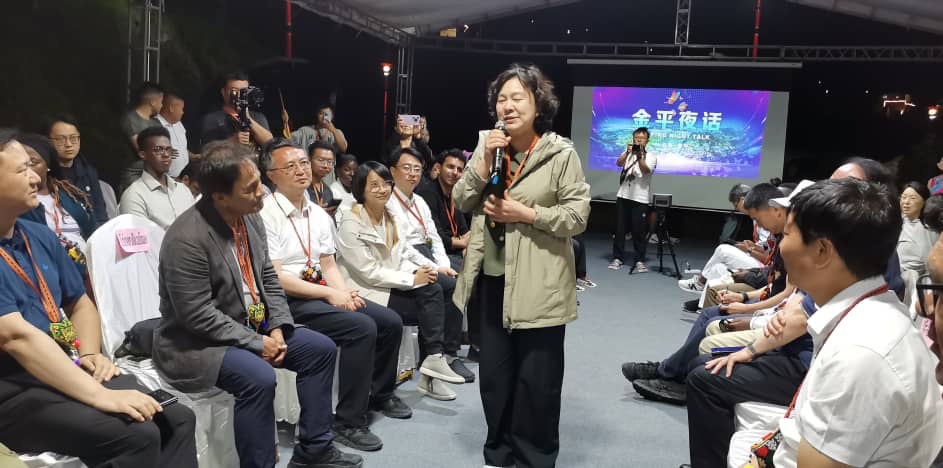
Meanwhile, Ms Hua Chunying, the Vice Minister of China’s Foreign Ministry, in an interaction with foreign journalists, on the sideline of her working visit to Jinping, affirmed the Government’s resolve to continue investing in the county in order to make life comfortable for the people.
“For 33 years, with the dedicated support of the Ministry, assistance of friendly foreign governments and institutions worldwide, as well as the collective efforts of compassionate individuals across society, Jinping has undergone a remarkable transformation.
“Today, the county has been revitalised that farmers’ income have grown substantially, living standards have improved dramatically, and public services in education, healthcare, and transportaion have been elevated.
“Boundless compassion warms the frontier, sincere dedication showers mountain villages. In these fleeting yet fruitful three decades, with the steadfast support from the Ministry and partners worldwide, Jinping has blossomed into a symbol of hope.
“We firmly believe our country’s future will shine brighter than ever,” says Ms Hua with a smile.
GNA
SOF