By Priscilla Oye Ofori
Accra, Sept. 4, GNA – Women leaders have been urged to leverage their influence, networks and leadership capital to drive community development beyond physical infrastructure, while creating sustainable opportunities for women, children and young people.
NanaHemaa A. Awindor, Nkosuohemaa of Afigya-Kwabre, made the call when she addressed Queenmothers and women leaders at a Gender and Women Leaders Short Course, organised by the Regent University College of Science and Technology (RUCST), in collaboration with the Obaapa Development Foundation and its partners.
The course sought to equip Queenmothers and women leaders with knowledge and skills in key areas, including laws and legal frameworks, gender theories and advocacy, basic information technology skills, and sustainable women and community health.
NanaHemaa Awindor, who is also the Executive Director of the Obaapa Development Foundation and External Relations Coordinator of Gh-UNIQ, said community development was often misconstrued as the provision of physical infrastructure.
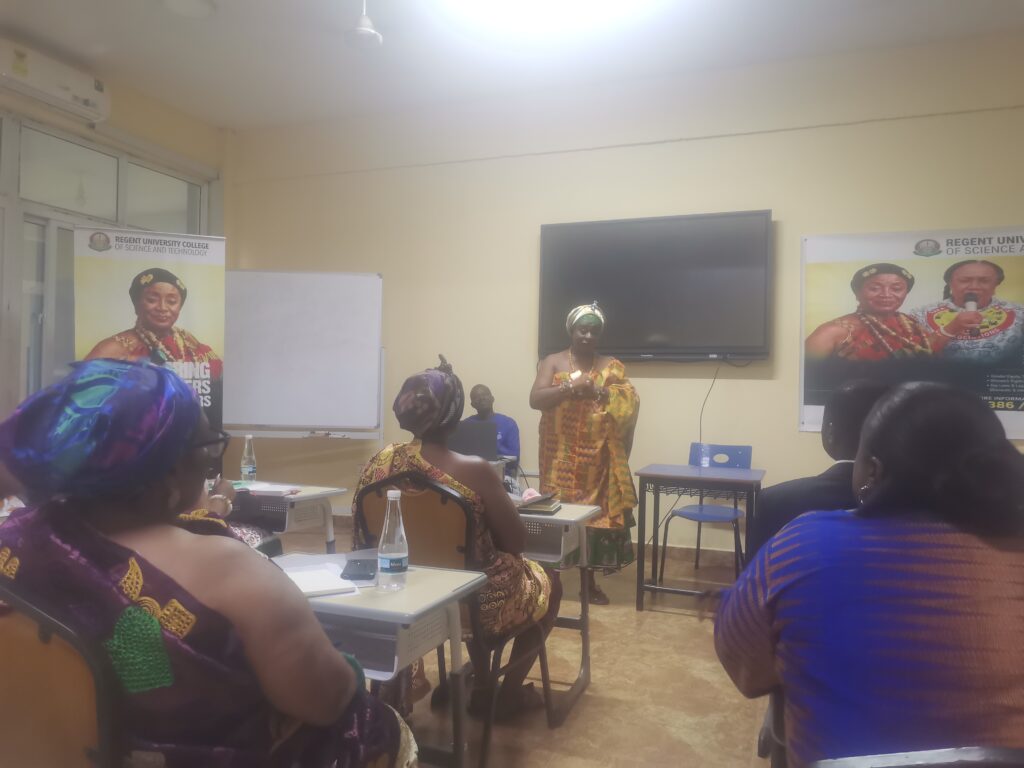
She noted that the absence of visible physical structures did not necessarily mean that development had not taken place.
Development, she noted, also encompassed institutional strengthening, creating educational opportunities, keeping girls in school, child protection and economic empowerment.
“When we do anything that will keep a girl in school, that is community development,” she said.
NanaHemaa Awindor emphasised that leadership capital, including convening power and influence, was a critical resource for community development beyond financial resources.
She said women leaders had the convening power to bring together women, parents and young people, as well as the networking power to deliberately connect and collaborate with others for greater impact.
She explained that resources were not limited to money as the ability to mobilise people, engage schoolchildren and institutions, connect stakeholders and build partnerships were equally powerful resources for development.
“Programmes may end, but leaders remain in the communities,” she said, stressing the need to strengthen the capacity of community leaders to understand issues, take action and sustain solutions.
Dr Nancy Ansah, Vice President of RUCST, described Queenmothers as a sustainable community structure for advancing the wellbeing of women and children in Ghana.
She said unlike politicians, “who come and go,” Queenmothers remained permanently in their communities and were often the first point of contact when issues affecting women and children arose.
“In fact, they are always contacted when there are issues of women and children in the community. So, if their capacity is enhanced, they are able to do more,” Dr Ansah said.
She stressed the importance of equipping Queenmothers with knowledge of laws and policies relating to gender-based violence, child marriage and reproductive health, to enable them to provide appropriate guidance when handling such cases.
Dr Ansah said strengthening the capacity of Queenmothers would enhance community-based response systems and ensure sustainable protection for women and girls.
She also urged leaders to demonstrate emotional intelligence, empathise with others and bring diverse groups together.
“Successful leaders are not necessarily those who confront aggressively, but those who demonstrate emotional intelligence,” she said.
Dr Ansah called for stronger coalition-building among women leaders, saying numbers gave strength to advocacy.
“When we all come together and we are making a demand, people listen. Democracy is numbers; when we have the numbers, our voice is stronger,” she said.
GNA
Edited by Agnes Boye-Doe