By James Amoh Junior
Accra, Sept. 3, GNA – The United Nations Capital Development Fund (UNCDF) and FIDO Microcredits Limited have commenced the second phase of partnership aimed at expanding access to innovative digital financial services.
It covers micro, small and medium-sized enterprises (MSMEs) in Ghana with particular focus on businesses led by women and young people.
The partnership forms part of a joint programme being implemented by UNCDF, the United Nations Development Programme (UNDP) and the United Nations Conference on Trade and Development (UNCTAD), in collaboration with the Ministry of Trade, Agribusiness and Industry, under the leadership of the UN Resident Coordinator.
The programme is funded by the Joint Sustainable Development Goals (SDG) Fund and seeks to support digital transformation and financial inclusion for MSMEs.
The Phase One intervention focused on leveraging digital ecosystems to increase MSME productivity, with youth and women-led MSMEs in Ghana identified as the target audience.
The strategic goal was to expand access to new or emerging digital financial services.
The project received a US$30,000 grant to support deep research and prototype solution development and conducted field research in the Western, Ashanti and Northern regions.
A total of 470 MSMEs were engaged directly during the field research, including six focus groups and nine key informant interviews.
The project also assessed the financial behaviours, needs and satisfaction levels of women- and youth-led businesses, while identifying operational gaps and opportunities affecting their direct access to and use of digital financial services.
A prototype was subsequently developed and tested with MSMEs in the field.
The intervention also supported the modification of FidoBiz by removing formal business documentation requirements to make access easier for informal businesses.
EasySave was opened to the public, while Fido Academy’s learning management system was scaled to the public.

The three solutions; Fido Credit, EasySave and Fido Academy, were positioned as key interventions to bridge the financial exclusion gap and accelerate financial literacy.
Under Phase Two, UNCDF is providing FIDO with a US$200,000 grant to enable it to scale its interventions, with an expectation that the funding would catalyse US$1 million in loans and savings.
Maame Yaa Owusu-Amoah, Technical Specialist, Digital Finance and Ecosystem, UNCDF, speaking at the signing of the second phase, said the organization’s responsibility under the programme was to increase access to innovative digital financial services.
She said FIDO was selected as one of five financial service providers to participate in Phase One after going through a rigorous selection process.
Ms Owusu-Amoah commended FIDO for its performance during the pilot, saying the project involved work in the Northern, Western and Ashanti regions, including a human-centred design exercise.
She said the first phase had provided useful experience for the partners and paved the way for the second phase, which would focus on scaling the interventions.
Ms Owusu-Amoah explained that the grant arrangement reflected the project’s leverage responsibility of one to four, meaning that for every dollar deployed by UNCDF, a minimum of an additional four dollars was expected to be catalysed.
She said the project was expected to end in July, leaving about a year or slightly less for FIDO to meet the target.
Ms Owusu-Amoah said international development assistance continued to diminish, encouraging FIDO to ensure that the financial services reached women and young people who needed them, particularly in communities that were not usually reached by such services.
She urged the team to extend its activities to underserved communities in the Northern Region and ensure that savings and loans were channelled to micro-businesses led by women and young people.
Mr Philip Twum, Head of Business Development at FIDO, said Phase One had successfully met its scaling target, and that the project had recorded 1,988 youth loans disbursed, with a total amount of GHS494,760.
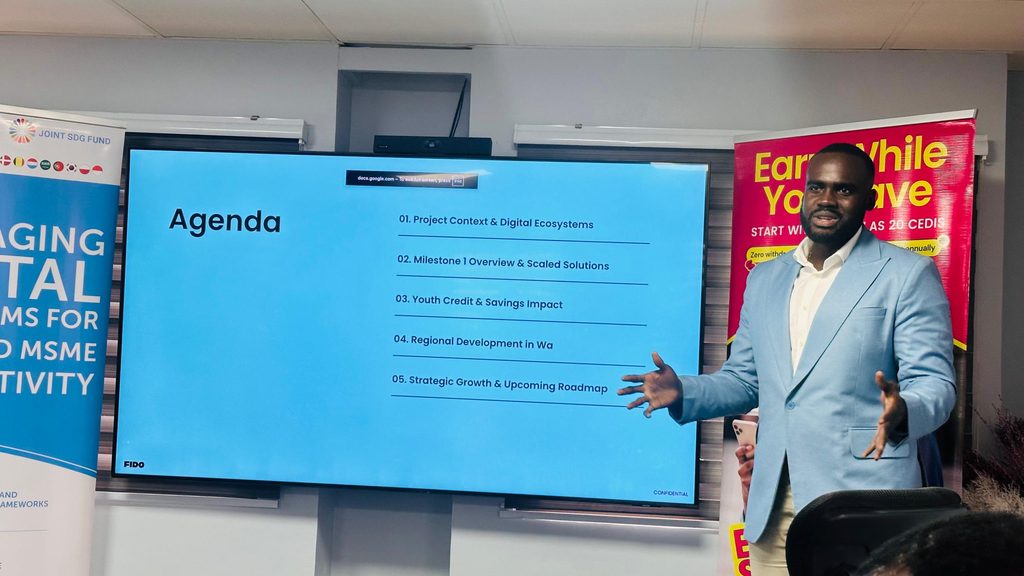
Mr Twum also reported that 1,762 new youth savings accounts had been opened, with a youth savings portfolio of GHS382,040.
The results, he said, were achieved through generic digital marketing efforts.
Mr Twum also said FIDO had sponsored the CPI project in Wa in the Upper West Region, with the objective of supporting young entrepreneurs in the Northern sector.
Ms Cynthia Prah, Head of the UN Communications Team at the UN Resident Coordinator’s Office, described the partnership between UNCDF and FIDO as an important milestone in implementing the joint programme on digital transformation and financial inclusion for MSMEs in Ghana.
She said joint programmes were an important vehicle for implementing Cooperation Framework priorities by turning shared analysis and commitments into coordinated support for national development and the SDGs.
Ms Prah said such programmes enabled the UN, particularly in a constrained financial environment, to present more coherent, catalytic and results-oriented solutions while strengthening resource mobilisation and partnerships around shared development goals.
She said the collaboration was helping to create an enabling ecosystem for MSMEs by linking policy reform, digital platforms and innovative financing solutions.
Ms Prah said the UN looked forward to continuing its collective efforts to ensure that Ghanaian entrepreneurs, particularly women and young people, had the tools, resources and opportunities needed to thrive.
GNA
Reporter: James Amoh Junior
Email: [email protected]
Edited by George-Ramsey Benamba