By James Amoh Junior, GNA
Accra, Sept. 29, GNA – The United States is seeking a gradual transition from long-term health assistance to greater country ownership and self-reliance, Mr Rolf Olson, Chargé d’Affaires of the U.S. Embassy in Accra, has said.
He said the approach was aimed at helping countries progressively assume responsibility for financing and managing their health programmes rather than remaining dependent on external assistance.
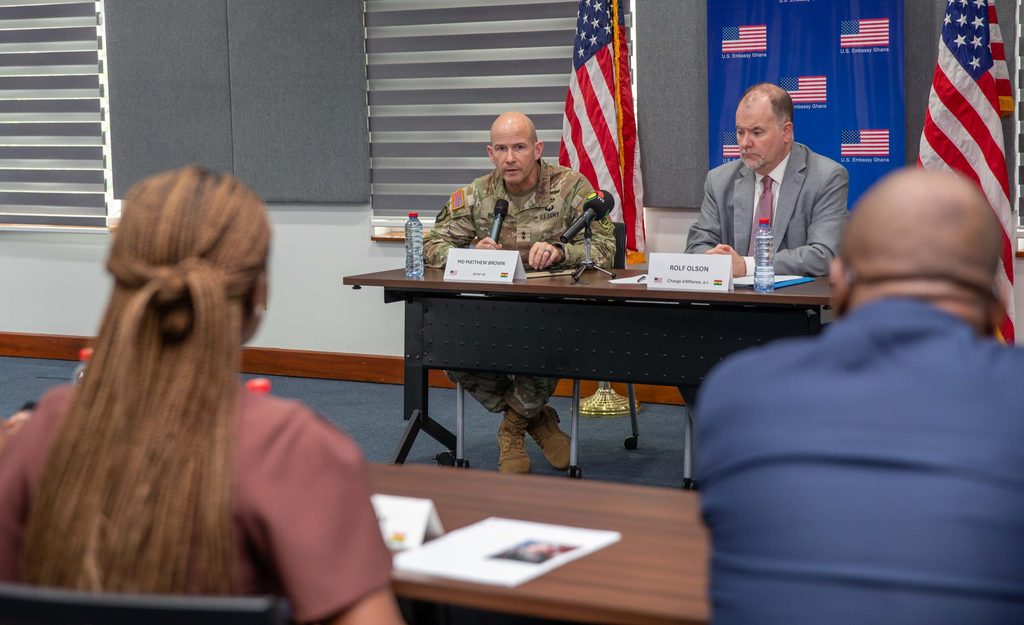
Mr Olson made the remarks during a media roundtable with selected journalists in Accra, where he explained the thinking behind the proposed bilateral health Memorandum of Understanding (MOU) between Ghana and the United States.
He said the proposed arrangement formed part of a broader shift in U.S. foreign assistance policy towards multi-year, co-investment agreements intended to strengthen the health sovereignty of partner countries.
Mr Olson said in September 2025, the U.S. Administration released the America First Global Health Strategy, which sought to strengthen bilateral relationships through multi-year co-investment agreements, prioritising trade over assistance and promoting U.S. health innovation.
The U.S. State Department had so far signed 35 bilateral global health MOUs, including 24 with sub-Saharan African countries, involving $24.6 billion in new health funding.
Of that amount, he said, more than $14.5 billion represented U.S. assistance, while more than $10.1 billion constituted co-investment from recipient countries.
The agreements were intended to strengthen the sovereignty of partner countries and gradually move them towards greater responsibility for their health systems.
“Through these agreements, our intention has always been to strengthen our partners’ sovereignty,” he said.
Mr Olson said the new approach prioritised “trade over assistance, and opportunity over dependency” and was intended to support countries to build sustainable systems rather than remain reliant on external financing.
He said the approach also aligned with Ghana’s own stated efforts towards greater health sovereignty.
“Contrary to some reporting, we did not immediately pull the plug and cut off all assistance in one fell swoop. Rather, we continued to invest in partner capacity so that we could transition programme accountability in a responsible manner,” he said.
He said the United States invested $82.5 million in Ghana during the first year of the new U.S. Administration and a further $53 million in Fiscal Year 2026.
He added that the United States had also been considering a final multi-million-dollar instalment for Fiscal Year 2027.
Mr Olson said the funding formed part of the broader transition towards greater country ownership and was not an abrupt termination of U.S. health assistance.
The proposed arrangement was therefore designed to gradually reduce U.S. health assistance over a number of years while allowing Ghana to strengthen its capacity to finance and manage its own health programmes.
“The MOU was an attempt to gradually decrease assistance over a period of years,” he said.
Mr Olson said the United States believed health assistance should ultimately help countries develop the capacity to take responsibility for their own health systems.
“It shouldn’t be about dependency. It should be about assistance to try to gradually, over time, help countries be able to be responsible for their own assistance for their own countries,” he said.
He cited the U.S. President’s Emergency Plan for AIDS Relief (PEPFAR), established more than two decades ago, as an example of an emergency response that had evolved into a long-running global health programme.
He said U.S. Secretary of State Marco Rubio had pointed to the word “emergency” in the programme’s name to illustrate the need for countries to eventually transition from external support towards greater ownership.
Mr Olson said the proposed MOU was intended to provide a structured and measured pathway for that transition, rather than an abrupt withdrawal of assistance.
Under the proposed arrangement, he said, funding would continue at the planned level initially before gradually declining over subsequent years, with the eventual objective of Ghana assuming greater responsibility for the programmes.
He said the proposed agreements with partner countries were not identical, as the details were negotiated at country level and took into account each country’s circumstances and the nature of the health programmes already being supported.
“The particular details are not necessarily the same in every single case, because they were negotiated at the country level,” he said.
Mr Olson said negotiations between Ghana and the United States had continued for several months, describing the discussions as robust and conducted in good faith.
The comments come against the background of Ghana’s decision to reject the proposed health compact, with President John Dramani Mahama saying some of the conditions attached to the agreement were unacceptable.
President Mahama, speaking at the Council on Foreign Relations in New York, said the proposal, which was intended to replace some health funding previously provided through the United States Agency for International Development (USAID), had been reviewed by the Ministry of Health before being submitted to Cabinet.
The Ministry identified concerns relating to Ghana’s health data, financing obligations and regulatory authority, he added.
The President said the proposed agreement required Ghana to provide the United States with its pathogen profile and medical records and to commit a specified amount of counterpart funding.
The agreement, he noted, contained provisions under which medicines and other medical products supplied under the programme would not be subject to inspection by Ghana’s Food and Drugs Authority.
President Mahama said those provisions contributed to Cabinet’s decision to reject the agreement and directed the Minister of Health to communicate Ghana’s position to the U.S. Ambassador.
The development has brought renewed attention to Ghana’s dependence on external financing for key health programmes and the need to strengthen domestic capacity to sustain those programmes.
President Mahama has subsequently advocated greater health self-reliance under the Accra Reset initiative, including increased domestic production of medicines and vaccines, stronger research capacity and health systems that were less dependent on external financing.
Mr Olson, however, said the United States remained proud of its contribution to Ghana’s health sector and the impact of its investments over the years.
He said U.S. health assistance had contributed to significant improvements in health outcomes, including a substantial decline in malaria among children and progress in the fight against HIV/AIDS.
He cited the global impact of PEPFAR, saying data presented during the programme’s 20th anniversary showed that about 25 million lives had been saved.
“For us, the way we think about this is obviously that the dollar terms are always what drives the fundamental programme, but the reality of what matters ultimately is lives,” he said.
He said the funding level for Ghana was not arbitrarily determined but was based on a variety of factors, particularly the health assistance already being provided in the country.
Mr Olson said the United States remained opened to engagement with Ghana on issues of mutual interest.
GNA
Edited by Agnes Boye-Doe
Reporter: James Amoh Junior
Email: [email protected]