By Hafsa Obeng
Accra, Sept. 23, GNA – Dr Zaneto Agyeman-Rawlings, Minister of Environment, Science, Technology and Innovation, has called for stronger collaboration between the Council for Scientific and Industrial Research (CSIR), government and the private sector to translate research into commercially viable products for national development.
She said there was the need to bridge the gap between scientific research and the public to enable Ghanaians and the private sector to understand, access and benefit from innovations developed by Ghanaian scientists and researchers.
Dr Agyeman-Rawlings made the call when she paid a working visit to the CSIR in Accra as part of her familiarisation tour of agencies and institutions under the Ministry.
The tour, she said, was intended to enable her to better understand the environment, people and work of the agencies through direct and interactive engagements.
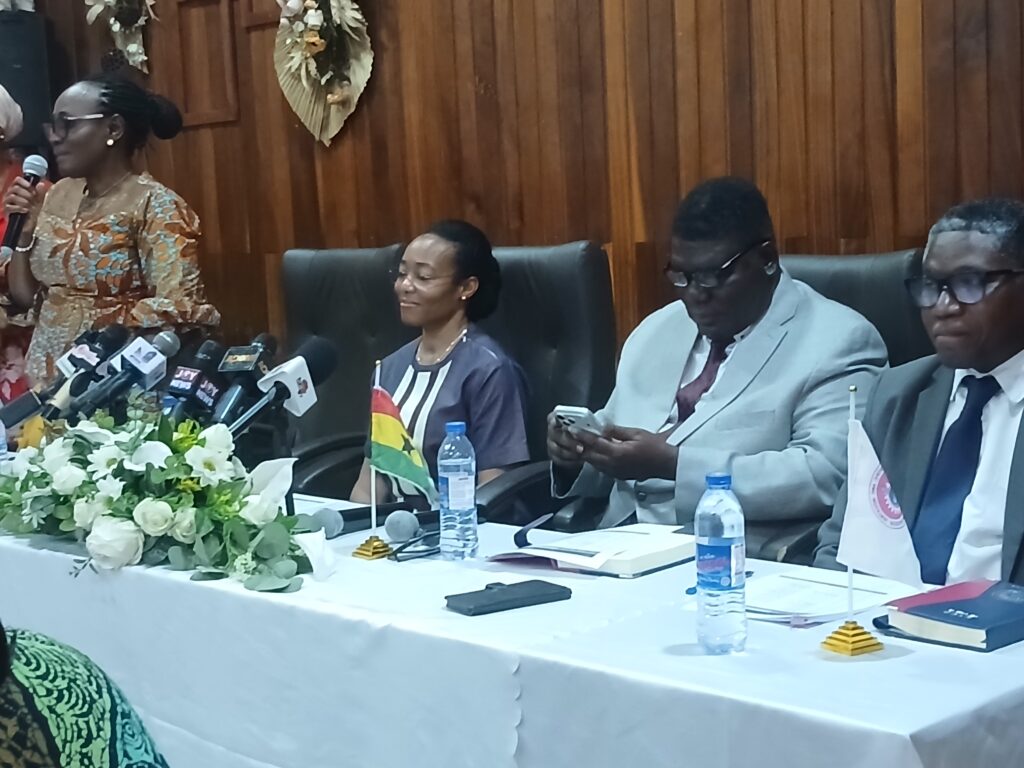
The Minister said the CSIR had immense potential to contribute to Ghana’s development, noting that the institution already had expertise and research covering a wide range of sectors.
“There’s a disconnect between research and academia and the public. Because of that disconnect, sometimes it’s difficult for us to help the private sector tap into what you’re doing,” she said.
She therefore urged the CSIR to work closely with the Ministry’s Public Relations Directorate to showcase its research, innovations and products at the Ministry and through its communication platforms.
Dr Agyeman-Rawlings said the Ministry intended to display samples of products developed by CSIR institutes, including agricultural products, cereals and other innovations, at its reception to enable visitors to see and appreciate the institution’s work.
“We want people to know who you are. We want people to know what you do. We want us to celebrate your scientists, your researchers,” she said.
She said the Ministry would also use its social media platforms, screens, display panels and website to showcase the work of scientists and researchers.

The Minister said the initiative would make science more relatable, particularly to young people, and encourage them to consider science as a broad career field with practical applications.
She said the Ministry was also working to make its website more engaging, including featuring scientists of the month, quarter or year and their research.
Dr Agyeman-Rawlings said CSIR research must move beyond publication to practical application, commercialisation and job creation.
“It’s time we move forward in terms of how we support what you do and commercialise it at home and tap into the presence of the African Continental Free Trade Area and see how we can make use of that platform to send your knowledge and technology across this continent,” she said.
The Minister expressed concern that Ghana sometimes sought technologies from outside the country when similar solutions already exist within CSIR.
She said the country needed to identify and support existing local technologies and create opportunities for the private sector to invest in and commercialise them.
Dr Agyeman-Rawlings also called for increased attention to research and development, saying Ghana needed to work towards the African Union’s target of spending one per cent of Gross Domestic Product on research and development.
She said although funding constraints remained a challenge, scientists and researchers also needed to make a stronger case for investment by demonstrating the practical and economic value of their work.
The Minister said she was particularly interested in research and pilot projects that could support the remediation of degraded lands, purification of polluted water bodies and protection of the environment.
She encouraged the various CSIR institutes to review their research archives and identify innovations that could be showcased and developed into scalable and economically viable projects.
Dr Agyeman-Rawlings said such initiatives would help Ghana attract funding for projects capable of producing measurable results while safeguarding the environment for future generations.
She also acknowledged concerns raised about retaining scientists and researchers, saying conditions of service were important but would have to be considered within the broader context of the institution’s financial sustainability.
“If you can commercialise what you do and we can make a case for you retaining more of what you get, you can decide on how to improve your conditions. So it’s a collaborative effort,” she said.
She urged CSIR staff to communicate their challenges openly to the Ministry but, where possible, accompany those challenges with proposed solutions.
Dr Agyeman-Rawlings said she looked forward to visiting all 13 CSIR institutes across the country to understand their research, challenges and potential contributions to national development.
Prof. Paul P. Bosu, Director-General of CSIR, said the Minister’s visit was particularly significant at a time when Ghana was looking with renewed urgency to science, technology and innovation as instruments for addressing national challenges and accelerating socio-economic development.
He said CSIR had built a rich reservoir of scientific expertise over nearly seven decades in agriculture, natural resources, environment, industry, energy, food and nutrition, biotechnology and other areas critical to national development.
Prof. Bosu said climate change, new technologies, artificial intelligence, biotechnology and advanced materials were transforming economies and creating new opportunities.
“Ghana cannot afford to be merely a consumer of knowledge and technology. We must increasingly become a producer, an innovator and a problem solver,” he said.
He said CSIR was ready to become an even stronger partner to government by providing scientific evidence for policymaking, developing technologies to address national needs, supporting industry and entrepreneurship, and promoting commercialisation.
Prof. Bosu said the institution had 13 specialised institutes located in Accra, Kumasi, Bunsu, Kade, Nyankpala and other parts of the country, supported by about 60 field stations.
He invited the Minister to visit the institutes to gain first-hand knowledge of the breadth of CSIR’s work.
Ing. Mark Taylor, Chairman of the CSIR Governing Council, said the institution remained committed to turning research into practical solutions for Ghana’s development.
He said CSIR faced challenges including the retention of scientific talent, inadequate research logistics and infrastructure, environmental degradation and the need to move research outputs into commercial ventures.
He said CSIR was ready to provide technical support for efforts to restore forests and polluted water bodies and to develop alternative livelihood strategies.
Ing. Taylor said the Council looked forward to working with the Minister to strengthen research, innovation and industrial development.
GNA
Edited by Kenneth Odeng Adade
Reporter: Hafsa Obeng