By Edward Dankwah
Accra, Sept. 23, GNA – The Fisheries Commission (FC) has inaugurated two national-level fisheries co-management committees to strengthen participatory, science-based and coordinated management of Ghana’s fisheries resources.
The committees, the Scientific and Technical Committee (STC) and the Fisheries Management Operational Committee (FMOC), were inaugurated separately at the Fisheries Commission Conference Room in Accra.
A statement issued in Accra said the initiative was supported by Global Fisheries and Resilience Action (GFRA) under the Inshore Exclusion Zone Enforcement and Transparency (IEZET) Project.
It said the inauguration formed part of efforts to align Ghana’s fisheries co-management structures with the Fisheries and Aquaculture Act, 2025 (Act 1146), and strengthen their institutional and legal basis.
Under Sections 11 and 13 of the Act, the Governing Board of the Fisheries Commission is empowered to establish committees, including co-management committees, to support the effective management of fisheries resources.
Professor Benjamin Campion, Executive Director of the Fisheries Commission, explained the governance arrangements under the new law and outlined the respective roles of the Governing Board, the Commission and the Ministry of Fisheries and Aquaculture.
Professor Wisdom Akpalu, Chairman of the Governing Board, said the committees were important for strengthening science-based, evidence-informed and participatory fisheries management.
He urged members to critically assess scientific and technical recommendations submitted to the committees to support sustainable fisheries management.
The STC, chaired by Dr Angela Lamptey, would provide scientific and technical advice to inform fisheries management decisions, with its mandate expanded to cover inland fisheries and aquaculture in addition to marine fisheries.
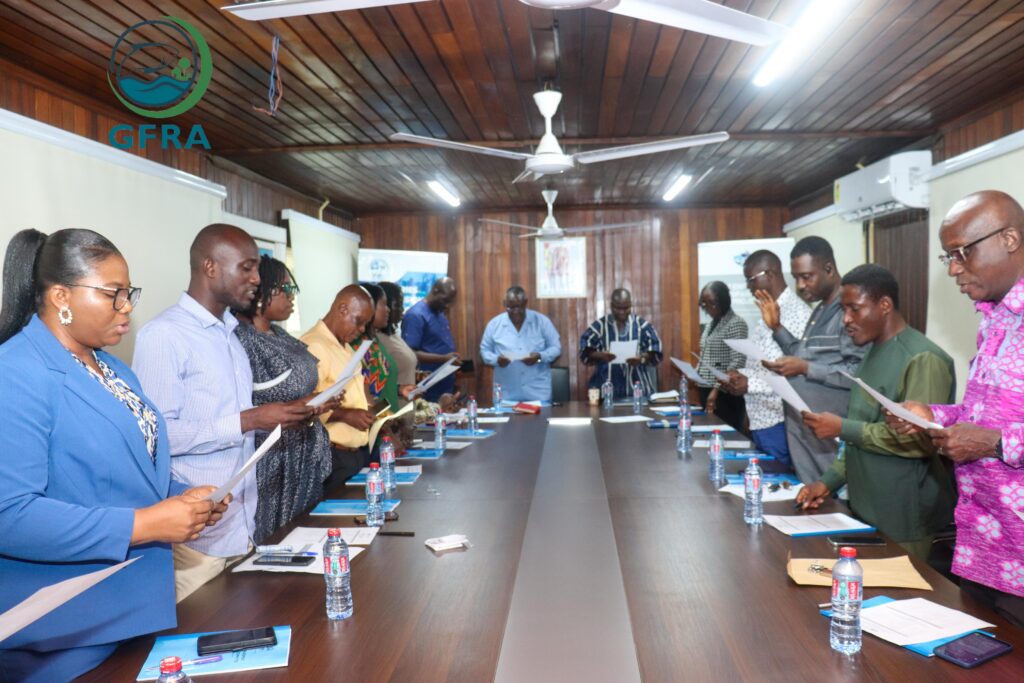
Mr Daniel Owusu, who chairs the FMOC, said the Committee would translate scientific and technical advice into coordinated operational action, including developing annual implementation plans and coordinating relevant divisions of the Commission and stakeholder institutions.
Together, the committees are expected to strengthen the link between scientific advice and fisheries management implementation while providing platforms for collaboration among government institutions, technical experts and fisheries stakeholders.
GFRA, an organisation focused on sustainable development and community resilience, is implementing the IEZET Project with the Environmental Justice Foundation and Hen Mpoano to support implementation of key provisions of the Fisheries and Aquaculture Act, including enforcement of the extended Inshore Exclusion Zone and fisheries transparency measures.
GNA
Edited by Kenneth Odeng Adade