By Eric Appah Marfo
Accra, July 30, GNA – The United Nations Industrial Development Organisation (UNIDO) has urged Ghana’s financial institutions to increase financing for businesses driving the country’s transition to a circular economy.
The organisation said access to capital would be critical to expanding enterprises engaged in recycling, resource efficiency and sustainable production.
Mr Eric Gyenin, UNIDO Country Coordinator and Coordinator of the Ghana Circular Economy Centre (GCEC) Project, made the call at the opening of a capacity-building programme for representatives of banks and other financial institutions in Accra.
“Our economy has been linear for many years, but government wants to change the story,” he said, adding that what many people considered waste could become valuable resources for new production.
Mr Gyenin said Ghana’s transition from the traditional “take, make and dispose” model would require stronger collaboration among government, industry and the financial sector.
He said financial institutions had consistently identified regulatory certainty and stronger government policies as key requirements for reducing investment risks and expanding financing for circular economy enterprises, particularly those operating in the informal sector.
The training programme forms part of the Ghana Circular Economy Centre Project, which seeks to equip financial institutions with the knowledge and tools to develop financing products for circular economy businesses.
Mr Gyenin said the initiative was focusing on plastics, textiles and agro-waste value chains and was expected to incubate about 200 new circular economy businesses while supporting more than 100 existing small and medium-sized enterprises to adopt circular business models.
He said the project had conducted 12 training sessions across the country for about 360 financial sector professionals, with the Accra programme marking the final phase of the nationwide engagement.
Presenting on financing opportunities, Mr Kwame Baffoe Ababio of Deloitte Ghana urged Africa to embrace circular economy finance, projecting 11 million jobs and US$66 billion Gross Domestic Product contribution by 2030.
Introducing participants to the concept, he explained the need to move from the traditional linear model of “take, make and dispose” to one that eliminated waste, kept products and materials in use, and regenerated natural systems.
Mr Ababio said the current model had contributed to resource depletion, greenhouse gas emissions and supply chain risks, while the circular economy presented significant opportunities for job creation, investment and sustainable growth.
He said that Ghana would require an estimated US$2.5 billion to finance its transition and highlighted policy initiatives and financing mechanisms already supporting the country’s circular economy agenda.
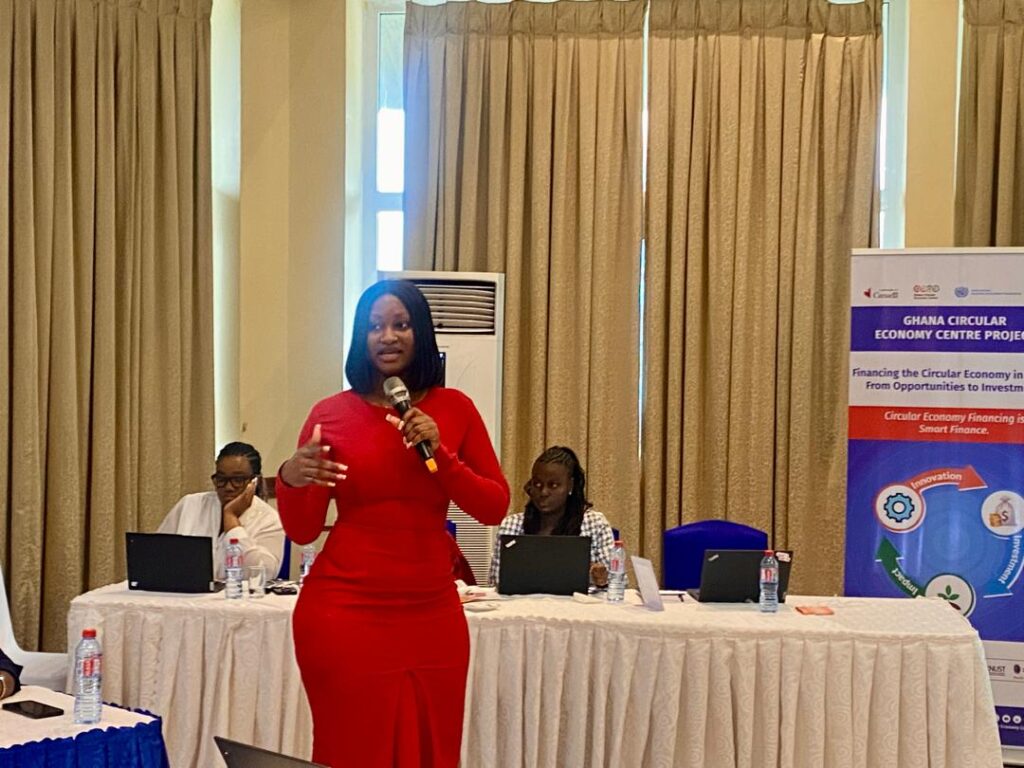
Ms Sisley Puorideme of Deloitte Ghana said policy uncertainty, limited technical expertise,
inadequate market data and collateral-based lending continued to constrain investment in circular economy businesses.
She called for blended finance, credit guarantees and stronger collaboration among government, development partners and financial institutions to reduce investment risks.
Ms Curlcy Afua Amandi of Deloitte Ghana urged financial institutions to design financing products that addressed the needs of micro, small and medium-sized enterprises, women, youth and businesses operating in the informal sector.
The GCEC Project is funded by the Government of Canada through Global Affairs Canada and implemented by UNIDO in partnership with the Ministry of Environment, Science and Technology, the Environmental Protection Agency, Ho Technical University, the Kwame Nkrumah University of Science and Technology, the University of Cape Coast and OR Foundation.
GNA
Edited by Kenneth Sackey
Reporter: Eric Appah Marfo