By Edward Dankwah
Accra, July 28, GNA – Alhaji Amin Abdul-Rahman, the Chief Director, Ministry of Local Government, Chieftaincy and Religious (MLGCRA), says the true measure of success of Ghana’s National Urban Policy (2026–2035) and the National Slum Upgrading and Prevention Strategy (2026–2035) will not be the quality of the policy documents alone, but the effectiveness of their implementation.
He said the two frameworks provided a clear roadmap for managing Ghana’s rapidly changing urban landscape through sustainable growth, improved land use planning, climate resilience, affordable housing, enhanced urban services and the prevention and upgrading of informal settlements.
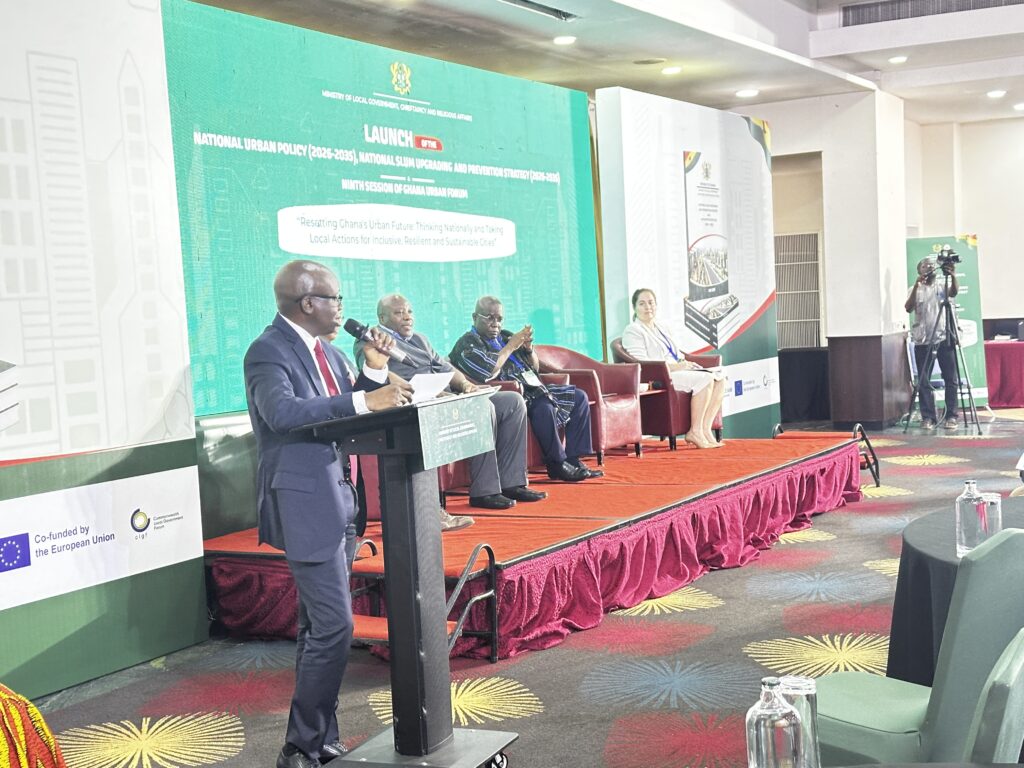
The Chief Director was speaking at the launch of the National Urban Policy (2026 – 2035) and the National Slum Upgrading and Prevention Strategy (2026 – 2035), during the opening ceremony of the Ninth Session of the Ghana Urban Forum, in Accra.
It was held under the theme, “Resetting Ghana’s Urban Future: Thinking Nationally and Taking Local Actions for Inclusive, Resilient, and Sustainable Cities.”
Alhaji Abdul-Rahman, speaking on behalf of Mr. Ahmed Ibrahim, the Sector Minister, said described the occasion as a renewed national commitment to shaping the future of Ghana’s towns and cities through deliberate, coordinated and inclusive action.
He noted that Ghana’s urbanisation had created significant opportunities for economic growth, innovation, trade and job creation but had also brought challenges including housing deficits, infrastructure gaps, congestion, flooding, environmental degradation and the expansion of informal settlements.
“The maiden National Urban Policy introduced in 2012 provided an important framework for addressing these challenges and guided interventions that strengthened urban governance, infrastructure development, mobility, resilience and service delivery across the country,” he added.
The Chief Director said lessons from more than a decade of implementation informed the development of the new two frameworks, following a comprehensive review involving government institutions, local authorities, academia, professional bodies, development partners and civil society organisations.
He said the new National Urban Policy sought to promote sustainable and balanced urban growth, effective land use planning and management, climate resilience, environmental sustainability, urban economic development, improved infrastructure financing, affordable housing, urban safety and equitable access to essential services.
He added that the National Slum Upgrading and Prevention Strategy responded to the realities faced by residents of informal settlements, by providing a framework for integrated slum upgrading, improved service delivery, stronger land and housing management systems, enhanced community participation and measures to prevent the emergence of new slums.
Alhaji Abdul-Rahman stressed that successful urban development could not be achieved by government alone, but required stronger collaboration among central and local government institutions, traditional and religious leaders, development partners, the private sector and citizens.
He commended institutions and partners that contributed to the development of the frameworks, particularly technical agencies, local authorities, professional bodies and development partners including UN-Habitat, the World Bank, the European Union, UNICEF and UK-FCDO.
Alhaji Abdul-Rahman urged Metropolitan, Municipal and District Assemblies to integrate the two frameworks into their development plans and budgets, while calling on development partners, the private sector and citizens to support efforts to build cleaner, safer and more resilient communities.
He assured President John Dramani Mahama and the people of Ghana that the Ministry would coordinate the implementation, monitoring and evaluation of both frameworks to ensure they guided investments, strengthened institutions and improved the quality of life of Ghanaians.
Mr. Kenneth Gilbert Adjei, the Minister for Works, Housing and Water Resources, said cities were the engines of economic growth, centres of innovation, and hubs of opportunity, yet they faced mounting challenges, including housing deficits, inadequate infrastructure, traffic congestion, environmental degradation, and the growing impacts of climate change.
He said the Ministry viewed themselves as a key partner in realizing the objectives of the National Urban Policy, given their mandate in the provision of housing, public infrastructure, water resources management, and other essential services that underpinned sustainable urban development.
“I am pleased to announce that the Ministry has commenced review of the National Housing Policy. The revised Policy will align with the vision and aspirations of the National Urban Policy and provide a modern framework to address Ghana’s evolving housing needs”
“It will respond to the realities of rapid urbanisation by promoting affordable housing, climate-responsive settlements, innovative approaches to housing delivery and stronger partnerships between government, the private sector and development partners,” he stressed.
Mr. Adjei said more importantly, it would support the development of complete communities where housing was integrated with infrastructure, water supply, sanitation and other essential services.
GNA
Edited by Benjamin Mensah