By Stephen Asante
Accra, May 31, GNA – Justice Sir Dennis Dominic Adjei, a Justice of Ghana’s Supreme Court and the African Court on Human and Peoples’ Rights, has called on the nation to leveraged the transformative influence of music on human rights and environmental consciousness.
“Ultimately, music allows us to express emotions and advocate for justice in ways that words alone cannot, making it an indispensable partner in our effort to build a more informed and just society,” he said.
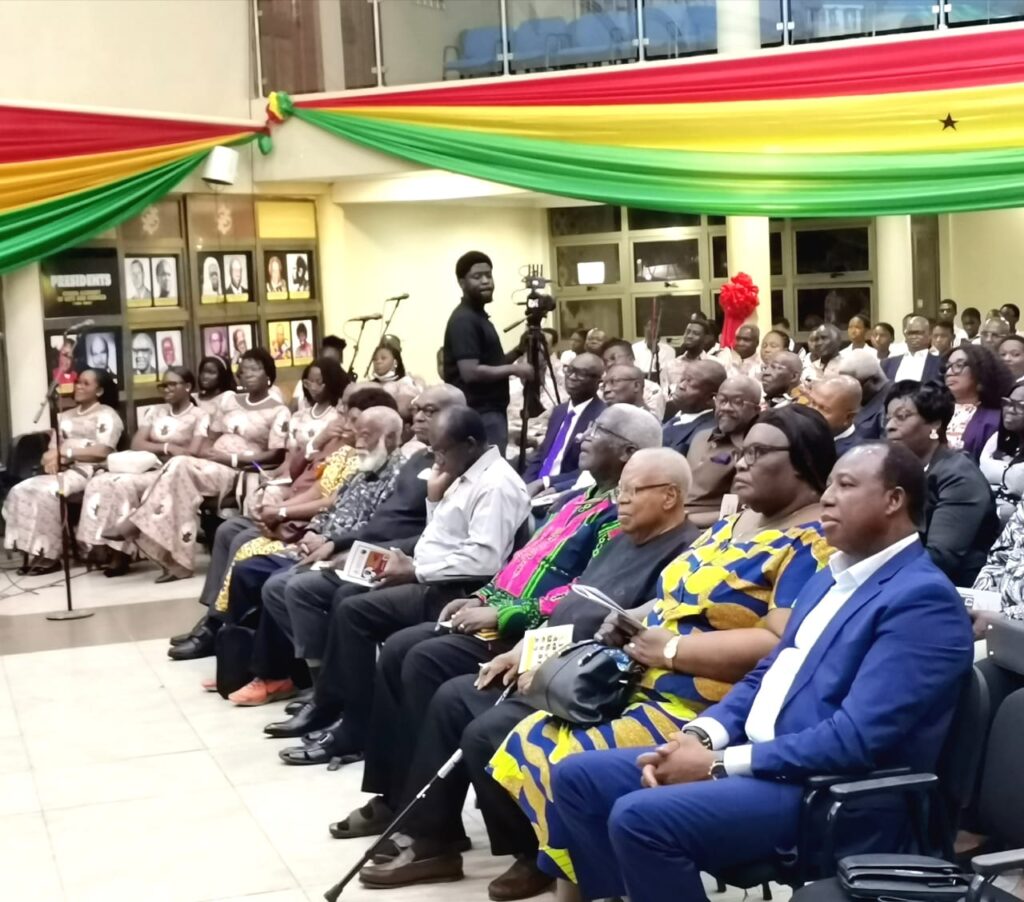
Speaking on the topic ‘Advancing Human Rights through Music’ at the Ephraim Amu Memorial Lecture 2026 in Accra, the legal luminary said evidence had shown that music often left a more lasting impression than the spoken word.
The Ghana Academy of Arts and Sciences (GAAS) organised the lecture, aiming to highlight music as a powerful and essential tool for learning and retention.
Chaired by Emerita Professor Takyiwaa Manuh, Vice President of GAAS’ Arts Section, the programme sought to provide an in-depth analysis of human rights, and songs that have been composed to address human rights principles from both national and international spheres.
It served as a platform to critique and comment on injustices emanating from human rights abuses by advocating and lobbying policymakers for policy changes, particularly to address environmental degradation and illegal mining.
In his presentation, Justice Sir Adjei linked the importance of music to all aspects of life, such as sickness, joy, sadness, poverty and riches, and its propensity for calming the passionate, encouraging the despairing and humbling the proud.
His references included the theories and feasibility studies by great philosophers and theologians, including Plato, Confucius, Saint Augustine of Hippo, Martin Luther, Charles Wesley and John Wesley.
The Supreme Court Judge indicated that countries worldwide used music to project their national anthems for several reasons, to evoke memories and feelings “that words and printed information cannot”.
“A national anthem, as a symbol of national identity, is sung to evoke history, patriotism and unity. The national anthem, as a universal song, achieves its objective through an inspiring message conveyed by its melody and lyrics, making it easier to remember and sing with national pride,” he explained.
That, he said, was critical as those experiences reflected the identities and cultures of people of a common heritage.
“By utilising music across platforms, from traditional festivals to modern social media, we can effectively disseminate information about our fundamental rights and duties,” he added.
Justice Sir Adjei called for the integration of human rights content into mainstream Ghanaian music.
That should be done using local languages and genres such as gospel and hiplife to appeal to people living in both rural and urban areas, he advised, saying music served as therapy in helping the vulnerable to withstand their physical, emotional or cognitive challenges, and express feelings and emotions that words could not.
On environmental degradation, he proposed that the Ministry of Lands and Natural Resources, in its quest to fight illegal mining (galamsey), should consider providing funding to integrate human rights content in songs that dealt with the destruction of the ecology and biodiversity.
“Encourage and reward musicians who engage in rights advocacy, as well as television and radio stations that play that music during prime time, with tax waivers. The festivals that use music to name and shame wrongdoers in their respective communities, such as the ‘Apoo’ and ‘Alolue’ festivals celebrated by the people of Bono(Techiman) and Sefwi, respectively, shall be used to fight galamsey kingpins within their communities,” he said.
The lecture was in honour of the Ghanaian legend, Ephraim Amu, a renowned musicologist who used music to promote unity, culture, human rights, patriotism and the propagation of Christianity.
Born on September 13, 1889, at Peki-Avatime in the Volta Region of Ghana, he taught music at Achimota School and the University of Ghana, and produced great musicians who have also impacted others.
He used local musical instruments, such as the atenteben (a bamboo flute), to produce melodious songs.
In total, the music legend reportedly composed over 200 songs in Twi, Ewe and English, including ‘Yen ara Asaasi Ni (Mia denyigba lolo)’, ‘Onipa da so ho so’, ‘Asem yi di ka’, ‘Biako Ye’, ‘Bonwire Kente’, ‘Esrom Miele’, ‘Ko Na Kotutu’, ‘Adikanfo Mo’, ‘Dzodzoenyenye’, ‘Enye Yen Nyame’, ‘Mo Mma Yen Nkoso Mforo’, ‘Adawura abo me’, ‘Fare thee well’, ‘Yetu Osa’ and ‘Israel Hene’.
The songs composed by Amu were mainly patriotic, human rights and religious, reflecting his background as a catechist, teacher and musicologist who taught Christianity in an African way, and succeeded in imparting patriotism, human rights and Christianity among Ghanaians.
He died on January 2, 1995, at the prime age of 96.
The central theme of Amu’s music sought to appeal to the conscience of the masses, raising awareness and mobilising people to take action for the betterment of society.
GNA
May 31, 2026
Reporter: Stephen Asante
[email protected]
Edited by Samuel Osei-Frempong