By Edward Dankwah
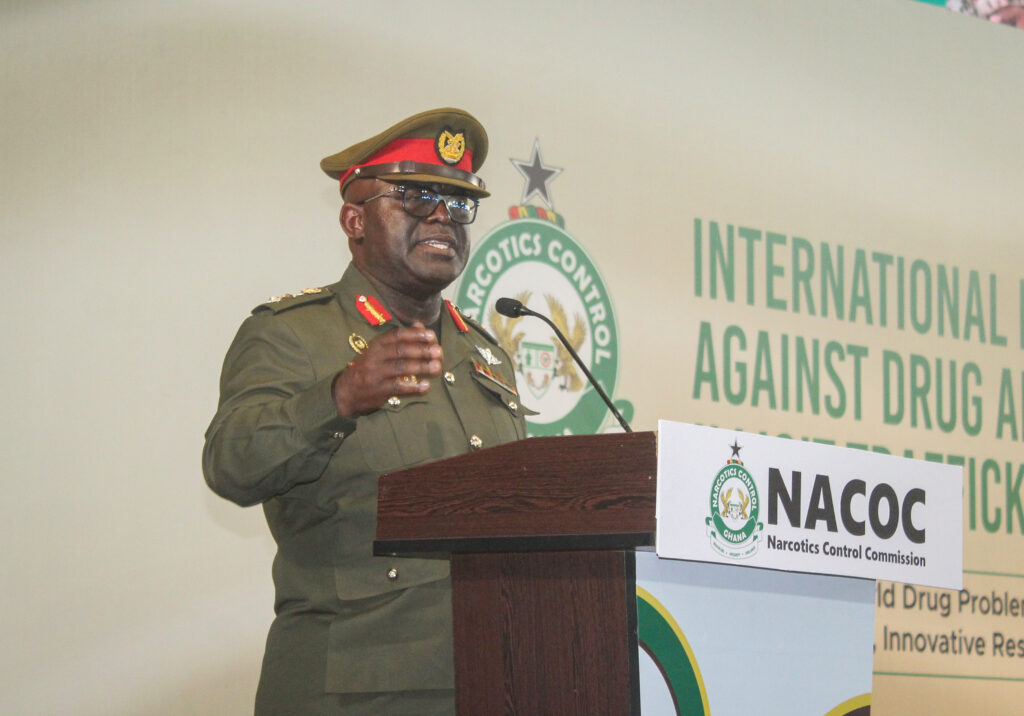
Accra, June 27, GNA – Brigadier General Maxwell Obuba Mantey, Director-General, Narcotics Control Commission (NACOC), has issued a stern warning to all drug dealers, declaring that Ghana will not be allowed to serve as a safe operating base for illicit drug networks.
He said the evolving nature of the global drug trade demanded an equally adaptive and aggressive response from law enforcement and policy actors, stressing that both long-standing and emerging drug threats were intensifying at an alarming rate.
The Director-General was speaking at the International Day Against Drug Abuse And Illicit Trafficking (World Drug Day) 2026, on the theme, “The World Drug Problem: Persisting Issues, New Challenges, Innovative Responses, in Accra.”
Citing the 2025 World Drug Report by the UN Office on Drugs and Crime (UNODC), Brigadier General Mantey revealed that about 316 million people globally used illicit drugs in 2023, with the illegal drug economy generating hundreds of billions of dollars annually.
He warned that West Africa, and Ghana in particular, had become deeply embedded in global trafficking routes.
“According to the Global Initiative Against Transnational Organised Crime, as much as 30 per cent of Europe’s cocaine could be transited through West Africa. Ghana sits at the centre of that corridor,” he stated.
The Director-General further disclosed a worrying shift in Ghana’s drug landscape, noting that the country was no longer just a transit hub but increasingly a consumption and distribution market.
He highlighted evolving trafficking tactics, including the concealment of methamphetamine in charcoal bags and the use of encrypted digital marketplaces by criminal syndicates.
Brigadier General Mantey credited recent operational gains to increased government support under the administration of President John Dramani Mahama, noting significant investments in NACOC’s capacity.
In addition, he revealed ongoing efforts to install modern drug detection scanners at the Accra International Airport through collaboration between the Government of Ghana and the Kingdom of the Netherlands, expected to be fully operational by August 2026.
“A new Drug Forensic Laboratory is also being developed to strengthen scientific analysis of controlled substances and improve prosecution outcomes,” he added.
The Director-General raised alarm over findings from mandatory drug screening of applicants to Ghana’s security services, revealing that over 6,000 candidates, about 7 per cent tested positive for substances including cannabis, cocaine, methamphetamine, and opioids.
“This is not a cause for despair. It is a cause for urgent, systematic action,” he said, calling for permanent drug screening in all security recruitment processes.
Between 2025 and April 2026, NACOC recorded 217 arrests, 165 prosecutions, and the seizure of more than 8.5 tonnes of narcotic drugs.
The Commission also intercepted 45.4 million tramadol tablets within the same period.
Brigadier General Mantey disclosed that 1,179 individuals received treatment and counselling in 2025 across 30 centres nationwide, with most cases involving cannabis, cocaine, opioids, and alcohol, with 85 per cent of clients between the ages of 20 and 44.
However, he said treatment infrastructure remained inadequate, calling for the establishment of more rehabilitation centres and stronger community-based care systems.
He highlighted the absence of a national drug prevalence baseline survey, describing it as a major policy gap that limited effective planning and response.
The Director-General announced plans, in partnership with UNODC and national research institutions, to complete Ghana’s first comprehensive drug prevalence survey by 2027, alongside a national early warning system for synthetic drugs.
“To every trafficker, every syndicate, every network that thinks Ghana is open for business: we are coming for you,” he warned.
He called for national unity in the fight against narcotics, adding that Ghana’s future “is not negotiable.”
GNA
Edited by Kenneth Odeng Adade