By Anthony Adongo Apubeo
Tarikom (U/E), June 26, GNA – The Economic Community of West African States (ECOWAS), in collaboration with the Government of Ghana, has commissioned boreholes and provided livelihood skills training and start-up support to refugees and host communities in the Bawku West District.
Four boreholes have been provided for both refugees currently hosted at Tarikom and the host communities, while beneficiaries have been provided with skills training such as tailoring, soap making, bakery, shea butter processing, goat rearing, barbering and petty trading, among others.
The intervention formed part of the ECOWAS-Ghana Joint Support Project for Persons of Concern, implemented by Right to Be Free, a non-governmental organisation, in partnership with the Ghana Refugee Board (GRB) and the National Disaster Management Organisation (NADMO).
The project sought to improve access to water, strengthen livelihoods and enhance the resilience of refugees, returnees, internally displaced persons and vulnerable members of host communities.
Speaking at the commissioning ceremony at the Tarikom Refugee Settlement Centre, Ambassador Mohammed Lawan Gana, Resident Representative of ECOWAS in Ghana, said the initiative reflected the regional body’s commitment to supporting vulnerable populations across West Africa.
He explained that the project included the provision of potable water through boreholes, rehabilitation of schools and livelihood support for refugees and other persons of concern.
“We are here in this refugee camp to assist refugees and returnees to enable them to settle down. We have provided food supplies and start-up kits for people with skills so they can generate income and support themselves,” he said.
Ambassador Gana noted that the intervention aligned with ECOWAS’ vision of transitioning from “an ECOWAS of states to an ECOWAS of people,” ensuring that vulnerable populations were not left behind in the region’s development agenda.
He added that despite reductions in international donor funding, ECOWAS had mobilised resources internally to sustain critical humanitarian interventions across member states.
Dr Nasibatu Taahira-Swallah, Deputy Executive Secretary of the Ghana Refugee Board, said the project was helping refugees move from aid dependency to self-reliance and resilience.
She said women refugees had received training in shea butter processing, bakery and other income-generating activities, which was contributing to improving their economic independence.
“Currently, we are facing funding cuts from UNHCR, so we are gradually moving from aid dependence to self-reliance and resilience. These livelihood support programmes are helping refugees support themselves and their families,” she said.
Dr Taahira-Swallah indicated that the construction of boreholes for both refugees and host communities, and the involvement of the host communities in the project, was a strategy aimed at promoting peaceful coexistence and social cohesion.
“As part of our policy, we ensure that any intervention that comes to refugees also benefits the host community. This helps strengthen relationships and demonstrates that refugees are partners in development rather than a burden,” she said.
She disclosed that Ghana currently hosted more than 21,000 registered refugees, with many others yet to be registered, and appealed to development partners and donors to support refugee protection and welfare programmes amid funding constraints.
Mr Eric Peasal, Chief Executive Officer of Rights To Be Free, said the project had supported about 40 returnees and several refugees and vulnerable persons with livelihood opportunities.
He explained that beneficiaries had received training and start-up support in tailoring, soap making, bakery, shea butter processing, groundnut paste production, dawadawa production, goat rearing, barbering and petty trading, among others.
“In addition to the livelihood support, we have drilled boreholes in four communities and provided a mechanised borehole at the refugee settlement to support farming activities and improve access to water,” he said.
Mr Peasal expressed appreciation to ECOWAS for funding the initiative and reaffirmed the commitment of implementing partners to improving the welfare and resilience of refugees and vulnerable populations across the country.
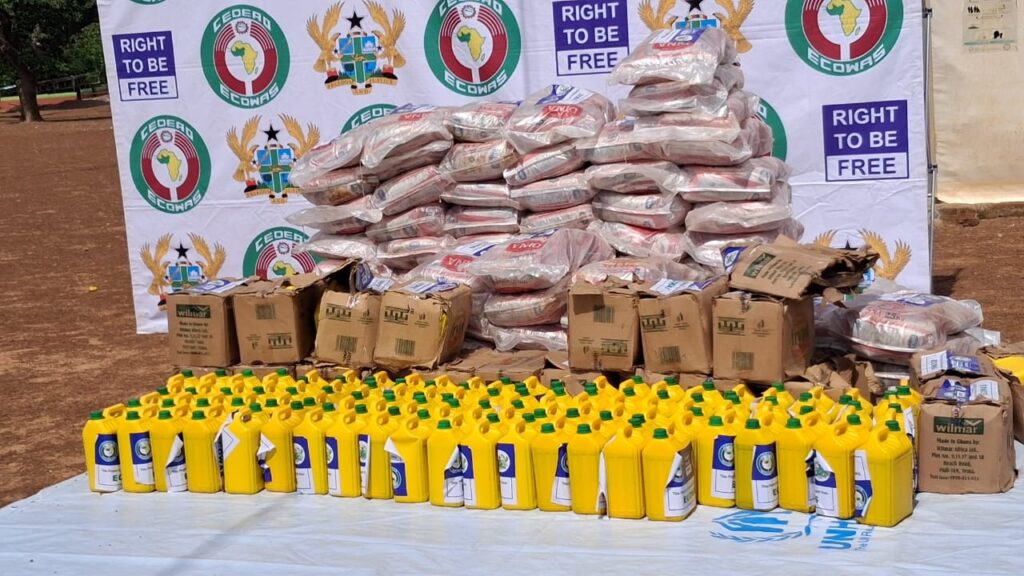
During the commissioning of the projects, the project also presented food items such as rice and cooking oil to the refugees at the Tarikom Refugee Camp.
The asylum seekers expressed gratitude to ECOWAS and the Government of Ghana for the support, adding that it had relieved them of water stress and empowered them economically.
Naba James Ayoore, the Chief of Tarikom, thanked the donors for extending the support to the host communities, adding that it would help promote peaceful coexistence.
GNA
Edited by Caesar Abagali/George-Ramsey Benamba
Reporter: Anthony Adongo Apubeo
Email: [email protected]