By Benjamin Adamafio Commey, GNA
Accra, May 27, GNA – Madam Kathleen Addy, the Chairperson of the National Commission for Civic Education (NCCE), has called on young people to play active roles in helping to build a just and corruption-free society.
She said the youth, especially tertiary students, had the responsibility to help change negative mindsets and promote integrity, fairness and accountability in society.
“We want a society where people know that if they do the right thing and follow the right course, it will take them somewhere,” she said.
Madam Addy made the call at a symposium for Civic Education Clubs in tertiary institutions organised by the NCCE under its ongoing project dubbed: “Civic Engagements on the Rule of Law and the Fight Against Corruption.”
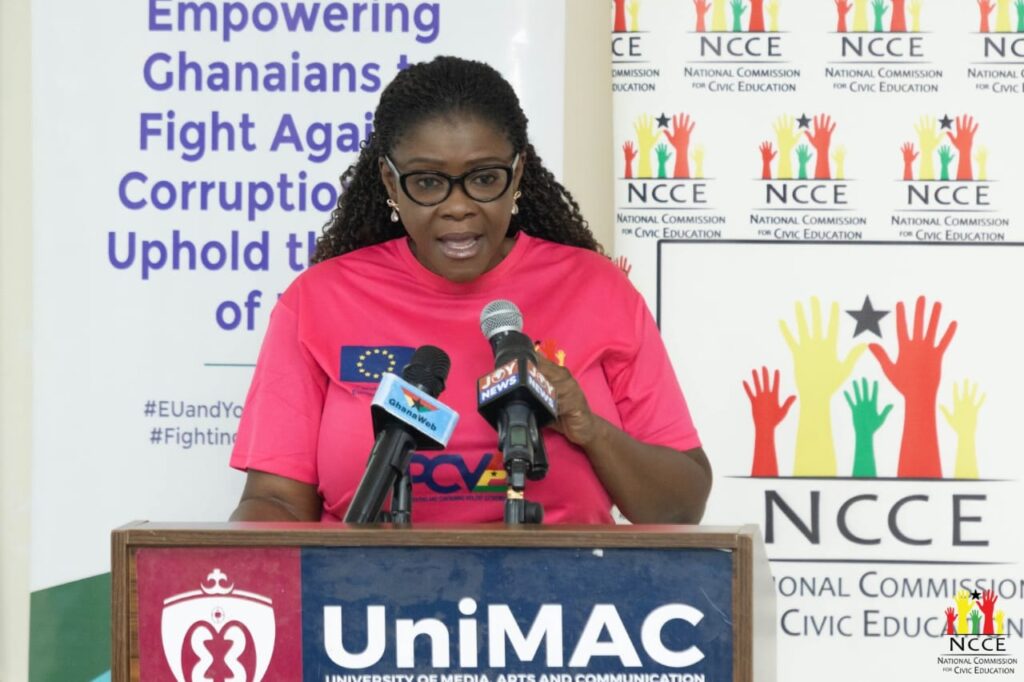
The programme forms part of the Participation, Accountability and Integrity for a Resilient Democracy (PAIReD) Programme.
The symposium is one of a series of engagements the Commission is holding with tertiary students across the country with support from the German Federal Ministry for Economic Cooperation and Development (BMZ).
It is co-financed by the European Union (EU) and the Swiss State Secretariat for Economic Affairs (SECO) and implemented by GIZ.
Madam Addy said corruption had become almost normalised in society and that many people engaged in corrupt practices in their daily activities without recognising them as wrong.
The NCCE Chairperson stressed the need for transparency and due process in all activities, noting that public perception was important in promoting accountability.
She explained that the fight against corruption should begin with individuals making small changes in their daily lives.
“If we don’t change the individual mindset, it will be much harder to fight corruption,” she said.
To effect the needed change, especially at the youth level, Madam Addy said the NCCE currently had more than 5,000 Civic Education Clubs in basic, second cycle and tertiary institutions across the country, serving as important platforms for promoting civic responsibility and educating young people on national issues.
She encouraged members of the Civic Education Clubs to see themselves as future leaders who had the ability to influence positive change in their communities and the nation at large.
She urged students to examine their own actions and behaviours instead of focusing only on corruption involving public officials and politicians, adding that students and young leaders must always follow laid down procedures and involve others in decision-making processes to avoid suspicion and conflict of interest situations.
“If we internalise and normalise corruption, then the end results should not surprise us,” she said, advising the students not to see corruption as a norm.
Touching on illegal mining, otherwise known as galamsey, Madam Addy described the practice as dangerous and harmful to the country’s future, adding that the menace posed serious threats to public health, agriculture, tourism and national development.
“We all drink from the same water sources and eat food grown on the same land. If the land is contaminated, we are all at risk,” she said.
Madam Addy urged students to speak against illegal mining activities in their communities and help educate others on its harmful effects, assuring that the Commission would continue to undertake public engagement on the issue to help curb it.
Professor Etse Sikanku, the Dean of the Faculty of Journalism and Media Studies, University of Media, Arts and Communication (UniMAC-GIJ), underscored the need for Ghana to build a strong civic education culture to safeguard and strengthen the country’s democracy.
He said civic education remained central to nurturing responsible citizenship, promoting democratic values and ensuring that citizens appreciated the importance of the rule of law, accountability and peaceful political participation.
Prof Sikanku commended the NCCE for promoting civic consciousness among the youth and said civic education was indispensable to national development and democratic consolidation.
“If we want to build a nation that we are proud of and a democracy that stands the test of time, we cannot do this without a very strong civic education culture,” he stated.
Prof Sikanku urged students and young people to engage in politics and national discourse responsibly and respectfully, regardless of their political affiliations, cautioning against insults and inflammatory language in political discourse, stressing that such behaviour undermined democratic development and weakened constructive national dialogue.
Dr Daniel Appiah, a Lecturer in the Department of Public Administration at the University of Ghana Business School, speaking on; Ethical Leadership and the Rule of Law, called for respect for rules and equal treatment under the law, stressing that those were essential to sustaining democracy and accountability in society.
He cautioned against conflict of interest situations, emphasising the need for leaders to always put the interests of the group above personal gain.
He urged students, particularly student leaders, to practise integrity in their daily activities, especially in handling student funds, procurement and leadership responsibilities.
The symposium brought together civic education clubs from tertiary institutions including the University of Ghana, Christian Heritage University, University of Professional Studies, Accra, and Ghana Telecom University.
The NCCE also swore in executives of the new civic education club at UniMAC.
GNA
Edited by Agnes Boye-Doe
Reporter: Benjamin Adamafio Commey