By Morkporkpor Anku, GNA
Accra, April 30, GNA – The Global Health Research Centre for Non-Communicable Disease Control in West Africa under the National Institute for Health and Care Research (STOP-NCD Project) has made significant progress in implementing people-centred interventions to tackle NCDs across Ghana, Burkina Faso and Niger.
Professor Irene Agyepong, Co-Director of the Centre, said the interventions, co-produced in the three countries, were tailored to respond to complex health system challenges through integrated approaches embedded within primary healthcare systems at the community and sub-district levels.
The Centre is led by the Ghana College of Physicians and Surgeons and the London School of Hygiene and Tropical Medicine, with research partners including Ashesi University, the Catholic University of West Africa in Burkina Faso and LASDEL in Niger.
Prof. Agyepong made these highlights at the ongoing National Institute for Health and Care Research Global Health Research Cross-Centre Symposium in Accra.
The Symposium, being held from April 28 to April 30, was on the theme: “Ensuring Sustainability from Global Health Research Centres.”
It focused on strengthening partnerships, sustaining capacity, and embedding NCD interventions within national health systems.
It brought together policymakers, funders, researchers and stakeholders from more than 12 countries across Africa, Asia, Latin America and the United Kingdom to share progress, lessons and strategies for long-term sustainability of global health research initiatives.
It aims to provide a platform for sharing the work of the five NIHR Global Health Research Centres and reflect on sustainability across partnerships, associations and collaborative networks.
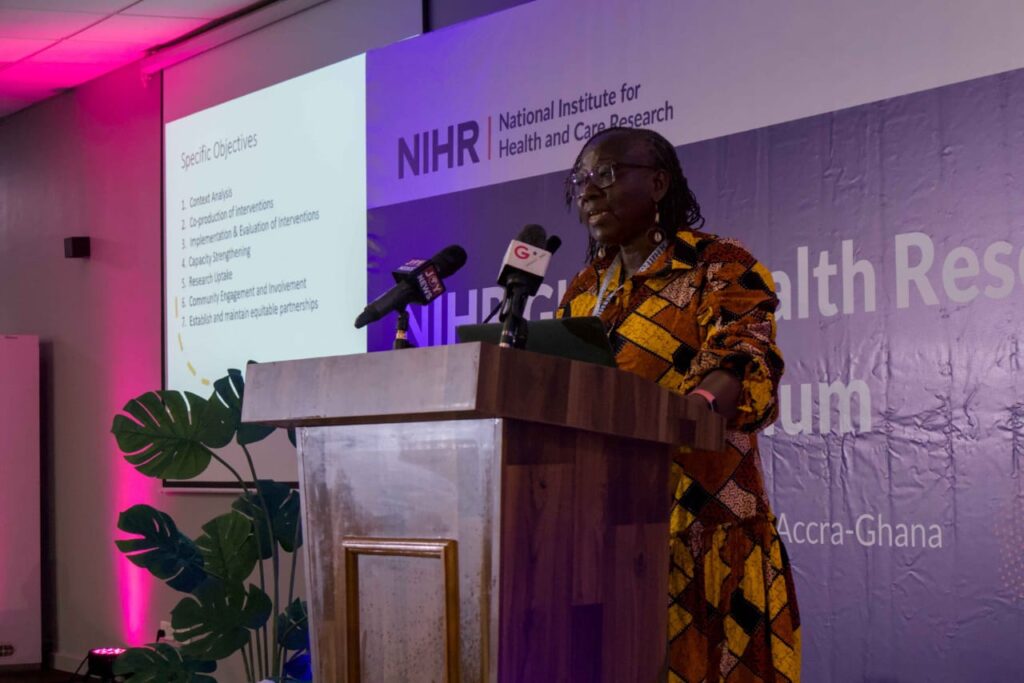
Prof. Agyepong explained that the initiatives also promoted referral systems and peer support networks for people living with NCDs, while strengthening local research capacity and generating policy-relevant evidence.
While the interventions shared common features, each country introduced innovative components to enhance impact and enable cross-learning, she noted.
In Burkina Faso, efforts focused on establishing and strengthening patient registries, while Niger is deploying telemedicine to improve access to specialist care amid infrastructure constraints.
In Ghana, community-based screening modules for NCDs and risk factors have been integrated into an electronic tracker, alongside interventions linked to the Community Health Planning and Services (CHPS) and National Health Insurance Scheme to improve access and reduce financial barriers.
Prof. Agyepong disclosed that Ghana had piloted the NCD-CareNet intervention across selected districts in Greater Accra and the Eastern Region, with full implementation, which started in February 2026 and would be scaled up from Friday, May 1, 2026
“The Centre, with support from Ashesi University, was also developing “Nutribot,” a WhatsApp-based tool to promote healthy diets and lifestyles,” she added.
Mr Kwabena Mintah Akandoh, the Minister of Health, said the growing burden of NCDs in Ghana and across West Africa was alarming.
He emphasised that addressing NCDs required a strong and resilient primary healthcare system capable of early detection, continuous management and prevention of complications, thereby reducing pressure on higher-level health facilities.
The Minister outlined three key pillars for effective NCD response: community engagement to promote healthy lifestyles, routine screening and early diagnosis, and reliable access to essential medicines and long-term care at the community level.
He commended National Institute for Health and Care Research (NIHR) and the UK Government for their support, describing it as timely in helping Ghana strengthen its response to NCDs and advance universal health coverage.
Mr Akandoh noted that Ghana was prioritising primary healthcare through initiatives such as the CHPS system and the Ghana Medical Trust Fund (Mahama Cares), aimed at improving access to care and mobilising domestic resources for NCD treatment.
He reaffirmed government’s commitment to strengthening health systems, promoting equitable partnerships and ensuring that research translated into tangible health improvements.
GNA
Edited by Agnes Boye-Doe
Reporter: Morkporkpor Anku
[email protected]