By George Agboklu
Accra, April 10, GNA – Ghana’s favourite NASA astronaut, Christina H. Koch, and her three crewmates splashed down in the Pacific Ocean in their Orion capsule on Friday, 10 days after the Artemis II mission launched on a historic journey into deep space and a flyby of the moon’s far side.
Ms. Koch, the Mission Specialist’s crewmates aboard the spacecraft were NASA astronauts Reid Wiseman, Mission Commander, and Victor Glover, Mission Pilot, and Canadian Space Agency (CSA) astronaut, Jeremy Hansen, also a Mission Specialist.
Artemis II, NASA’s first crewed test flight in the Artemis campaign, launched on April 1, 2026. It comes more than 50 years since humans last travelled to the Moon during the Apollo missions.
The 10-day mission was designed to confirm that the spacecraft’s systems operate as intended in the deep space environment.
The mission also served to prove that Orion’s life support systems are ready to sustain crews on future missions, allowing the quartet to practice operations essential to the success of Artemis III and beyond.

Many Ghanaians followed Astronaut Koch’s space exploits closely following her 2019 post on X (formerly Twitter) reflecting on her time as an exchange student at the University of Ghana.
During her time at Legon in the 1999/2000 academic year, she studied History of Ghana, History of Africa, Twi for Beginners, Music and Rural Sociology—an experience she described as life-changing.
20 years ago, I was studying abroad at the @UnivofGh. Like spaceflight, it was a positive, life-changing, perspective-deepening experience. Seeing the beauty of Ghana from space reminds me of the amazing people I met there and how in exploring the world, we learn about ourselves. pic.twitter.com/zK3CfRWJHY
— Christina H Koch (@Astro_Christina) December 12, 2019
President John Dramani Mahama, celebrating Ms Koch on her historic membership of the Artemis II mission, stated: “It is a point of immense pride to learn that Christina, the only woman on this pioneering lunar mission, was once an exchange student at our very own University of Ghana during the 1999/2000 academic year.”
“Her time at Legon was not just a passing visit; she truly immersed herself in our culture and heritage,” the President said.
The Artemis II mission follows the uncrewed Artemis I flight test, which demonstrated the capabilities of the Agency’s Space Launch System (SLS) and the Orion capsule.
According to NASA, these missions would allow astronauts to explore the Moon for scientific discovery and economic benefits, while building momentum for the first crewed missions to Mars.
Following the April 1 launch, Orion and its upper stage—the interim cryogenic propulsion stage (ICPS)—orbited the Earth twice to ensure all systems were functioning correctly while still close to home.
While in Earth’s orbit, the crew performed demonstrations of manual piloting, including proximity operations, docking and undocking, to provide performance data and operational experience that could not be fully gained on the ground.
In the days that followed, the spacecraft was propelled onto a path toward the Moon which also set it on the free-return trajectory that would ultimately bring crew back to Earth for splashdown.

On April 7, NASA released the first flyby images of the Moon captured during the April 6 flyby of the lunar far side.
The images revealed some regions no human has seen, including a rare in-space solar eclipse.
In a news release, NASA said the astronauts used a fleet of cameras to take thousands of photos, and that it would release more images in the coming days.
“Our four Artemis II astronauts — Reid, Victor, Christina, and Jeremy — took humanity on an incredible journey around the Moon and brought back images so exquisite and brimming with science, they will inspire generations to come,” said Dr. Nicky Fox, associate administrator, Science Mission Directorate, NASA Headquarters in Washington.
NASA noted that during the lunar flyby, the crew documented impact craters, ancient lava flows, and surface fractures that would help scientists study the Moon’s geologic evolution.
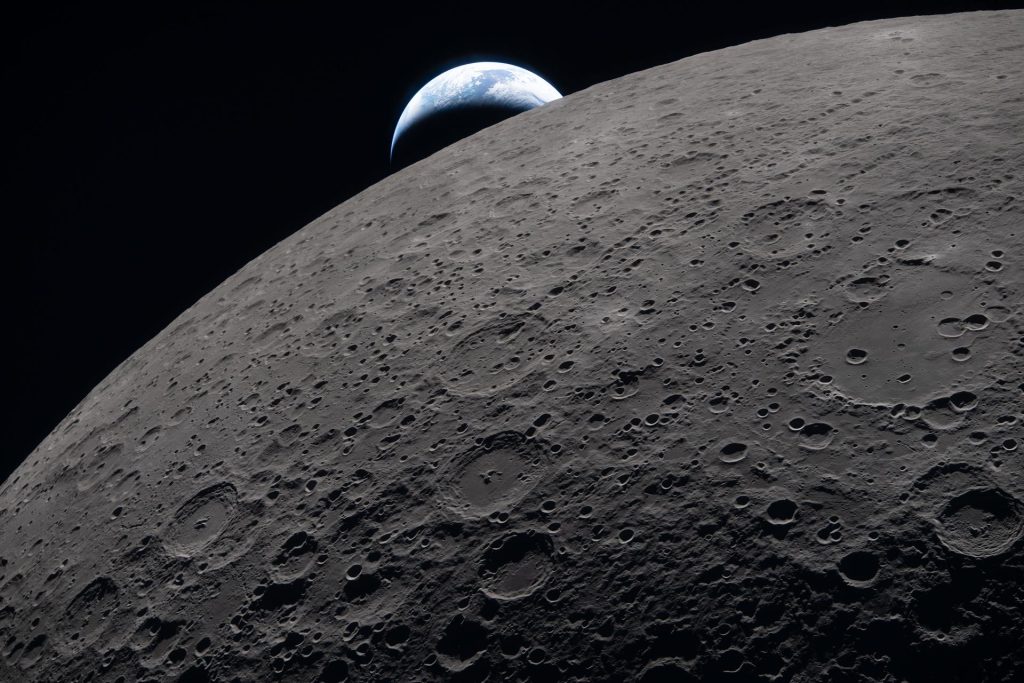
In this image, the dark portion of Earth is experiencing nighttime, while on its day side, swirling clouds are visible over the Australia and Oceania region. In the foreground, Ohm crater shows terraced edges and a relatively flat floor marked by central peaks — formed when the surface rebounded upward during the impact that created the crater. Credit: NASA
GNA/Credit: NASA