By Elsie Appiah-Osei
Accra, March 30, GNA — The University of Ghana (UG) has been adjudged the winner of the Pan-African Shifting the Power Youth Debate, held in Accra on Monday.
For their prizes, the participating teams were presented with trophies, medals and other souvenirs.
Organised by the STAR-Ghana Foundation and the West Africa Civil Society Institute (WACSI), the event brought together young debaters from the UG, Lilongwe University of Agriculture and Natural Resources, Malawi, and Copperbelt University, Zambia, to showcase innovative ideas on Africa’s development.
The initiative, supported by Comic Relief and the Foreign, Commonwealth, and Development Office (FCDO) of the UK is described as “a continental platform for youth-led ideas, critical thinking, and transformative dialogue, designed to interrogate entrenched development systems, elevate local knowledge, and champion community‑led solutions.”
The Shifting the Power Programme has the aim of investing up to £60m over ten years (2020-2030) to support organisational strengthening and sustainability of locally led Civil Society Organisations (CSOs) in Ghana, Zambia, and Malawi.
In a high‑stakes intellectual contest, debaters explored pivotal themes such as gender justice, climate action, mental health, early childhood development, and democratic consolidation.
The final motion: “This house would ban international NGOs from operating in developing countries unless they are fully locally led,” which was a tiebreaker between the top-scoring teams, UG and Copperbelt University, Zambia, aimed to highlight the ingenuity and leadership of Africa’s next generation.
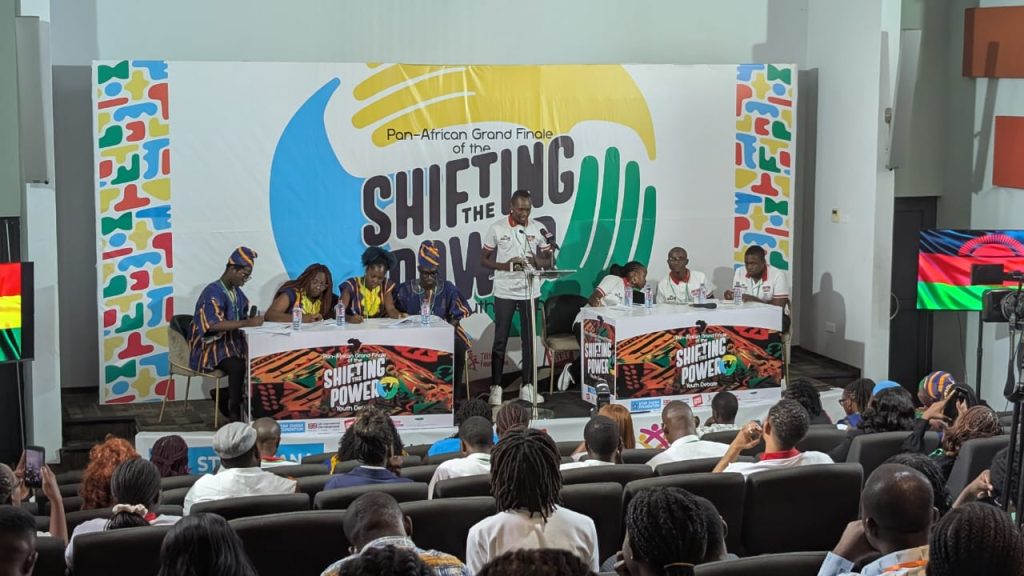
While the UG was for the motion and won with just a point, their counterparts from Copperbelt University, Zambia, were against the motion.
Dr. Nana Asantewaa Afadzinu, the Executive Director, WACSI, highlighted the importance of youth-led development in Africa and how young people were driving change and shaping their own narratives.
She said the theme of shifting power dynamics and centering African youth voices was key.
“Africa’s youth are drivers of change, armed with courage, creativity, and a vision for locally led solutions,” she said.
The Executive Director urged partners and the global community to develop it to be owned and led by Africans and for Africans.
Mr. Gideon Ahenkorah, Programme Communications, WACSI, narrating the Shifting Power Youth Debate journey, said it had showcased the best of Africa’s young talent, with teams from Malawi, Zambia, and Ghana going head-to-head on critical issues like climate action, education, and mental health.
He said the stories of resilience and teamwork were inspiring, from Lilongwe University of Agriculture and Natural Resources’ nail-biting win in Malawi to Copperbelt University, Zambia’s, comeback in Zambia and the UG’s dramatic finale victory.
“These young debaters aren’t just competing; they are shaping the future of Africa’s development, with evidence-based arguments and a commitment to locally led solutions,” he said.
According to Mr. Ahenkorah, African youth were taking charge of their narrative, leading with courage, creativity, and a vision for a brighter future.
He added that development was not a spectator sport; it was a participatory game, and the young leaders were rewriting the rules.
“The Pan-African Grand Finale isn’t just a debate; it’s a declaration that power is shifting, and the people are taking the reins.
“That Zambian proverb says it all—leadership isn’t about titles; it’s about action and initiative. These young minds are proving they are not waiting for permission; they are leading the charge,” he said.
Ms. Sarah Adjei, Projects Manager, Civil Society Strengthening Programme at STAR-Ghana Foundation, said, in March last year, the programme successfully delivered a grand finale debate in the United Kingdom (UK), hosted at 10 Downing Street, where Prime Minister Sir Keir Starmer convened young people from across the UK to debate the future of power, participation, and public decision-making.
She said the event demonstrated how civil society institutions could powerfully signal trust in youth voice while strengthening democratic culture and civic engagement among young citizens.
“Building on this momentum, organizers convened a Pan-African edition of the debate in Ghana, Zambia, and Malawi, culminating in February 2026 and the grand finale on Monday, March 30, 2026, in Parliament House, Accra, Ghana,” she said.
GNA
Edited by Benjamin Mensah